'People are going to retire, and they are going to retire into pretty abject poverty. It's difficult living in private rented housing as someone in your 20s or 30s. It's impossible to live in private rented housing as someone in your 80s and 90s.'
@AaronBastani in conversation with housing expert and journalist, @PeteApps.
Watch the full episode of Downstream on our YouTube channel.
“He later admitted at interview that he didn't read the ecological reports that he had commissioned to gain planning permission in full.
These reports stated that Great Crested Newts were living in or near two of the 11 ponds within the land.” Why are landowners like this?
@cutlerstom@herdyshepherd1 The answer is to stop over-financialising land and property so that it does not swallow up every single earned penny in rent and mortgage, rather than food. Also allows more access to land for people to produce their own food. Also weights in favour of local distribution chains.
@herdyshepherd1 No. If you’re a landowner you also have a responsibility for the care of the nature on, and condition of, the land. Not just business + profit. I dislike this Gov’s approach, but there’s also been a clear disregard of the social contract by many ‘trad’ farmers/landowners.
Burning wool just shows a complete lack of imagination about what else can be done with it. There’s a profound farmer myopia around sheep that considers practices developed post-war as “traditional”, therefore correct.
Across Britain right now, farmers are shearing their sheep, bagging up the wool, and burning it. Some bury it. Some leave it to rot in a corner of the field. The wool-burning has made the odd headline as a protest, but the truth is duller and sadder. The fleece is worth less than the diesel it would take to haul it to the depot.
The numbers are grim. In recent years a kilo of British wool has fetched somewhere between twenty and sixty pence, and hill breeds like Swaledale and Welsh Mountain sank as low as ten. A whole fleece off a mountain ewe might bring thirty pence. Shearing that same ewe costs the farmer around two pounds. One Lincolnshire farmer added it up out loud: over three pounds to shear and cart a single fleece to the depot, and twenty-six pence back. So she burns them. A great many do.
Here is the part that stings. The shearing still has to happen, every year, whatever the wool will fetch. A sheep left in full fleece overheats, struggles to move, and gets eaten alive by maggots. So the job carries on purely as welfare, a cost the farmer simply eats to spare the animal, with the wool itself going on the fire straight after.
And think about what this fibre once was. For centuries wool was the engine of the English economy, the country's greatest export and the crown's main source of tax. It raised the soaring wool churches of the Cotswolds. It turned merchants into princes. To this day, whoever presides over the House of Lords sits on the Woolsack, a literal cushion of wool, put there in the fourteenth century so nobody would forget where the nation's wealth began.
Prices have lifted off the floor this past year, the first real relief in a long while. It still does not cover the shears for a hill farmer. The fibre that built England now smoulders in a heap behind the barn, and almost nobody notices the smoke.
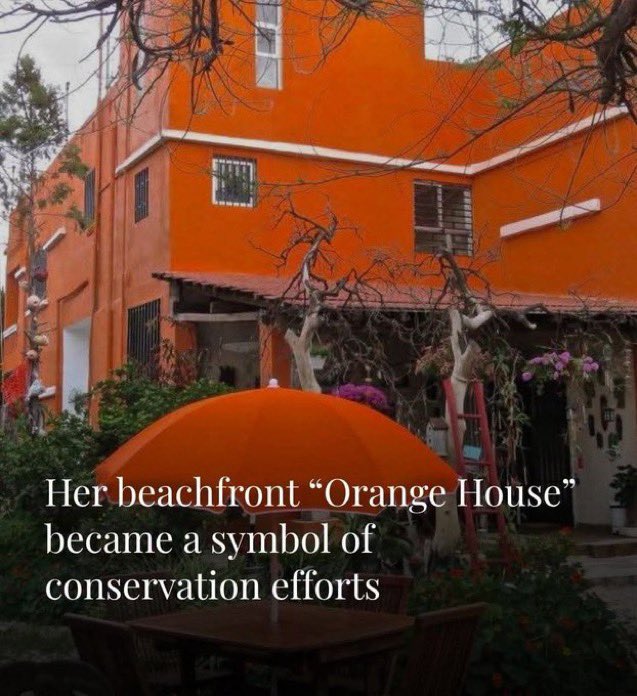
“They knew exactly who Mona Khalil was.
They knew the bright orange house in Mansouri, south Lebanon. They knew it was not a military site, not a command center, not a battlefield position. It was one of the most recognizable symbols of environmental conservation on Lebanon's southern coast; a sanctuary dedicated to protecting endangered sea turtles and preserving life.”
Marwa Osman writes about Israel’s deliberate targeting of a prominent environmental activist in Lebanon. ⬇️
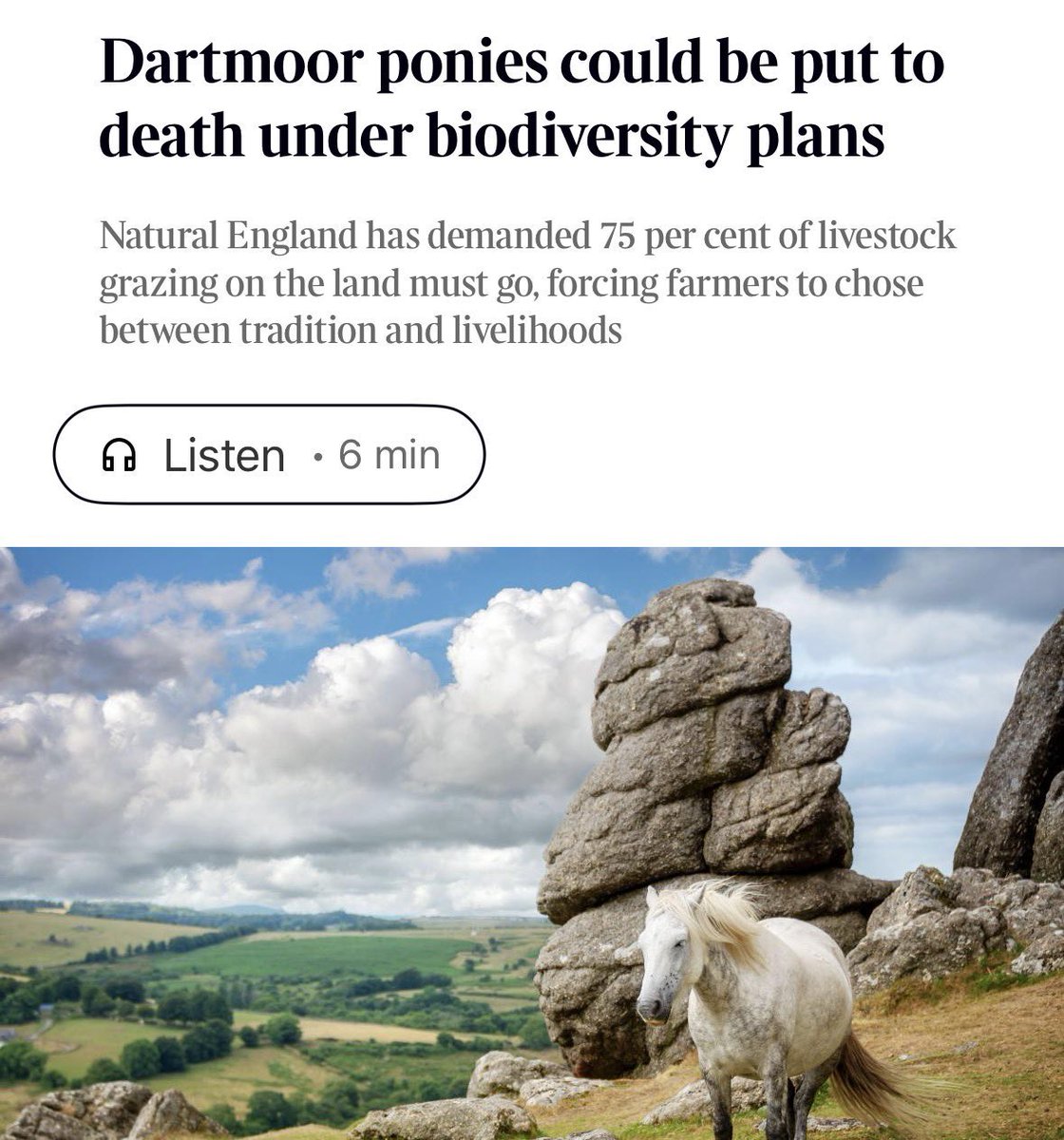
On the left, *not* a Dartmoor pony.
On the right, actual Dartmoor ponies.
The photos used are a pretty good indicator as to who knows what they’re talking about and who is spreading conspiracy theories.
The interesting part is why they are telling lies about murdering ponies. Quite simply, a number of established vested interests do not want to see nature restored on Dartmoor or any of our other woefully nature-depleted landscapes. They want no change, and for the public money to continue flowing no strings attached.
Bristol is the most unaffordable city for renters in England. Renters send their landlord 5 & a half months of income each year.
We urgently need @WestofEnglandCA & local politicians to pledge their support for new powers to tackle unaffordable rents.
https://t.co/wEuFjmpFUI
Streetlights are one of the worst insect death traps humans have ever built.
The mechanism is simple: flying insects evolved to navigate by the moon and stars. To an insect, your streetlight is closer, brighter, and far more confusing than any celestial body. They fly toward it, circle until they die of exhaustion, or get picked off by bats and spiders that wait at the light.
A 2021 study in Science Advances found 50% fewer caterpillars in hedgerows under streetlights compared to dark hedgerows just 60 meters away. Caterpillars are food for nearly every songbird that nests in your neighborhood.
Your streetlight is eating the baby bird food.
The fix is even simpler: it's better light. The German Leibniz Institute has shown that streetlights can be redesigned to drop insect mortality by 50-75% without reducing visibility. The changes: warm amber color temperature (under 2200K, ideally around 1800K, what you'd call "candle-colored"), full shielding so light only goes down, motion sensors so they're not on all night, and lower mounting heights so the light spreads less.
Some cities (Tucson, Flagstaff, parts of the Netherlands) have already converted. Insect populations near retrofitted streets respond within a single season.
Streetlights aren't bad, but a streetlight that runs all night, bright white, unshielded, broadcasting toward the sky is catastrophic to nocturnal insects.
Time capsule hiding inside this root ball! 😲👇
I was checking out a dying oak tree today and found across this absolute gem deep in the roots—a super scarce vintage brewery glass bottle! 🪵🍾
Final note even though lots of other people are saying this bit: Zack does not own a £2m house. A lot of people writing stories about the "£2m house" do.
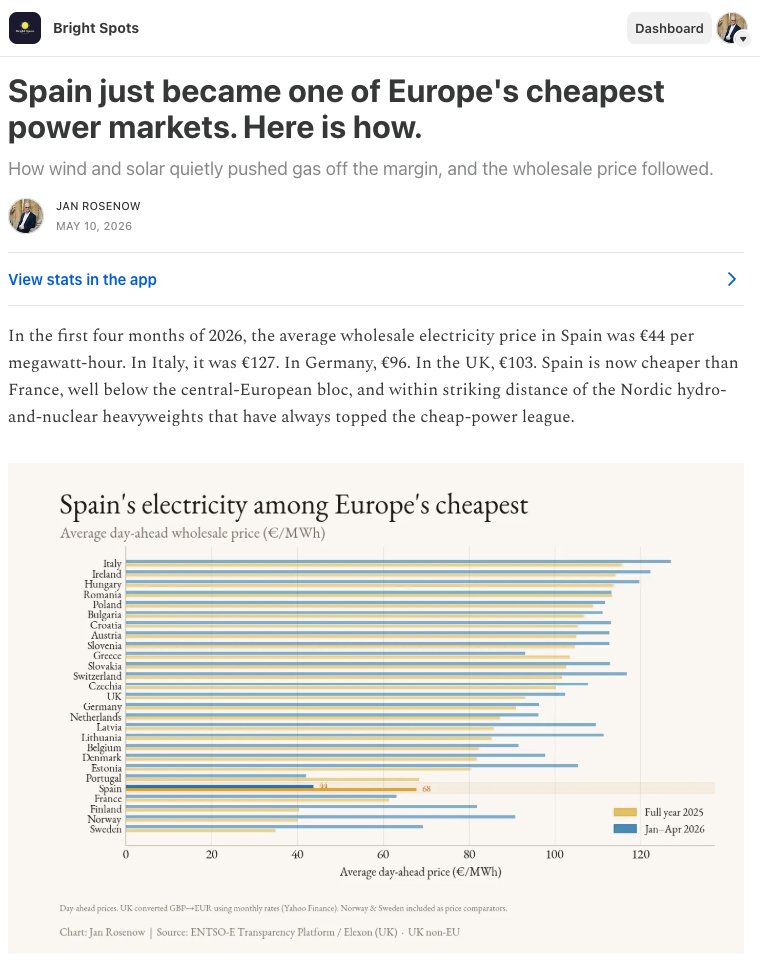
NEW ANALYSIS: What's going on in Spain?
Spain's wholesale electricity price in early 2026: €44/MWh. Italy: €127. Germany: €96. UK: €103.
Wind+solar deliver 44% of generation. Gas sets price in just 9% of hours, down from 55% in 2022.
Full analysis: https://t.co/ZpDqJ4goY2