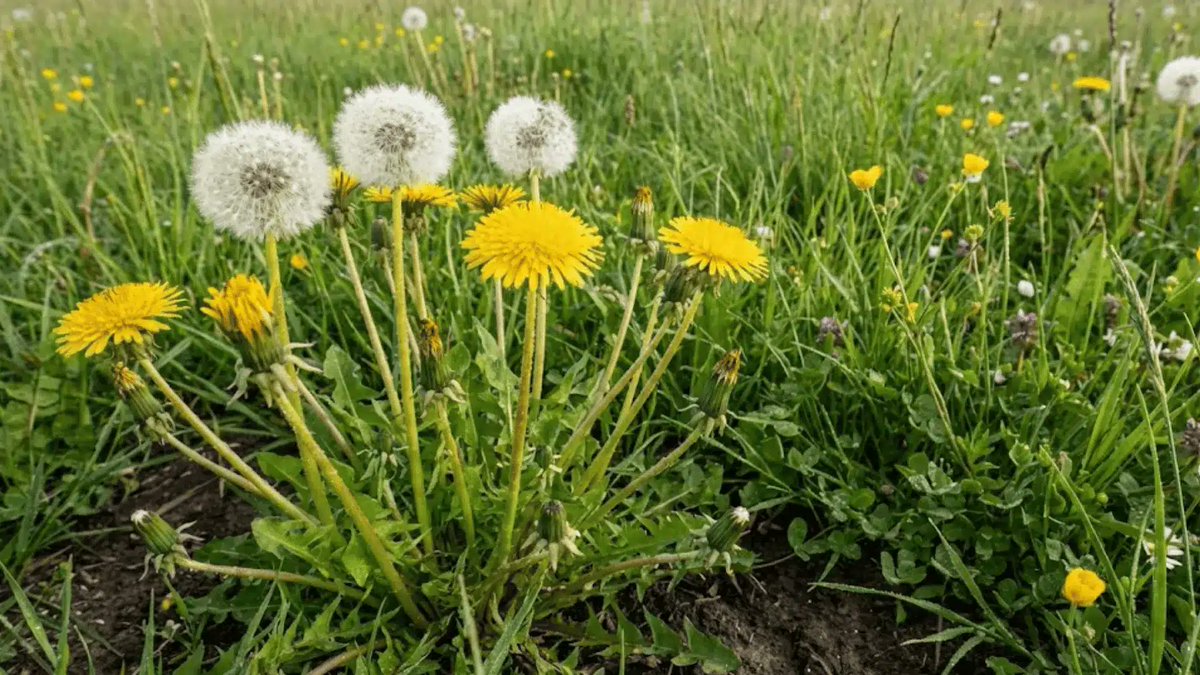
The reason we think dandelions are weeds is because of a 1950s marketing campaign.
Dandelions, native to Europe and Asia, were brought to North America in the 1600s by European colonists who grew them deliberately.
Every part is edible. The leaves are a salad green, the flowers were made into wine, and the roots were roasted as a coffee substitute and used medicinally for liver and kidney conditions for thousands of years. They were a kitchen-garden staple well into the 1800s.
The shift happened after World War II, when 2,4-D (originally developed for chemical warfare research) was approved as a residential herbicide. Companies like Scotts built the modern lawn-care industry around the idea that a perfect green lawn meant zero broadleaf plants.
Dandelions, being bright yellow and resistant to mowing, became a visible enemy, and the campaign worked. By the 1970s, "dandelion-free" was synonymous with "well-kept."
They aren't native, but they aren't doing significant ecological harm either. The herbicides used to kill them, on the other hand, kill bees, contaminate groundwater, and have been linked to non-Hodgkin lymphoma in humans.
If you hate dandelions, it's most likely due to a marketing campaign that ran before you were born.
No Mow May is ending. What you do in June matters more than what you did in May.
A month-long pause helps a little, but most native bees don't even emerge until June, July, or August. If you mow on June 1 like nothing happened, the May benefit goes with the grass clippings.
The University of Minnesota Bee Lab recommends "Slow Mow Summer," which is closer to what the research actually supports.
If you need to mow, try to only every two weeks instead of every week. The Lerman study found that lawns mowed every 1-2 weeks supported nearly as many bee species as lawns mowed every 3 weeks, and they stayed neighbor-friendly.
Raise your mower deck to 3-4 inches. Taller grass shades the soil, holds moisture, shelters insects, and lets low-growing native flowers (violets, self-heal, native asters) actually bloom.
Leave a patch unmowed, somewhere out of the way. Ground-nesting native bees, queen bumble bees, fireflies, and overwintering moths all use undisturbed grass and leaf litter.
Mykolaiv, a city in southern Ukraine, has become a symbol of resilience and recovery, significantly shaped by Danish support.
Assistance from @DanishMFA has helped the city endure its darkest moments.
🧵 1/11 ⬇️
❤️🔥 Ukraine’s very first McDonald’s location has reopened following a devastating Russian missile strike on Kyiv.
The iconic restaurant completed rapid repairs to resume operations after sustaining heavy facade and structural damage.
If you're worried about ticks, put up an owl box.
The animal driving most Lyme disease in the eastern US is the white-footed mouse. Ticks that feed on them are far more likely to come away infected than ticks that feed on other animals. The bigger the local mouse population, the worse the next year's tick year.
A single barred owl pair raising chicks can take hundreds of rodents in a breeding season. Owls also don't carry Lyme. The bacterium can't survive their digestive tract, so an owl that eats an infected mouse is a dead end for the disease.
Researchers at the Cary Institute, the leading lab on Lyme ecology, have been explicit about this: "Landscapes that support predators have reduced Lyme disease risk."
One owl box on its own isn't going to fix a tick year. But a yard with owls, foxes, bobcats, and weasels in it has fewer mice, and a yard with fewer mice has fewer infected ticks.
If you have woods or fields nearby, a properly sized barn owl or screech owl box (different species, different boxes) is one of the most useful single things you can do for tick exposure at the landscape scale. Match the box to the owl that lives near you.
The mouse is the problem, owls are the solution.
At World Press Photo, we champion photographers who document the world with integrity, courage, and care, bringing vital stories to audiences globally. Please consider supporting our work: https://t.co/u6C3PlD8Jj