Britain’s Bitcoin Opportunity is out today.
The UK has done much of the hard work already. Its approach to digital asset property rights, the new cryptoasset regime and the FCA’s final rules put it among the best-prepared jurisdictions in the world. Our paper asks a constructive question. How does the UK turn that legal clarity into global market leadership before the regime starts on 25 October 2027?
Our answer is implementation, not new primary legislation. The paper sets out practical steps in six key areas:
🔹 Market access: restoring Stocks and Shares ISA eligibility for regulated Bitcoin products
🔹 Disclosure and promotions: rules that reflect what Bitcoin verifiably is
🔹 Banking access: clearer guidance so banks assess firms on their regulatory status, not a sector label
🔹 Bank capital and tax: risk-sensitive capital treatment, and tax rules that fit lending, collateral and everyday payments
🔹 Seized Bitcoin: strong custody standards and a presumption of retention for any net Crown recoveries
🔹 Energy: using flexible Bitcoin mining to help reduce grid constraint costs
@xapobankapp has worked in this space since 2013, and we were glad to contribute our experience as a regulated, Bitcoin-native bank. We want the UK to take full advantage of the position it has built, and we hope this paper helps that conversation.
Thank you to the @bitcoinpolicy, in particular my co-author @Conner_Brown, and to @Caro_Malcolm (Cambridge Centre for Alternative Finance, Cambridge Judge Business School)
@freddienew (@bitcoinhodlco)
@valkenburgh (@coincenter) and;
@alexneumueller (Cambridge Centre for Alternative Finance, Cambridge Judge Business School), for their research, contribution, time and challenge. Thanks too to Diego Ballon Ossio and the team at Clifford Chance for their final review and feedback and to the policymakers and regulators who have engaged with us along the way.
Read the paper: https://t.co/2qSBf0Rtbp
#Bitcoin #UKPolicy #DigitalAssets #FinancialServices #Regulation
@ARedbord, @Scaramucci, @dieguito, @josh_blockchain, @HenriArslanian, Anju Patwardhan, @adam3us, Bruce Terry, Barnali Biswal, Sheila Warren
Interesting to learn which ai providers will refund tokens to users who were defrauded due to stolen keys through no fault of the user . ( tldr: everyone except Anthropic and OpenRouter )
Saylor's Strategy owns ~4% of all bitcoin. NEAR has its own version and CT barely talks about it
SVRN, a nasdaq company, holds ~55m $NEAR. that's about 4% of the supply too
the backstory is wild. it used to be OceanPal, a shipping company hauling iron ore and coal. this summer it sold its last ships and didn't sell a single NEAR to do it. in the co-CEO's words: "no debt, no ships, and a treasury of NEAR"
their target is 10% of all NEAR
a public company turned itself into a NEAR bag and accumulating more is still first on its list. gigabullish 🫡
tl;dr tillräckligt många viktiga aktörer agerade snabbt och resolut, inga stora kända problem ännu.
Lite längre: Det var ganska svårt att nyttja exploiten plus att många varit väldigt bra på att uppdatera med den fix som kom snabbt plus centrala uppdateringar för många (särskilt wordpress som utgör omkring 40% av webben) plus att cloudflare agerade innan fixen kom (har runt 25% av trafiken) => Internet lever.
Men den här typen av säkerhetsutmaningar kommer vi få leva med ett tag, tills ”vi” fått lika bra ordning på försvaret som de potentiella attackerna är.
P(doom) är inte 1 ännu.
Cool tweet. And yet, speaking of crucial infrastructure, I am somehow myself financing a sustainability effort for Curl. X pays zero, Meta pays zero, Apple pays zero, OpenAI pays zero, Alphabet pays zero, Anthropic pays zero, Tesla pays zero, SpaceX pays zero.
Curl has received some 1,030 Curl vulnerability reports since it started a Hackerone project in 2019. A third of those reports were submitted in 2026. You don’t want the team to use AI to address them.
But I guess it’s cool to just trust the random guy running it from his villa in Huddinge, Sweden (Daniel Stenberg, right) and the other random guy from Sollentuna, Sweden (that would be me, left) picking up the bill for some more developers to cope with the increased load, and to ensure redundancy.
I am working on some things to ensure a sustainable future for the 20 billion active installations of curl through our new outfit Curlify, because we need to ensure that this software continues to run smoothly.
Security called me at 6:12 AM today.
"Patch every PHP server immediately."
I asked what happened.
"Two critical vulnerabilities. Remote code execution. No authentication required."
Cool.
How many PHP servers do we have?
According to inventory: 12
According to reality:
Nobody knows.
We found one running WordPress.
Three running old internal tools.
One under someone's desk.
Two inside vendor appliances.
A forgotten employee directory from 2016.
And a server named:
PHP-OLD-DO-NOT-TOUCH
Naturally, that one runs payroll exports.
Then we found a PHP 5.6 box.
I asked who owned it.
The documentation said:
BRIAN.
Brian left in 2019.
We called Brian.
He said:
"Oh wow, that's still running?"
Excellent.
By 8 AM, leadership joined the incident call.
CEO:
"Can hackers actually get in?"
Security:
"Potentially yes."
CEO:
"Without a password?"
Security:
"Yes."
CEO:
"Then why do WE need passwords?"
Not the lesson.
Finance asked if we could wait until the weekend to patch because downtime affects revenue.
Security explained that the alternative was letting strangers execute code on our servers.
Finance asked for a cost comparison.
At 9:17, someone suggested temporarily taking the vulnerable websites offline.
Marketing refused.
"Our campaign is live."
So for the next hour, the company officially decided maintaining a landing page for 20% off webinar registration was more important than preventing remote server takeover.
We finally patched everything we could find.
Then our scanner discovered another PHP server.
Hostname:
TEMP-PHP-2014
Uptime:
4,512 days.
Nobody knows what it does.
Nobody owns it.
Nobody can shut it down.
But every time we block network access, the warehouse stops printing shipping labels.
Security has classified it as critical infrastructure.
It is running PHP 5.4.
The vulnerability has existed longer than half our employees.
The emergency patch took four hours.
Finding out what PHP actually runs took eleven.
The internet isn't held together with code.
It's held together with servers everyone is afraid to turn off.
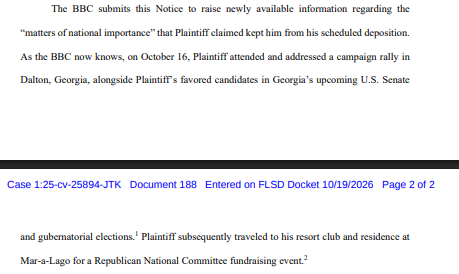
NEW BBC pushes again for a date for President Trump to give his deposition in defamation suit. It was originally Oct 16 - but Trump said "matters of national importance" meant he would be unavailable.
BBC lawyers rather dryly say they now know what those "matters of national importance" were ...