I recorded a 20-min tutorial on how to read the footprint correctly
0:16 - passive/aggressive flow
1:37 - tick sizes
4:02 - clusters vs profiles
6:00 - positioning
11:30 - aggregated data
14:05 - example trade
15:20 - nuances
16:53 - highs/lows
18:52 - context
In this weeks notes on the principles of @Moneytaur_ we will be touching on likely the most important concept of all.
-------
- RISK MANAGEMENT -
- The Risk From Within
The biggest risk to any trader isn’t the market, it’s themselves. Critical thinking, emotional awareness, patience, discipline, and strong risk management are what separate consistently profitable traders from the rest. Yet this truth is rarely preached in the space, and that is by design.
“In school, no one teaches you about money. At work, almost everyone has an employee mindset. In this space, almost no one teaches risk management. And that’s exactly why almost no one is winning.”
https://t.co/DbYBblaMTJ
The first rule your potential future is built on is managing your risk. Losing is a certainty, the only thing you can control is how much you lose. Cultivating strict risk management rules is paramount and forms the backbone of a disciplined trader.
Practice does not make perfect, it makes permanent.
“You need to develop a great risk management strategy. You can’t be greedy. You must be disciplined. Don’t chase quick gains. Play it right over several weeks to months to years, and you win.”
- Risk per Account & Cumulative Risk
When I refer to risk, I’m talking about the relative risk to a specific trading account, not total portfolio exposure.
You likely have separate accounts for spot, futures, etc. If you hold $100K in total, but your futures account has $10K, then 1% risk on a trade from that account = $100, not $1,000.
Technically, your total risk is all open correlated positions, whether spot or leveraged. How tightly correlated they are is up to your judgment, and how you split your allocation is your choice. But remember: more exposure = more risk.
-------
- Assessing Risk
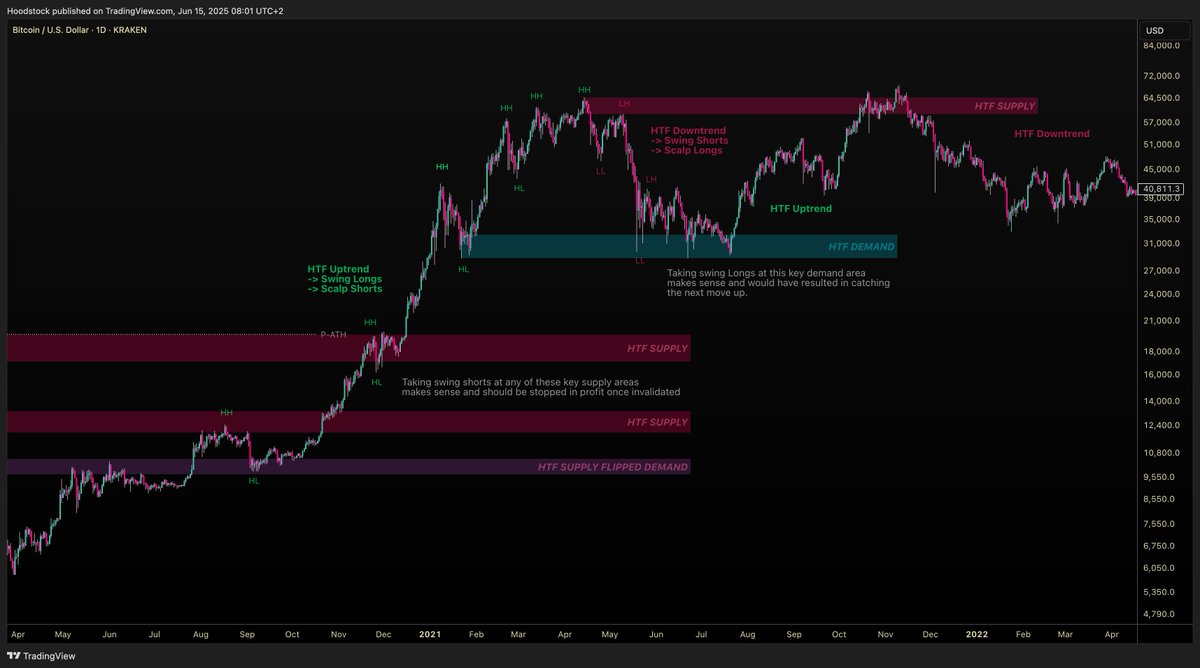
- HTF Trend
The first thing we should be paying attention to is the overall market structure. Are we in an uptrend or a downtrend? To keep it simple, if we are printing HHs & HLs on a daily TF we are in an uptrend.
HTF Uptrend:
Longs - Be more patient and let your trade run longer
Shorts - Be more defensive and only play key levels
HTF Downtrend:
Longs - Be more defensive and only play key levels
Shorts - Be more patient and let your trade run longer
🔺Trends are timeframe dependent. If you are taking a LTF trade targeting a range low in an overall uptrend, the HTF market structure is still relevant, but less so than if you are trying to take a higher TF swing trade against the trend.
- Key Levels & Exhaustion
When price is nearing key levels, we can consider counter trend swing trades. These levels can produce strong reactions, and with proper risk management, the worst outcome is a small % account drawdown, the best, catching a macro top or bottom.
As I will cover in my notes on "Patterns", we can use market structure and price action to spot signs of exhaustion. These phases often take time to develop, giving us space to identify levels and plan entries. The more signals, the more counter trend trades become attractive.
- Level Appropriate Risk
Higher timeframe levels carry a greater probability of having the desired reaction. The criteria for defining optimal levels is detailed in the write up on order blocks. https://t.co/ulfUNUTdK0
A key part of risk assessment is reading market dynamics accurately. Even the best levels need the broader market to “play along”, especially with altcoins. Smaller fish follow larger ones.
"HTF plays: up to 3% of trading account (max 5% if optimal)
MTF plays: up to 2% of trading account
LTF plays: up to 1% of trading account"
https://t.co/jODB2FYCws
MT states that there are exceptions. Small trading accounts can increase their risk exposure to a maximum of 10%. However, this should only be considered after consistently outperforming the market.
“Stick to your initial trading budget, even if you’ve doubled or tripled your capital. Doubling your capital doesn’t mean you’ve mastered the game yet. Don’t chase the money. Focus on continuously improving your skills. If you stay disciplined and keep refining your approach, the money will come to you naturally. Success is a byproduct of consistent growth, not reckless ambition.”
-------
Risk to Reward (RR)
The next step is assessing the risk to reward potential of a setup (how much you stand to gain compared to how much you’re willing to lose).
We aim for nothing under 3RR. If our risk is $100, a 3RR trade offers $300 potential reward.
��Anything < 3 is not worth it when there’s plenty of 10R+ opportunities. I’ve shared many this year. Anything < 2 is absolutely amateur and no trader is profitable with it as their average R:R
------
Do you set a minimum RR?
------
I can just refine any opportunity into maximizing the R:R. I don’t really play anything < 4 and many are > 10 with some > 30”
https://t.co/SbMCGcu5LU
If you only take 4RR setups, anything above 25% win rate is enough to be profitable. But keep in mind the psychological aspect of losing 75% of your trades. Another reason to favour quality over quantity.
“I know very rich traders who have <40% success rate on LTF plays. Imagine traders who have higher success rate than that…”
Trading is a game of probabilities, and risk-to-reward goes far beyond the number you on the long tool in TV.
An optimal long near a macro top is not the same as the same level in extreme discount. Position matters. We’re after optimal levels with optimal potential, the kind that can fuel multi week/month moves into major liquidity zones and beyond.
- Thinking in Terms of RR
When managing a position, always consider where your trade currently stands. Thinking in terms of RR from CMP makes decision making much clearer.
Market signals are augmented by how much reward is left in the trade. A momentum shift near target matters more because the potential reward for holding has mostly dried up.
This is also known as “Dynamic R multiple”
-------
- Calculating Risk
Once we have our level, know our targets and have assigned the appropriate risk, we need to calculate what that means in $ terms.
Max risk = Account balance × Risk %
Example:
Account balance: 10000
Level: Optimal = 3% Risk
10000 × 0.03 = 300
Now that we have defined what the maximum is that we stand to lose, we need to calculate how big our position size can be. This is defined by the size of our stop loss.
Position size = Account balance × Risk ÷ Stop loss
Example:
Account balance: 10000
Level: Optimal = 3% Risk
Stop Loss = 4%
(10000 × 0.03) ÷ 0.04 = 7500
We’ll explore MT’s refined approach further down.
📝To accurately calculate risk for multiple positions, you will need to find the weighted average of all your entries.
- Using Leverage
Some people confuse leverage and risk.
Risk defines how much capital you stand to lose in the worst case scenario
Leverage defines how large of a position you can control with your capital
Leverage does not change the actual dollar value of your risk allocated to a trade. It only affects the amount of margin needed to have the same position size.
In the previously mentioned example a position size of 7500 on 10x leverage would only require 750 in margin.
Margin = Position size ÷ Leverage
Leverage is a powerful tool, and when used correctly, it can help level the playing field in favour of smaller traders.
There’s an ongoing narrative that portrays leverage trading as “gambling.” When applied with discipline and strategy, leverage becomes a tactical advantage, not a risk.
“It looks like another orchestrated effort to convince the ignorant that leverage equals gambling. A narrative designed to keep the herd hodling indefinitely, while whales maintain the illusion of safety and long-term promise.” https://t.co/sBZlkZVEeM
Taking trades with no plan and poor risk management is gambling. But the powers that be don’t want an educated herd that enters and exits markets with purpose, they want blind holders who buy the narrative.
“High leverage isn’t dangerous; what’s dangerous is a lack of knowledge and wide stops.” https://t.co/G9VYLhOvUW
- Margin Types
There are two types of margin:
Isolated Margin → Only the margin assigned to the position is at risk.
Cross Margin → Your entire account balance backs the position.
Only use isolated margin! With cross, if a flash move skips your stop, your whole account is at risk. In volatile markets like crypto, the downsides of cross can be disastrous.
- MT’s Margin Logic
MT always adjusts his margin based on the trade. There is no one size fits all approach.
The defining variable is the stop loss.
Wider stop → Lower leverage
Tighter stop → Higher leverage
His positions range from 0 leverage spot trades to 100x+ on highly refined setups.
“The leverage I use is never fixed. It will depend on the SL. If I find an opportunity with a very tight stop (such as 0.4%) I can use 50X and still risk losing up to -20% of my position (+ fees).
If SL is 2% I will likely choose between 10 to 20X leverage.
If SL is 5% I will likely choose < 10X leverage.
If my SL is 10% I will likely play Spot only.” https://t.co/hcxwnxGzEn
-------
- MT’s Risk Allocation System
Once MT has done all the groundwork, identified his levels, planned TP/SL, and mentally mapped different scenarios, he decides on the total risk allocation based on how optimal the setup is.
From there:
- The stop loss defines the leverage. He calculates the maximum leverage to ensure he does not exceed ~35% of the allocated risk if his stop is hit
- This number can vary, and for scalp trades MT may use up to 50%
-The setup quality defines the risk, and the SL defines the leverage.
This means:
His maximum risk is fixed (e.g., $100)
Flash crash = full $100 lost
His actual loss if SL triggers is smaller (e.g., $35)
SL respected = ~$35 loss
-------
Tractor beams is in essence range trading, learned this technique from @CJ900X.
You anchor a Gann Box (name of the tool) at a range low and range high as per example.
Generally price stays in the range, however, on a breakout or breakdown it is likely to react from the 0.25 and 0.5 breakout levels.
I have tested this on several trades in the past and has lead to amazing gains and consistency.
These breakout levels are called “tractor beams” not sure why took that over from CJ.
In essence it comes down to rangebound trading 🫡
Please also find my settings of the tool in one of the attached photos.
Everyone’s panicking about the market.
Meanwhile, the Gulag’s calm.
The Circle’s already positioned.
No signals. No noise.
Just understanding the game before it plays out.
If you’re still reacting, you’re late.
Step 1: https://t.co/t3QYZu95D1
Step 2: https://t.co/pwbMOlrxKj
We don’t follow trends.
We are the liquidity.
There’s a moment in life where you feel it
that spark.
The sublime.
You’re chasing something real,
something that makes your heart beat again.
Most people never feel that.
They never try.
They’re scrolling, watching, comparing,
trapped in an algorithm not a life.
Guys, you won��t find magic lying in bed.
You won’t find purpose in distractions.
You find it when you go for something.
Try. Fail. Get up. Build again.
That’s where the sublime lives.
And remember,
your “friends” who only call when you’re up aren’t your friends.
When you hit rock bottom, you’ll see who’s real.
Be a good person.
Go to the gym.
Focus.
Stop feeling sorry for yourself.
It’s not that hard.
The world isn’t against you
you’re just not focused yet.
Start today.
Because once you feel that spark…
you’ll never settle for ordinary again.