the real edge is time, but only if you use it
save a little every month
learn one thing every week
journal every trade
ask why after every loss
compare yourself to yesterday, not the internet
keep what works, drop what doesn’t
repeat for years
one example from my own framework
- day trading perps
i run a separate account just for perp day trades. clean setups only, completely detached from everything else.
i don't do this bc i really have to. i'm in a comfortable spot financially. but i still enjoy day trading and see real value in it. small wins compound and i need a working routine next to sports and everything else in life.
the goal is $100 to $500 a trading day when a clean setup shows up, with very tight risk management. executed well, that adds up to more than a full salary each month, like a classic day trading job. always chasing 10k+ trades fries my brain and those belong elsewhere anyway. sizing up to make more is fine within other frameworks, but this account should pay me daily.
this account isn't about making big money. it has always stayed in the same size range, no matter how my net worth changed and i found that to be the most stress free approach for me. it's about staying close to the market, valuing the money i earn day to day and refining my skill set, so i can trade whenever and however i want, relying on nothing but myself.
once i hit my target and the trade played out as planned, i close it completely, either at my preset TP or manually. no thinking about what else i could have caught. trade closed, day done.
the next day i look at the market again. same or different coins, same or different ranges, and i use my experience and market read to find the cleanest day trade. if nothing looks good, i don't trade at all. if there's a clean momentum play based on relative strength, a support bounce, a catalyst or whatever else the market offers, i take it without thinking about bigger targets above. trades that need more time and higher TPs belong in a different account.
one of the biggest lessons i've learned over the years is to separate my accounts by approach. i simply trade better that way.
i have one account where i only DCA into ETFs. one for individual stock trades. one for longer term altcoin spot holds. one for perp day trades. wallets for meme coins. and one for HTF perp trades that play out over a longer period.
with everything separated like this, with predefined sizes and frameworks, i can stay consistent with just my day trading account, especially in uncertain phases like this one.
my routine for this account looks like this. i keep around $5k on it and trade it up to $20k. once i hit that, i withdraw $15k to my bank account, rotate that cash into my world ETF over time and start again from $5k.
if it drops below $3k, i stop trading. i go through my previous day trades first and think deeply about what went wrong, where i can be more defensive and what to change going forward. sometimes other approaches creep into my day trades without me noticing, like holding longer to make more or mistaking HTF targets for my daily profit target.
keeping the account small relative to my net worth keeps my size small and that keeps me away from overtrading.
in the end it's all about disciplined execution. no emotions, no overthinking working against me.
i'm not focused on big net worth targets. i'm focused on daily profit targets and being fine with them. the bigger goals come naturally over the years and when you're still young, rushing usually isn't the best way.
closing everything gives my brain the rest it needs. otherwise i’d be staring at charts late into the day, trying to make more.
using the right order types, being fine with small profits and calling it a day is crucial if you want to day trade with passion and stay clear headed doing it. actually logging off is one of the hardest parts of this job and this approach helps me a lot with it.
staying consistently profitable takes a clear head every day, years of learning and unemotional execution. and the calm of knowing there will always be another range, another setup, another trade.
this might not work for other traders. everyone has their own edge and framework. but it works for me, and that's all that matters.
overtraining and overtrading
when i prepare for an ironman, i only focus on the sessions planned for that day. i show up and do them with discipline, even when i’m unmotivated at the start. no extra run on top just to get more volume or reach the goal faster.
that’s the classic mistake. you keep the big race in mind, want to get there too fast and end up overtrained.
years in the sport taught me to trust the plan, stay consistent all year and actually rest. recovery isn’t lost time. it’s where the growth happens and that growth is what carries you on race day.
trading follows the same principles, especially in the capital building phase.
your day trading setup is your training plan. every day you focus on your range, take your small profits and move on. no “i could have caught the whole bounce”, no “i could have made x on this move”. keep the big picture in mind, but keep your day trading targets realistic.
and just like in training, not every day is a session day. when the market gives you nothing clean, sitting out is your rest day. it protects your capital the same way recovery protects your body.
the same mistake applies too. chasing the big goal too fast leads to oversized positions, forced trades and revenge trading.
overtraining means injury and lost progress.
overtrading means losses and lost capital.
one of my biggest lessons, in sports and in markets, is that consistency beats intensity. small sessions and small wins compound into something much bigger.
$BTC
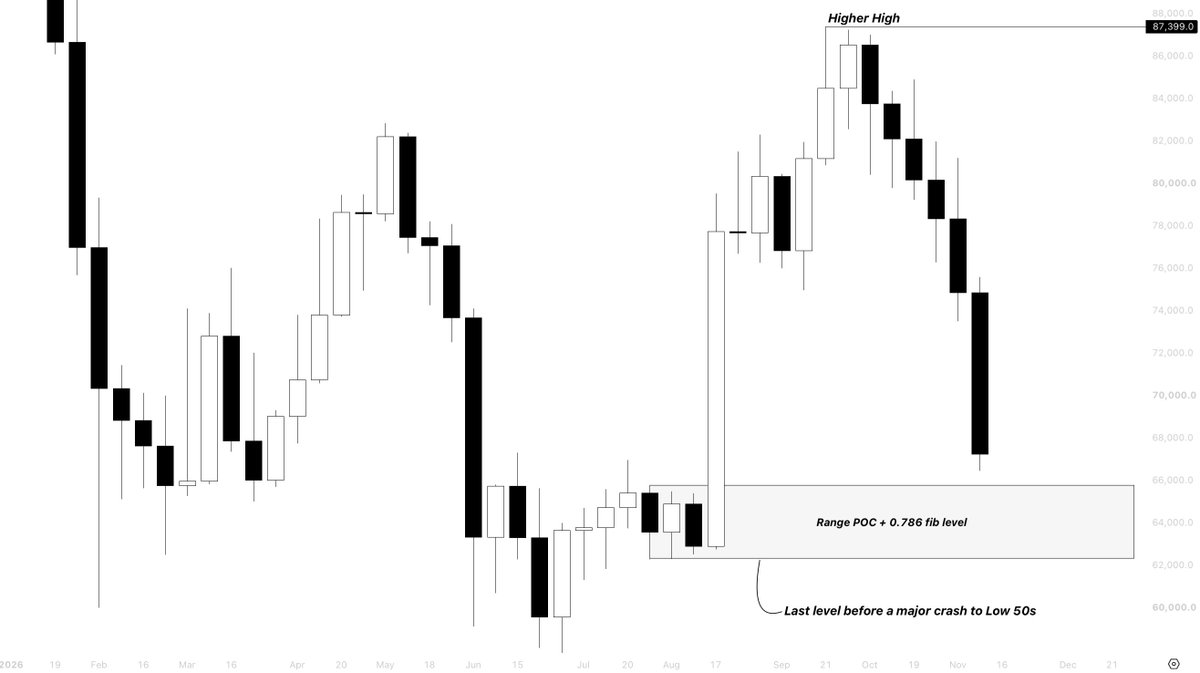
Price is breaking down again and no one knows where it's gonna bottom,
We have the range POC and 0.786 as the final level now.
If bulls fail to hold price here and we break below this zone,
Then it's very likely gonna create a new low around low 50s and this will be the first time in decades when BTC will be doing something like this.
I recorded a 20-min tutorial on how to read the footprint correctly
0:16 - passive/aggressive flow
1:37 - tick sizes
4:02 - clusters vs profiles
6:00 - positioning
11:30 - aggregated data
14:05 - example trade
15:20 - nuances
16:53 - highs/lows
18:52 - context