OVERRA DApp Beta Launch Update
This Thursday, we’re taking an important step forward as the OVERRA DApp Beta goes live.
Alongside the beta launch, we’ll be activating the Wallet-Authorised Containment System — one of the foundational components of the security infrastructure we’ve been building. Through wallet-based registration and authorisation, verified wallets become part of a trusted execution environment, adding an additional layer of security and control for users interacting with the platform.
However, this is only the beginning.
What you’ll see in the beta is just one component of a much broader execution-security architecture. We’re actively developing additional containment layers, execution verification systems, runtime security mechanisms and advanced infrastructure designed to help secure interactions in an increasingly autonomous digital environment.
Our goal has always been bigger than launching a product. We’re building security infrastructure for the next generation of Web3 applications, autonomous systems and on-chain execution environments.
We’re looking forward to hearing your feedback as the beta goes live.
More updates soon.
$OVERRA
The team has successfully completed another round of testing on the Wallet-Authorised Containment System and today we’re sharing an early demo of the current implementation.
In the video, you can see a user registering the DApp through a wallet. Once registered, the wallet becomes the trusted identity layer used for authorization and monitoring within the execution security environment.
You’ll also notice screenshots captured from a mobile device at the end of the demo. During testing, an attempt was made to access the environment using a standard account and password flow but the system denied authorization. Access is only granted through the wallet that was originally registered and verified within the containment system.
This is an important step toward wallet-linked execution authorization, trusted environment registration and runtime permission verification.
More infrastructure updates coming progressively.
Quick development update on the Wallet-Authorised Containment System.
Our team is currently building the next phase of the security infrastructure, where verified wallet identity becomes a core part of how containment and authorization work inside the system.
The goal is to make sure execution environments, wallet permissions and transaction activity are validated locally before anything unsafe can interact with blockchain execution.
Current development is focused on:
• wallet-based execution verification
• trusted environment registration
• runtime permission validation
• containment trigger systems
• execution integrity monitoring
We’ll be sharing an early demo video soon as development moves further ahead.
Quick development update:
The Overra Network DApp is now running core infrastructure systems, including user authentication, account creation, device registration and containment activation architecture.
Users can create accounts through secure onboarding flows. Once verified, the device environment is registered and connected to the execution-security layer, where the containment infrastructure becomes active inside the trusted execution environment.
What’s next?
We’re now expanding toward wallet-authorised containment infrastructure, where verified wallet identity becomes directly integrated into the execution-security and authorization framework itself.
More infrastructure updates and development progress will be shared progressively.
We are now sharing an early demo of the Overra DApp giving a first look at one of the main systems we’re currently building.
Deterministic containment: This system is designed to verify execution behaviour locally and stop unsafe actions before they can spread across blockchain environments.
It’s one of the core layers behind the execution and security infrastructure we’re building with Overra Network.
More development and architecture updates will be shared progressively as we continue building.
Demo Video!
We’ll be sharing demo videos of the OVERRA DApp today at 5:00 PM UTC.
The desktop version is running smoothly across supported environments. We did run into a few optimisation issues on the mobile version but the dev team is already working on improvements and polishing things up.
More updates coming soon.
Stay tuned with us.
$OVERRA
Most Web3 security still focus on wallets and smart contracts.
But execution environments themselves are becoming a major attack surface across Web3. As applications become more autonomous, security can’t rely only on detecting threats after execution.
The next evolution is proactive execution control, validating permissions, runtime behaviour and transaction context before unsafe actions occur.
Overra Network is being built around that principle.
Core architecture priorities include:
* Runtime-aware authorization
* Local verification systems
* Deterministic containment
* Execution integrity enforcement
Execution layer security will become a critical infrastructure category for the next generation of decentralized applications.
Whitepaper is now live!
A deeper look into the execution-layer security architecture powering local verification, deterministic containment and runtime enforcement for Web3.
Read below: https://t.co/WRvcZcTMcw
Most of Web3 has secured ownership.
It still hasn’t secured execution.
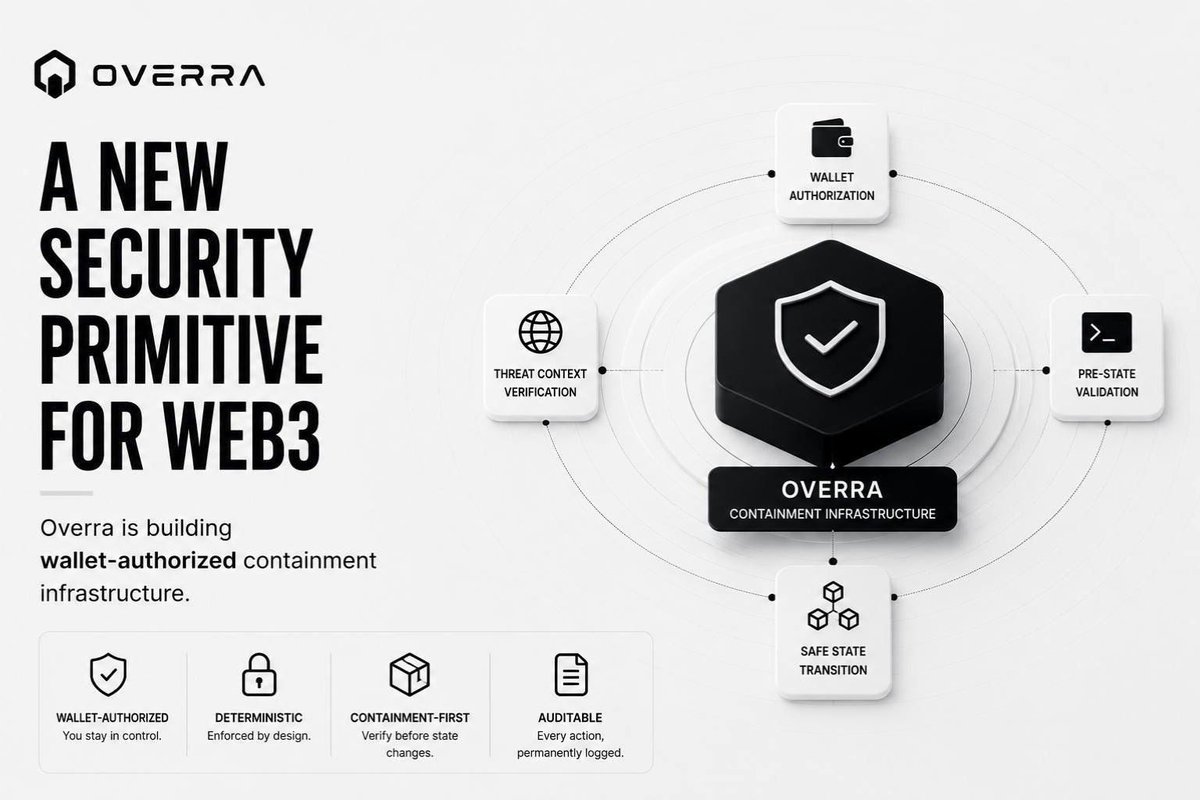
$OVERRA is building wallet-authorised containment infrastructure designed to secure execution environments before compromise can propagate into irreversible blockchain state changes.
The protocol introduces a deterministic execution-security model built around:
* Local verification
* Stateful security
* Runtime enforcement
* Deterministic containment
* Execution integrity
This is infrastructure built for the next generation of Web3 systems.
🎥 Watch the video and stay tuned for more updates.
DexScreener Updated!
Execution-layer security infrastructure for Web3 built around local verification, deterministic containment and runtime enforcement.
Chart: https://t.co/sP7DP39ptG
📱
OVERRA is now live.
Execution-layer security infrastructure for Web3 powered by local verification, deterministic containment and runtime enforcement.
The next generation of secure execution starts here.
CA: 0x04ce19771E9D093687bc1dEF8bD3A7DFBcf1Cebd
Link: https://t.co/4k6rGNHtFW
📱
Web3 has a serious execution-layer problem.
Wallets protect keys. Smart contracts protect logic But the execution environment itself remains exposed.
Most compromises today happen through:
* Session hijacking
* Malicious browser extensions
* Fake signing interfaces
* Runtime manipulation
* Unsafe authorization flows
The blockchain executes transactions correctly even when the execution context is compromised. That’s the structural gap most of the industry still ignores.
🚀Introducing Overra Network - (Launching Tuesday 06:00 PM UTC)
OVERRA is building wallet-authorised containment infrastructure designed to secure execution environments before compromise propagates into irreversible blockchain state changes.
The protocol introduces a deterministic security model where authorization is verified locally before unsafe state transitions occur.
Key infrastructure components:
* Local Verification Engine
* Deterministic Containment
* Stateful Security Architecture
* Execution-aware Authorization
* Append-only Auditability
* Runtime Enforcement Systems
This is not another reactive monitoring tool.
OVERRA is positioning itself as execution layer security infrastructure for the next generation of Web3 systems. As crypto moves toward institutional scale adoption, execution integrity becomes critical infrastructure.
That’s the layer overra is building.
TG: https://t.co/6LhDneIjQ8
WEB: https://t.co/ptU6YAyiMs
X: https://t.co/SBwL4pTIPD
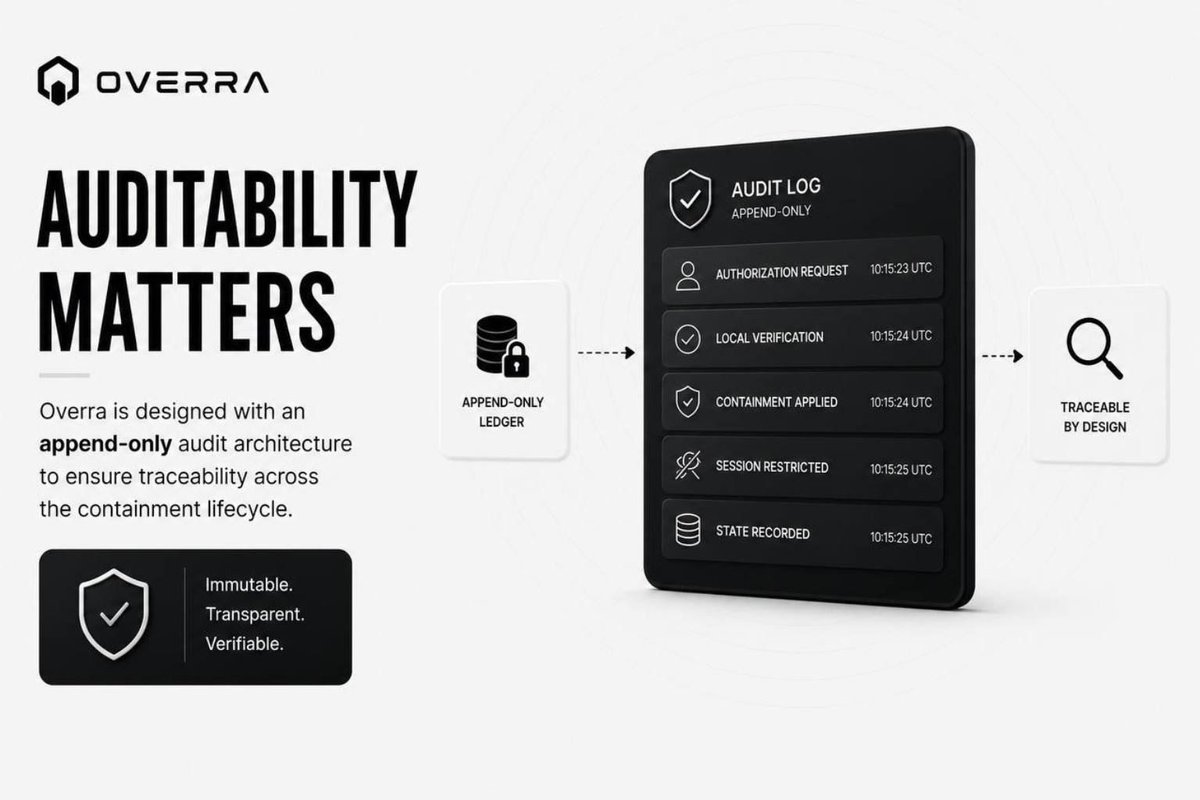
Auditability Matters
Every authorization request.
Every verification event.
Every state transition.
Logged.
Overra is designed with an append-only audit architecture to ensure traceability across the containment lifecycle.
Security infrastructure should be observable.
Security Should Be Stateful
Most security systems detect after compromise.
Overra introduces programmable device states:
Normal → Contained → Recovery
Wallet-authorized enforcement allows endpoints to transition deterministically under verified authority.
Security becomes executable infrastructure.
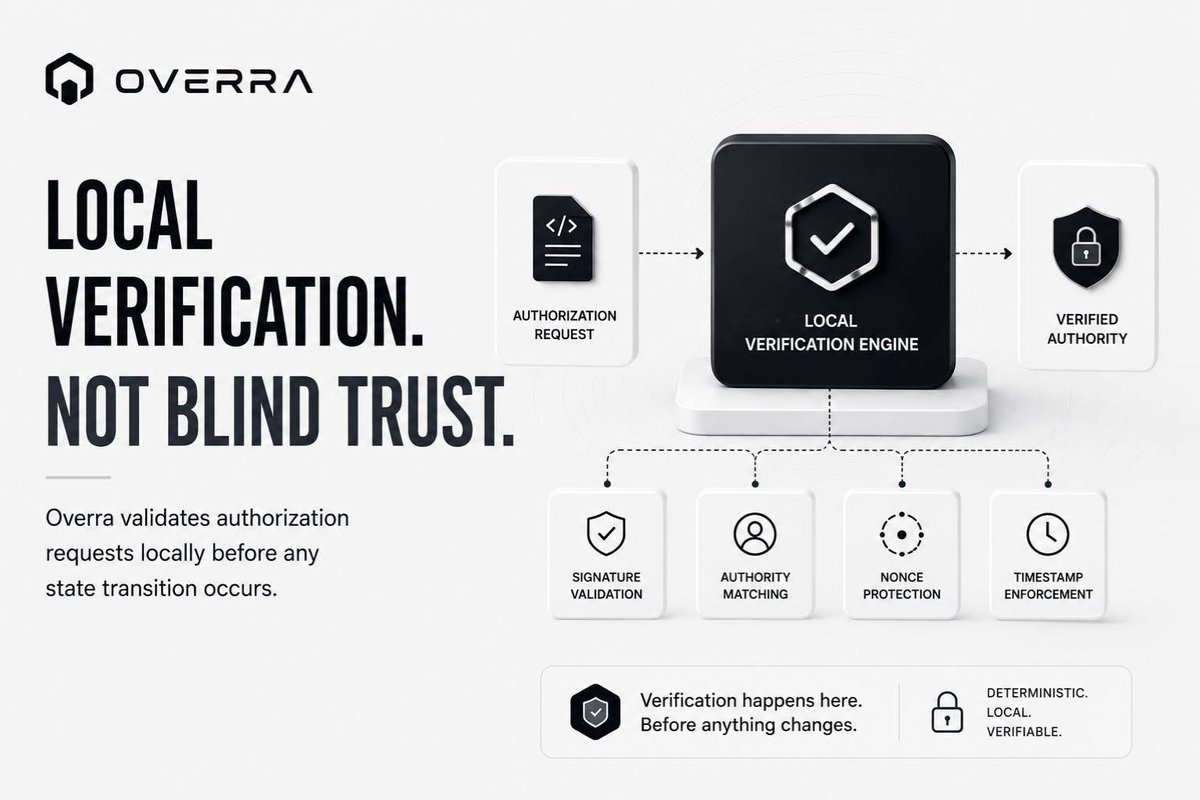
Local Verification. Not Blind Trust.
Overra validates authorization requests locally before any state transition occurs.
Every request is verified through:
Signature validation
Authority matching
Nonce protection
Timestamp enforcement
No centralized dependency.
No trust assumptions.
Only deterministic verification.
The Execution Layer Has Been Ignored
Wallet security evolved.
Smart contract security evolved.
But endpoint execution remains fundamentally reactive.
Overra introduces a deterministic containment layer between wallet authority and device execution.
Authorization should not stop at the wallet.
It should influence the endpoint itself.