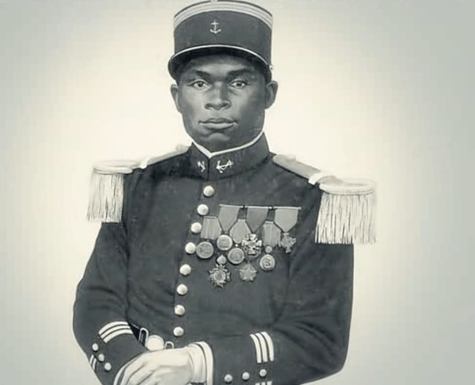
🇫🇷 This man is a hero.
He had earned his captain’s rank. His German captors saw only the color of his skin.
On June 7, 1940, following fierce fighting, after his men exhausted their ammunition, Captain Charles N’Tchoréré was captured at Airaines, northern France.
Born in Libreville, Gabon, in 1896, he had served during World War I, become a career soldier, and risen through the ranks. Promoted to captain in 1933, he volunteered for frontline service when another war began.
In June 1940, he commanded a company of the 53rd Mixed Senegalese Colonial Infantry Regiment. At Airaines, he stayed behind to cover his battalion’s withdrawal.
When resistance finally became impossible, he emerged with roughly fifteen men still fit to fight. The Germans separated African prisoners from Europeans. N’Tchoréré insisted on being treated as a French officer, invoking the Geneva Convention.
He was shot in the back of the neck. He was 43.
Several accounts attribute his murder to soldiers of Germany’s 25th Infantry Regiment, part of the 2nd Motorized Infantry Division.
His murder exposes a reality often overshadowed by accounts of tanks and battlefield maneuvers: the campaign of 1940 also included racist killings of captured African soldiers.
Remember Captain Charles N’Tchoréré. Share his story.
Follow @Vanguard_WW2 for more WWII history.
Eileen Nearne MBE
(a long-form post)
Her SOE codename was “Rose,” and she ran covert radio operations in occupied France during WW2.
Captured, she was sent to Ravensbrück, where she refused prison labour. Her head was shaved and she was threatened with execution. Transferred to a Silesian forced-labour camp, she endured torture.
On 13 April 1945, she escaped with two French women, hiding in a forest until liberation.
Eileen survived the war and lived quietly thereafter.
Post-war she was awarded the Croix de Guerre by the French government, and the MBE from King George VI.
In 1993, she returned to Ravensbrück with fellow agents to unveil a plaque honouring the four SOE women executed there in 1945.
She died alone from a heart attack in her seaside flat, where her body was discovered in September 2010. Her funeral was provided free of charge by the Torbay & District Funeral Service of Torquay.
Her legacy is cemented in the history books forever.
(end).