20 TEENAGERS, €10 MILLION+ IN FUNDING AND NOT ONE OVER 19
While many people are still deciding what career to pursue, these young entrepreneurs and innovators are building AI companies, satellites, robots and next-generation technologies.
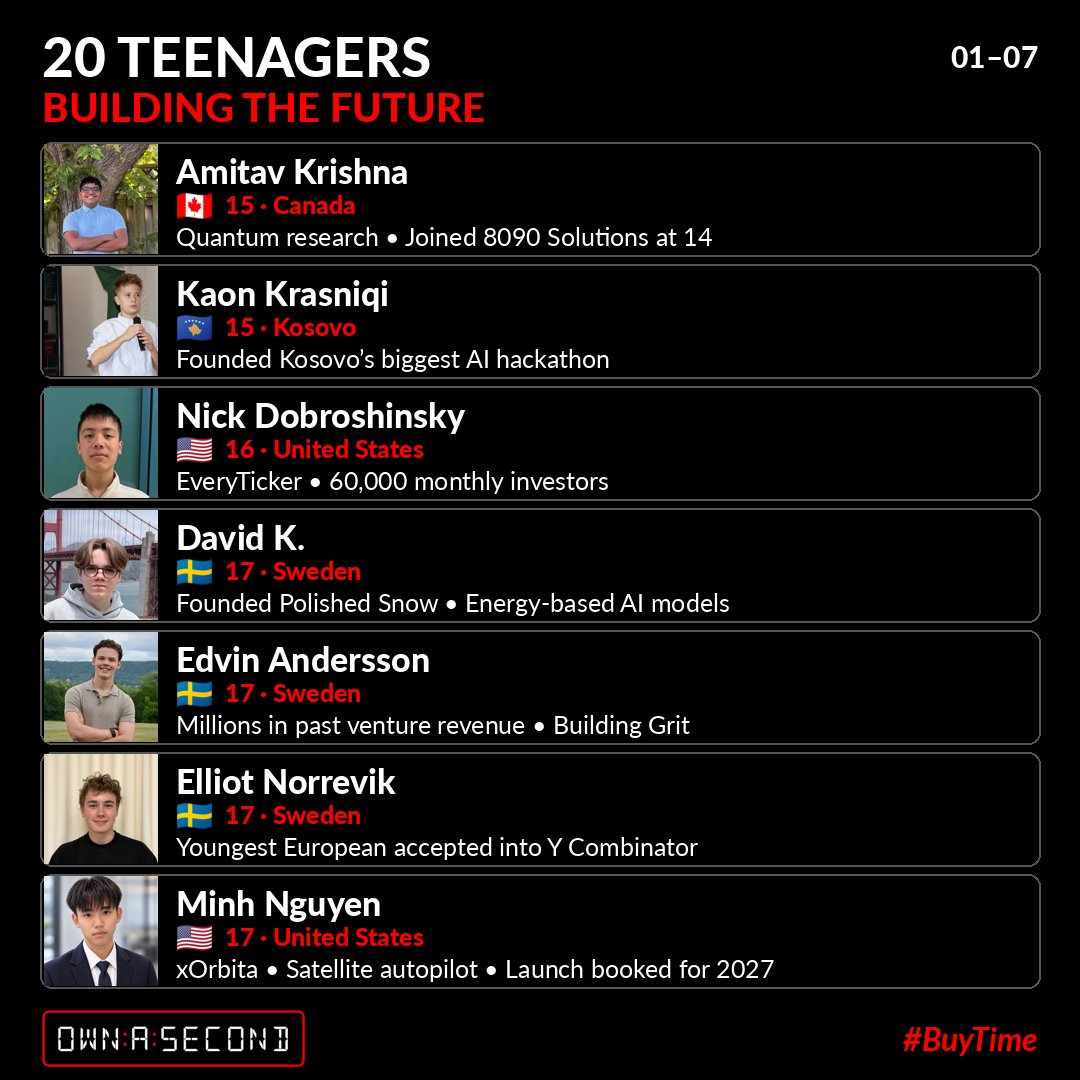
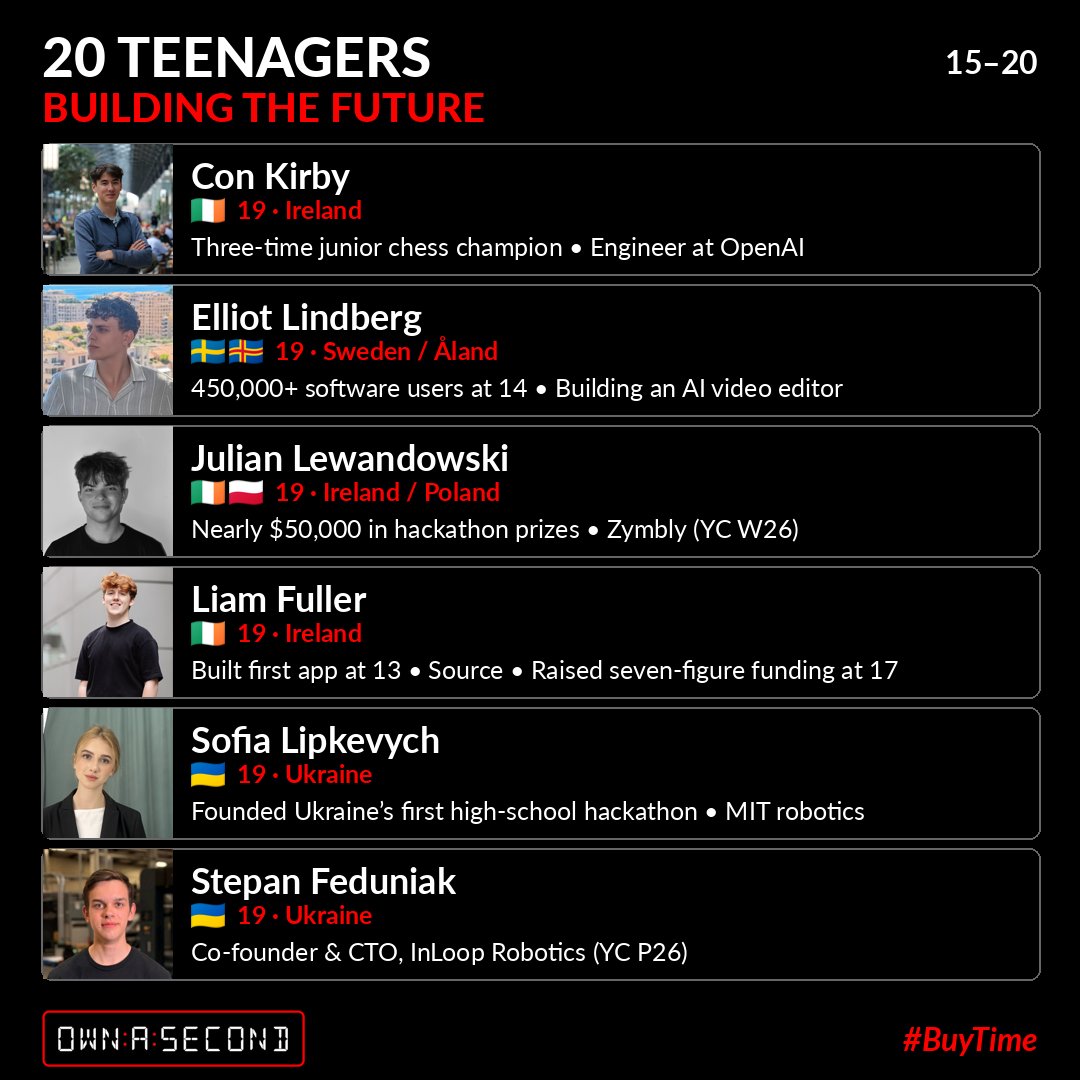
Meet the Slush 20u20 class of 2026 — 20 exceptional young people aged just 15–19 from around the world.
Their achievements are remarkable:
💰 $1.1 MILLION — Maximilian Lippert secured a VC deal on his 18th birthday, just two weeks after starting his latest venture.
💰 $895,000 — Fifi Siddiqui raised pre-seed funding for her AI startup after building businesses since the age of 11.
📈 450,000+ USERS — Elliot Lindberg built software reaching hundreds of thousands of users at just 14.
📊 60,000 MONTHLY INVESTORS — Nick Dobroshinsky founded an AI-powered investment research platform at 14.
🛰️ 2027 SATELLITE LAUNCH — Minh Nguyen, aged 17, is building autonomous navigation technology for spacecraft.
🏆 $50,000 IN PRIZE MONEY — Julian Lewandowski has earned nearly this amount through hackathon competitions.
🇮🇪 OPENAI AT 19 — Con Kirby went from winning junior chess championships to founding a startup and working at OpenAI.
Others are building warehouse robots, researching quantum computing, developing cybersecurity technology and exploring how to grow plants in space.
What can aspiring entrepreneurs learn from them?
They started with curiosity, identified problems, developed their skills and turned ideas into action.
You don't need to build the next billion-dollar company to get started.
Your first business could be a simple app, a website, a digital product or a solution to an everyday problem.
Start small. Build something. Learn from your customers. Keep improving.
If you could launch one business or app tomorrow, what would it be?
Source: Slush 20u20 — 2026
⏱️ Own A Second — BuyTime
#startup #founder #entrepreneur #smallbusiness #marketing #builinpublic
THIS $5 BILLION STARTUP IS BUILDING 24/7 CAFÉS FOR ENTREPRENEURS
What happens when an AI insurance startup decides to enter the coffee business?
Founded in 2024 by Nico Laqua and Emily Yuan, Corgi set out to modernise business insurance using artificial intelligence.
But the company had another idea.
Why not create physical spaces where startup founders, developers and entrepreneurs could work, network, share ideas and build their businesses?
That's how Corgi Café entered the picture.
📈 FROM STARTUP TO $5 BILLION IN TWO YEARS
🚀 2024 — Founded and joined Y Combinator
💰 January 2026 — Announced $108 million in funding
🦄 May 2026 — Raised $160 million at a $1.3 billion valuation
📈 May 2026 — Raised another $106 million at a $2.6 billion valuation
💵 July 2026 — Reached a reported $4 billion valuation
🇬🇧 August 2026 — Opened its London café
💰 September 2026 — Reached a reported $5 billion valuation
🌍 6 CAFÉS ACROSS 4 CITIES
🇬🇧 London — Shoreditch
🇺🇸 San Francisco — FiDi, Dogpatch and Castro
🇺🇸 New York — NoMad
🇺🇸 Atlanta — Buckhead
But these aren't ordinary coffee shops.
Imagine working on your next app, meeting a potential co-founder, connecting with an investor or discussing your next business idea over coffee.
💻 Workspace and Wi-Fi
☕ Coffee around the clock
🤝 Networking opportunities
🚀 A community of founders, developers and entrepreneurs
Corgi is bringing its brand directly to the people most likely to become its customers.
Instead of simply promoting insurance to startup founders, it's creating an environment where entrepreneurs naturally want to spend their time.
The expansion hasn't been without challenges, but there's an interesting marketing lesson here.
You don't always need to chase your customers. Sometimes, you can build a place where your customers want to come to you.
Could your next big business idea come from combining two completely different industries?
🌐 https://t.co/bDEQglPrt1
⏱️ Own A Second — #BuyTime
#startup #founder #entrepreneur #smallbusiness #marketing #buildinpublic
THIS 21-YEAR-OLD BUILT A BIBLE APP — AN ESTIMATED $2 MILLION A MONTH
What if one of the world's oldest books could become one of today's biggest app business opportunities?
Meet Gabriel Jacobson, the young entrepreneur behind Scroll The Bible.
THE IDEA — REPLACE DOOMSCROLLING
Millions of people spend hours scrolling through TikTok, Instagram and other social media platforms.
Gabriel's app takes that familiar scrolling experience and turns it into something different — learning about the Bible, one verse at a time.
Instead of trying to change how people use their phones, the app changes what they're scrolling through.
📈 THE NUMBERS
Launched on 17 December 2025, Scroll The Bible has achieved some remarkable estimated figures:
🔥 337,000 monthly downloads
💰 $2 MILLION in estimated monthly revenue
⭐ 4.8-star rating
📱 18,100 ratings
💵 $24 MILLION in potential annualised revenue
Revenue and download estimates are from AppKittie, not confirmed company financial results.
💡 THE BUSINESS OPPORTUNITY
Bible apps already existed long before Scroll The Bible launched.
But competition doesn't mean there isn't an opportunity.
Gabriel took an existing market, identified a modern problem and combined it with a familiar digital experience.
🎯 An established audience
📱 A familiar user experience
💡 A clear purpose
💰 A subscription-based business model
🚀 THE LESSON FOR STARTUP FOUNDERS
You don't necessarily need to invent something completely new.
Take something people already love, identify a problem and find a better way to deliver it.
The next multimillion-dollar app idea could be hiding in an everyday habit.
🔥 THE BIG QUESTION
If you could turn one everyday habit into an app business, what would it be?
Could you build the next multimillion-dollar app?
👇 Share your ideas below.
⏱️ Own A Second — BuyTime
#startup #founder #entrepreneur #smallbusiness #marketing
THIS FOUNDER BUILT A FITNESS APP — NOW IT'S MAKING AN ESTIMATED $800,000 A MONTH!
What if your next business idea was something as simple as helping people exercise at home?
Meet LazyFit, the fitness app turning easy workouts into a potentially multimillion-dollar business.
🏋️ THE IDEA — FITNESS WITHOUT THE GYM
Not everyone wants expensive gym memberships, personal trainers or intense workouts.
LazyFit offers something different.
🪑 Chair workouts
🏠 Exercise from home
💪 Low-impact fitness
📱 Beginner-friendly routines
No complicated equipment. Just accessible workouts through your phone.
💰 THE NUMBERS
📲 5 MILLION+ Google Play installs
🌍 10 MILLION+ reported users
💵 $800,000 estimated monthly iOS revenue
🚀 $9.6 MILLION annualised equivalent
The $800K figure is a third-party App Store revenue estimate, NOT verified company turnover. The annual figure assumes that monthly rate continues for 12 months.
📈 THE MARKETING STRATEGY
LazyFit isn't selling gym memberships.
It's selling convenience, accessibility and the opportunity to get fitter without leaving home.
And its workouts are ideal for short-form video.
Show someone exercising from a chair.
Show a simple routine anyone can follow.
Suddenly, people understand the value of the app in seconds.
🎯 Clear target audience
💡 Simple solution
📱 Easy to demonstrate
💰 Subscription business model
🚀 THE LESSON FOR STARTUP FOUNDERS
You don't need to invent something completely new.
Fitness apps already existed.
LazyFit focused on making exercise easier for people who might otherwise avoid it.
That's the opportunity.
Find an existing market, identify an underserved audience and create a simpler solution.
ONE APP. 10 MILLION+ REPORTED USERS. AN ESTIMATED $800K A MONTH.
🔥 THE BIG QUESTION
If a fitness app can generate these kinds of numbers, what everyday problem could YOU turn into an app?
👇 Would you ever build your own app?
⏱️ Own A Second — #BuyTime
#startup #founder #entrepreneur #smallbusiness #marketing
HE BUILT CAL AI AT 17 — $40 MILLION IN ANNUAL SALES!
What if a teenager could build an app in his bedroom and turn it into a multimillion-dollar business?
Meet Zach Yadegari, the young entrepreneur behind Cal AI.
📱 THE IDEA — TAKE A PHOTO, COUNT YOUR CALORIES
In 2024, Zach co-founded Cal AI at just 17 years old.
The idea was simple.
Instead of manually searching for foods and entering calories, users could photograph their meals.
🤳 Take a photo
🤖 AI analyses the food
🔥 Get estimated calories and nutrients
📊 Track your daily intake
A complicated daily task became something you could do in seconds.
💰 THE NUMBERS — $40 MILLION
Cal AI's reported growth was extraordinary.
📅 2024 — Founded at age 17
📲 15 MILLION+ app downloads
💵 $40 MILLION in reported 12-month sales
🤝 Sold to MyFitnessPal
The acquisition price was not publicly disclosed, so $40 million refers to reported sales, NOT the amount paid for the business.
📈 THE MARKETING STRATEGY
Cal AI didn't just build an app.
It built a product that was perfect for TikTok and Instagram.
Creators could film themselves taking a picture of their food and instantly show the results.
No lengthy explanation needed.
🎯 Everyday problem
💡 Simple AI solution
📱 Easy to demonstrate
🌍 Huge potential audience
Influencer marketing helped turn a calorie-tracking app into a viral business.
🚀 THE LESSON FOR STARTUP FOUNDERS
You don't need decades of experience to spot a business opportunity.
Calorie-tracking apps already existed.
But Cal AI made the experience faster, simpler and more appealing to a generation comfortable with AI.
ONE IDEA. 15 MILLION+ DOWNLOADS. $40 MILLION IN REPORTED SALES.
And eventually, an acquisition by one of the biggest names in fitness tracking.
🔥 THE BIG QUESTION
Would you trust AI to count your calories from a photograph?
Or would you rather track everything yourself?
👇 What do you think?
⏱️ Own A Second — BuyTime
#startup #founder #entrepreneur #smallbusiness #marketing
90,000 WEDDING RING PROTECTORS SOLD — A $2.25 MILLION BUSINESS OPPORTUNITY!
What if a simple piece of silicone could become a multimillion-dollar business?
No complicated technology. No expensive machinery for customers to operate. Just a clever solution to an everyday problem.
Meet Buffr, the brand turning ring protection into a business.
💡 THE IDEA — PROTECT THE RING, NOT JUST THE DIAMOND
Millions of people wear wedding rings, engagement rings and smart rings every day.
But there's a problem.
🏋️ Lifting weights can scratch expensive rings
💪 Gym equipment can damage their surfaces
💍 Wedding rings can cost hundreds or thousands
⌚ Smart rings like Oura can be expensive to replace
Taking your ring off every time you exercise isn't always convenient.
So Buffr developed a simple silicone protector.
The clever part?
The thicker silicone section sits UNDERNEATH the ring, on the palm side of your finger.
It helps create a protective barrier between your ring and the equipment you're gripping.
A small product solving a potentially expensive problem.
🚀 THE PRODUCT — JUST $24.95
Buffr sells its silicone ring protector for approximately $24.95 per unit.
It's small, lightweight and designed for everyday use.
But the marketing opportunity is much bigger than the product itself.
Customers aren't simply buying silicone.
They're buying protection for something valuable.
📈 90,000+ RING PROTECTORS SOLD
In a company announcement published in September 2025, Buffr reported selling more than 90,000 ring protectors.
Now here's where the numbers get interesting.
💰 90,000 × $24.95 = $2,245,500
That's approximately $2.25 MILLION in potential gross sales value at the advertised single-unit price.
Important distinction: this is an illustrative calculation, not Buffr's confirmed turnover. Actual revenue depends on historical pricing, discounts, bundles and sales channels.
Nevertheless, the reported sales volume demonstrates the potential of solving a very specific problem.
🎯 THE MARKETING STRATEGY — SHOW THE PROBLEM
Buffr has a product that's particularly suited to short-form video.
Think about it.
A customer shows their expensive ring.
They pick up a dumbbell.
They demonstrate how the silicone protector sits underneath the ring.
And suddenly, viewers understand the product in seconds.
📱 Easy to demonstrate on TikTok
💍 Instantly recognisable problem
🏋️ Clear gym and fitness audience
🎥 Simple before-and-after content
🛒 A relatively affordable purchase
You don't need a complicated explanation when the product demonstrates its own purpose.
And that's a powerful advantage for a small business.
⌚ THE NEXT OPPORTUNITY — SMART RINGS
Buffr's product range also includes protection for smart rings, including Oura rings.
That's an interesting market to enter.
As more people wear technology on their fingers, protecting those devices becomes another potential customer need.
A product originally associated with jewellery can find customers in fitness and wearable technology.
💡 THE LESSON FOR STARTUP FOUNDERS
You don't always need to create an entirely new industry.
Sometimes the opportunity is hiding inside an existing one.
People already own expensive rings.
People already go to the gym.
And people already worry about damaging things they've spent money on.
Buffr connects those three realities with one simple product.
ONE EVERYDAY PROBLEM. ONE SILICONE SOLUTION. 90,000+ REPORTED SALES.
🔥 THE BIG QUESTION
Would you spend $24.95 to help protect a $500 smart ring or a $5,000 wedding ring?
Or would you just take it off before going to the gym?
👇 What do you think?
⏱️ Own A Second — #BuyTime
#startup #founder #entrepreneur #smallbusiness #marketing
3 FRIENDS BUILT AN ALARM APP — $100,000 A MONTH!
What if the snooze button on your phone was actually a million-dollar business opportunity?
Three 23-year-old friends decided to find out.
And their idea was surprisingly simple.
🚀 THE IDEA — AN ALARM YOU CAN'T JUST SNOOZE
Meet Wayk, an alarm app designed to help people get out of bed and build better morning habits.
Unlike a normal alarm, Wayk makes you complete a challenge before switching it off.
💪 Do push-ups
☕ Take a photo of your morning coffee
🌅 Photograph the sky outside
📱 Complete a task to prove you're awake
The goal? Stop people setting ten different alarms and sleeping through every single one.
📈 THE FIRST 30 DAYS — 25 MILLION VIEWS
According to co-founder Marlon Grandy's account of the launch, the three friends used TikTok to promote their app.
Rather than spending millions on traditional advertising, they created short videos demonstrating how Wayk worked.
The reported results were remarkable.
🔥 25 MILLION TikTok views
📲 100,000+ app downloads
⏱️ ALL WITHIN 30 DAYS
They had discovered something powerful — people loved watching the challenges, even if they weren't initially looking for an alarm app.
💰 OCTOBER 2026 — AN ESTIMATED $100,000 A MONTH
Third-party app analytics estimated Wayk was generating approximately $102,000 in monthly revenue in October 2026.
That's equivalent to around $1.2 MILLION A YEAR if the app maintains a $100,000 monthly revenue rate.
These are industry estimates, not independently audited company accounts.
And according to the founder's account, the business was launched without venture-capital funding.
Three friends. One everyday problem. A simple app.
📱 THE BUSINESS MODEL
Wayk operates in the growing market for habit-building and self-improvement apps.
People aren't necessarily paying for an alarm clock.
They're paying for a solution to a problem they experience every morning.
And that's what makes the business interesting.
🎯 THE MARKETING STRATEGY
Wayk's founders understood something that many startups overlook.
A product that's easy to demonstrate can become its own marketing campaign.
Instead of telling people how useful the app was, they showed the problem and solution in entertaining short videos.
Every demonstration became an opportunity to attract another customer.
And TikTok gave them access to a huge potential audience without needing a traditional advertising campaign.
💡 THE LESSON FOR STARTUP FOUNDERS
You don't always need to invent groundbreaking technology.
Sometimes the biggest opportunities come from improving something millions of people already use.
An alarm clock already exists on almost every smartphone.
But Wayk found a way to make it different, build an audience and create a business around changing people's habits.
3 FRIENDS.
25 MILLION VIEWS.
100,000+ DOWNLOADS.
AN ESTIMATED $100,000 A MONTH.
🔥 THE BIG QUESTION
Would you pay for an alarm app that actually forces you to get out of bed?
Or would you just throw your phone across the room? 😂
👇 What do you think?
⏱️ Own A Second — BuyTime
#startup #founder #entrepreneur #smallbusiness #marketing
🤖 PEOPLE ARE PAYING TO CHAT WITH AI — $1 MILLION A MONTH!
Would you pay to talk to an AI character that remembers your conversations, knows your interests and makes you feel like you're talking to someone familiar?
Apparently, hundreds of thousands of people are interested in exactly that.
And one startup is turning the idea into a potentially multimillion-dollar business.
🚀 JUNE 2026 — WHISPY AI LAUNCHES
Developed by Singapore-based NEXBASE TECH PTE. LTD., Whispy AI launched on iOS as an entertainment app where users can create AI characters, have personalised conversations and explore interactive stories.
Unlike a traditional AI assistant, Whispy focuses on characters, personalities and ongoing relationships.
💰 NOVEMBER 2026 — $1 MILLION A MONTH?
Just five months after its iOS release, third-party app analytics platforms were estimating Whispy's monthly revenue at around $1 MILLION.
Some estimates are even higher.
That's potentially $12 MILLION A YEAR if the app sustains a $1 million monthly revenue rate.
These are industry estimates, not independently confirmed company accounts.
📱 500,000+ ANDROID INSTALLS
By November 2026, Whispy had passed the 500,000-install milestone on Google Play.
The app is free to download, but users can purchase virtual gems to access additional conversations and features.
Some in-app purchase packages cost as much as $99.99.
🧠 SO WHY ARE PEOPLE PAYING?
Free AI chatbots already exist.
But Whispy isn't simply selling answers to questions.
It's offering:
❤️ AI characters with different personalities
💬 Personalised conversations and interactive stories
🧠 Characters designed to remember previous interactions
📱 An experience built around entertainment, companionship and engagement
Instead of competing directly with ChatGPT on productivity, Whispy is targeting a different reason people use AI.
THE BUSINESS MODEL
The more engaged users become with their characters and stories, the more opportunities the app has to generate repeat purchases.
It's a different approach to monetising artificial intelligence.
And it demonstrates how businesses can build specialised products around technology that is already widely available.
💡 THE LESSON FOR STARTUP FOUNDERS
You don't necessarily need to invent a new AI model to build a successful AI business.
Sometimes the opportunity is in how you package existing technology, who you build it for and what experience you create.
Launched in 2026. Over 500,000 Android installs. An estimated $1 million in monthly revenue.
Whispy is an example of how quickly a niche AI entertainment product can attract attention.
🔥 THE BIG QUESTION
Would you pay to have an AI companion that remembers everything you tell it?
Or is paying to chat with AI something you'll never understand?
👇 What do you think?
⏱️ Own A Second — #BuyTime
#startup #founder #entrepreneur #smallbusiness #marketing
💰 FROM POP STAR TO £3.7 MILLION IN SALES — THE ROCHELLE HUMES BUSINESS STORY!
Most people know Rochelle Humes from The Saturdays and her TV presenting career.
But behind the scenes, she's been building something very different — a multimillion-pound beauty business.
And it all started with an idea inspired by motherhood.
🚀 2020 — THE £100,000 GAMBLE
Rochelle reportedly invested £100,000 of her own money to launch My Little Coco, a skincare and haircare brand designed for the whole family.
The products were developed to be gentle, accessible and suitable for different skin and hair types.
Rather than simply putting her name on an existing product, Rochelle set out to create her own brand.
🛍️ 2021 — £1 MILLION IN SALES
My Little Coco reportedly generated £1 million in sales during its first year.
With products stocked by Boots, Rochelle had turned a personal idea into a growing retail business.
💷 2022 — £3.7 MILLION IN SALES
Just two years after launching, My Little Coco reportedly reached £3.7 million in annual sales.
That's an impressive milestone for a brand that began with a £100,000 personal investment.
And by 2023, the business was reportedly profitable.
But Rochelle wasn't finished.
✨ SEPTEMBER 2026 — ENTER EULAH
Rochelle launched her second beauty venture, Eulah, an affordable skincare brand for the face and body.
The range launched with 12 products, priced around £8–£12, and was made available through major retailers including Boots and Tesco.
Early reports described strong demand and product sell-outs.
From children's skincare to a wider beauty audience, Rochelle was expanding her ambitions.
📈 THE BUSINESS STRATEGY
What makes Rochelle's story interesting isn't simply her celebrity status.
It's how she has used her public profile to help build businesses around everyday consumer needs.
She identified a market, developed products, secured major retail distribution and built a recognisable brand.
And instead of stopping at one business, she launched another.
💡 THE LESSON FOR STARTUP FOUNDERS
You don't always need to invent something completely new.
Sometimes the opportunity is to take an existing product category and create something that speaks directly to a particular audience.
£100,000 invested. £3.7 million in annual sales. Two beauty brands.
Rochelle Humes is showing how a personal brand can become a business brand.
🔥 THE BIG QUESTION
Does having a famous face give entrepreneurs an unfair advantage, or does building a successful business still come down to having the right product?
What do you think? 👇
⏱️ Own A Second — #BuyTime
#startup #founder #entrepreneur #smallbusiness #marketing
🚀 19 YEARS OLD — $100K A MONTH — IN JUST 4 MONTHS!
What if your biggest business advantage was something you'd grown up with your entire life?
Meet Jared Huseby, the 19-year-old founder behind Ziggy, an app teaching American Sign Language (ASL).
💰 The numbers are impressive:
📱 2026 — Jared launched Ziggy, an app designed to make learning American Sign Language easier and more accessible.
🚀 4 MONTHS — According to a founder story shared on YouTube, Ziggy went from launch to generating approximately $100,000 per month.
👨👩👦 19 YEARS OLD — Jared grew up with deaf parents, giving him a personal connection to sign language and an understanding of its importance.
📲 THE MARKETING STRATEGY
Before launching Ziggy, Jared had already been creating TikTok videos for another sign language learning app called Anna.
He discovered something valuable — short educational videos about sign language could attract millions of views and potential customers.
Rather than starting from scratch, he applied what he'd learned to his own app.
No massive advertising budget. No traditional marketing campaign. Just an audience, a product and a strategy he already understood.
💡 THE BIGGER BUSINESS STORY
While companies like Duolingo compete in the enormous language-learning market, Jared spotted an opportunity in a more specialised audience.
He didn't need to reinvent language learning.
He needed to serve a community he understood.
And his experience creating content gave him an advantage that money alone couldn't easily buy.
🔥 THE QUESTION FOR FOUNDERS
Could the next big business opportunity be hiding in a niche that larger companies are overlooking?
Sometimes the biggest opportunities aren't about creating something completely new.
They're about understanding a particular audience better than anyone else.
Would you rather build an app for millions of people or dominate a smaller, underserved market? 👇
⏱️ Own A Second — #BuyTime
#startup #founder #entrepreneur #smallbusiness #marketing
Do you have a unique idea for a new business? If you do, (please, no internet-based ideas such as chatrooms/dating) then check out my investment company 👉https://t.co/8it8otCMhl. You’ve already seen many people build successful businesses with me over the years – why not you? 🫵
@ownasecond dublin's founder community is tight knit, that's its superpower.
ran a few dinners there and the intros kept happening weeks after, way more than other cities i've seen :)
007 — THE $7 BILLION JAMES BOND EMPIRE 🍸💰
What started with one British secret agent in 1962 became one of the most successful film franchises in cinema history
• 25 FILMS
• 7 OFFICIAL BONDS
• OVER $7 BILLION AT THE GLOBAL BOX OFFICE
Here's how James Bond became a multibillion-dollar business 👇
🎬 1953 — Author Ian Fleming introduced James Bond in his first novel, Casino Royale
🎥 1962 — Dr. No hit cinemas, starring Sean Connery, with a production budget of approximately $1.1 MILLION
💰 1962 — $59.5 MILLION — The film's estimated worldwide box-office earnings, launching a franchise that would last generations
🍸 1969 — George Lazenby became Bond for just ONE FILM, On Her Majesty's Secret Service
🎩 1973–1985 — Roger Moore starred in 7 Bond films, the most of any actor in the official series
🔫 1987–1989 — Timothy Dalton brought a darker Bond to the screen in 2 films
💵 1995–2002 — Pierce Brosnan starred in 4 films, generating approximately $1.5 BILLION at the worldwide box office
🔥 2006–2021 — Daniel Craig reinvented 007 across 5 films, generating approximately $3.9 BILLION worldwide
🏆 2012 — SKYFALL — Became the highest-grossing Bond film, earning approximately $1.11 BILLION worldwide
🎬 2021 — NO TIME TO DIE — Daniel Craig's final Bond film generated approximately $774 MILLION globally
💼 2022 — $8.45 BILLION — Amazon completed its acquisition of MGM, the Hollywood studio behind Bond's distribution history and thousands of other film and television titles
🤝 2025 — A NEW ERA — Amazon MGM gained creative control of the Bond franchise through an agreement with its long-standing producers, reportedly involving a deal worth more than $1 BILLION
🍸 16 NOVEMBER 2026 — THE NEW 007 — Robert Pattinson, 40, was announced as the seventh official James Bond, taking over the iconic role from Daniel Craig
AND THE BUSINESS GOES FAR BEYOND CINEMA 🎯
James Bond has helped sell luxury watches, cars, fashion, drinks, video games and countless licensed products
From Aston Martin and Omega to global advertising partnerships, 007 became much more than a film character
THE BUSINESS LESSON FOR FOUNDERS 👇
The actors changed
The decades changed
The technology changed
But the James Bond brand kept generating revenue
A recognisable identity, consistent positioning and decades of reinvention helped turn a fictional character into a global entertainment empire
SEVEN OFFICIAL BONDS — ONE BILLION-DOLLAR BRAND
🍸 Who was your favourite James Bond of all time, and do you think Robert Pattinson can live up to the legacy? 👇
⏱️ Own A Second — #BuyTime
#startup #founder #entrepreneur #smallbusiness #marketing
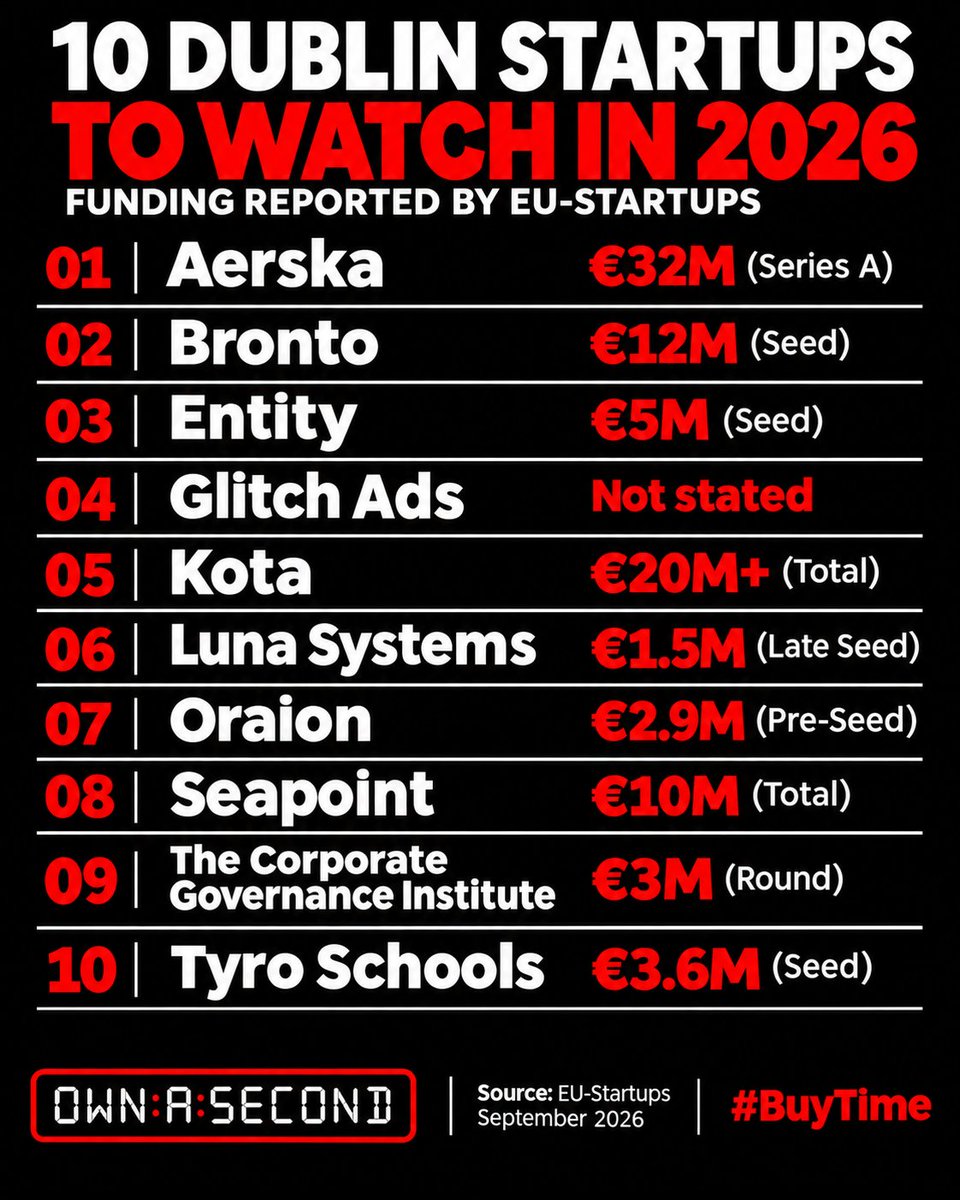
10 PROMISING DUBLIN-BASED STARTUPS TO WATCH IN 2026 🚀
Ireland's startup ecosystem continues to produce ambitious founders, innovative products and companies attracting millions in investment
From AI and cybersecurity to fintech, healthtech and education, these 10 Dublin-based startups are worth knowing about
💰 Some of the reported funding figures:
🇮🇪 Aerska — €32M
🇮🇪 Kota — €20M+
🇮🇪 Bronto — €12M
🇮🇪 Seapoint — €10M
Different industries, different stages, but all part of Dublin's growing startup community
🚀 Calling all founders, indie hackers, app developers, investors and tech journalists
I'm always looking to discover and shoutout interesting startups, new products and people building businesses from the ground up
Building something exciting in 2026?
👇 Drop your startup, app, logo or website in the comments
Let's discover what you're building!
📊 Source: EU-Startups, September 2026
Funding figures include reported rounds and cumulative totals
⏱️ Own A Second — #BuyTime
#startup #founder #entrepreneur #smallbusiness #marketing #buildinpubic
FROM A SIMPLE POLO SHIRT TO $200 MILLION IN SALES
In 2021, entrepreneur Justin Baer launched Collars & Co with one simple idea — a polo shirt that looked like a dress shirt, without the discomfort
Just a few years later, the business has reportedly generated OVER $200 MILLION IN LIFETIME SALES 🚀
Here's how it happened 👇
📅 2021 — Justin Baer founded Collars & Co, combining the comfort of a polo shirt with the smart collar of a dress shirt
💰 $5.4 MILLION — Lifetime sales by the time the company appeared on Shark Tank in 2022
📺 2022 — Justin pitched Collars & Co on Shark Tank Season 14
💵 $300,000 FOR 4% — His original investment offer, implying a $7.5 million valuation
🦈 MARK CUBAN & PETER JONES — Agreed to invest $300,000 for 10% equity, plus a $700,000 line of credit
🤝 $1 MILLION DEAL — The total proposed funding package, including the credit facility
📈 2023 — The company continued expanding its product range and growing its customer base
🔥 2026 — FOUR YEARS AFTER SHARK TANK
💰 OVER $200 MILLION — Reported lifetime sales
📊 $100 MILLION — Sales figure highlighted in the latest Shark Tank update, although the reporting period wasn't specified
👔 BEYOND POLO SHIRTS — The business expanded into a full menswear collection
🏬 RETAIL EXPANSION — Moving beyond online sales into physical stores
FROM $5.4 MILLION TO OVER $200 MILLION
That's more than 37 TIMES its reported lifetime sales at the time of the original Shark Tank appearance
And it started by improving something millions of people already owned — a shirt
THE LESSON FOR STARTUP FOUNDERS 👇
You don't always need to invent the next revolutionary product
Sometimes the opportunity is hiding in something customers already buy
Find the frustration
Improve the product
Build the brand
Scale what works
If you were starting a business tomorrow, what everyday product would you reinvent? 👇
⏱️ Own A Second — #BuyTime
#startup #founder #entrepreneur #smallbusiness #marketing @dragonjones@CollarsandCoUSA
🎮 FROM A SCOTTISH VIDEO GAME TO A MULTIBILLION-DOLLAR EMPIRE
1997: Grand Theft Auto launches, developed by DMA Design in Dundee, Scotland
1998: Take-Two Interactive acquires BMG Interactive, the publisher behind GTA, for approximately $14 million in shares
2001: GTA III changes gaming forever with its revolutionary 3D open-world experience
2002: GTA: Vice City becomes another blockbuster, selling millions of copies
2004: GTA: San Andreas sells over 27 million copies during its lifetime
2008: GTA IV generates approximately $500 million in its first week
2013: GTA V launches and makes an astonishing $800 million in just 24 hours
2013: Within three days, GTA V passes $1 BILLION in worldwide retail sales
2018: GTA V surpasses 100 million copies sold
2024: GTA V passes 200 million copies sold
2026: The GTA franchise has sold hundreds of millions of copies worldwide, generating billions of dollars across game sales and online spending
💰 THE BUSINESS LESSON
GTA didn't become a global phenomenon overnight
It took decades of building a recognisable brand, improving the product, understanding its audience and creating something customers wanted to return to
For startup founders, the lesson is simple:
Build something people love, keep improving it and think beyond the first sale
A business that started with one game in 1997 went on to become one of the most commercially successful franchises in entertainment
What can your business look like in 10, 20 or 30 years?
⏱️ Own A Second — #BuyTime
#startup #founder #entrepreneur #smallbusiness #marketing
TASKRABBIT HIT £100M+ IN REVENUE 📷
SHE RAN OUT OF DOG FOOD AND BUILT AN ODD-JOB BUSINESS THAT IKEA BOUGHT
In 2008, Leah Solivan was getting ready for dinner with friends in Boston when she realised she'd run out of dog food.
It was snowing outside, the shops would soon close, and she didn't have time to collect it herself.
Then she had an idea 📷
What if you could pay someone nearby to run an errand for you?
That simple frustration became TASKRABBIT.
📷 Here's how it happened
2008 — Leah left her software engineering career at IBM and launched RunMyErrand
2010 — It became TASKRABBIT, expanding into everyday household services
2010s — Raised $50M+ in venture capital and expanded internationally
2017 — IKEA acquired Taskrabbit
Today, people use TASKRABBIT for furniture assembly, cleaning, moving, repairs and countless other everyday jobs.
📷 THE BIG LESSON FOR FOUNDERS
Leah didn't start by trying to build a billion-dollar company.
She started with a problem she experienced herself
She recognised that other people probably faced the same frustration and built a business around solving it
Sometimes the best startup ideas aren't complicated
They're everyday problems waiting for someone to solve them
📷 What's one everyday frustration you think could become a successful business?
📷 Own A Second — BuyTime
#startup #founder #entrepreneur #smallbusiness #marketing