@SamsonMKasumba Nobody is locking them. They only have to renounce the other citizenship and only specified offices with good reason. Otherwise if one is not willing to relinquish then it says more about their loyalty
@wekesa_amos@cobbo3 All countries will try to protect thir interests. Its just the way it is. Humans are tribal. Let's also advocate for building strong businesses and systems internally, then we will have the strength to struggle better externally.
@nbstv@JustineNameere The irony- can one give what one does not have? If in elections we practice corruption, how can we be taken serious in calling it out. Let's practice what we preach. Who you are speaks louder than what you say
@SamsonMKasumba And the conflict is then framed as a religious conflict, not Jewish nationalism vs Arab nationalism. Israel, which is a secular nation!.
@benmwine You are right about the characterisation, but it is an adaptation to the environment we have created knowingly or unknowingly. We need to create a different kind of environment, and that starts with leaders at all levels.
@jamesonen Wonder why we can't get act together. We create the conditions for the outsiders to take advantage of, yet if we were stronger internally, we could then face off the outsiders. We need to create a stronger sense of one people. - Fairness and justice
Uganda is about 60 years old. One man has ruled it for about 40 of those years. That is not a small detail in our national story. It is the central fact that shapes how our politics behaves, how our institutions learn, and how citizens calculate risk.
So when we hear people say our elections are tense, institutions are weak, voters are trapped in survival politics, the military has been normalized in governance, and political maturity is low, we must stop treating these as neutral background conditions. They are not fog. They are not weather. They are products. A system trained for four decades around one center of power will naturally reproduce that power, even when the constitution and the language of democracy remain intact.
This is why Gödel’s insight about rule-based systems matters. Any system that is complex enough will always have truths it cannot prove from within its own rules. Elections are rule-based exercises. But an election cannot fully prove its own fairness by simply pointing to procedure. A legal victory does not automatically equal legitimacy. A clean tally does not automatically mean a free choice. Where fear exists, where poverty turns politics into a survival transaction, where information is controlled or distorted, and where state machinery is not neutral, “process” becomes an insufficient witness.
In such an environment, voters do not choose as free citizens. They choose as people managing danger, hunger, and uncertainty. Opposition becomes a high-risk career. Silence starts to look like consent. Institutions stop behaving like referees and start behaving like loyal staff. Even well-meaning public servants quickly learn what is rewarded and what is punished, and the system becomes self-reinforcing.
If Uganda wants elections that feel legitimate, the work is not cosmetic. It is structural. The current trajectory we are on as a country has many examples in history, and they rarely end well when societies postpone correction until frustration hardens into rupture. You do not repair a 40-year system with slogans and applause. You repair it by rebuilding the conditions that allow truth, choice, and accountability to exist outside the power center, and by making peaceful transfer of power normal, not terrifying.
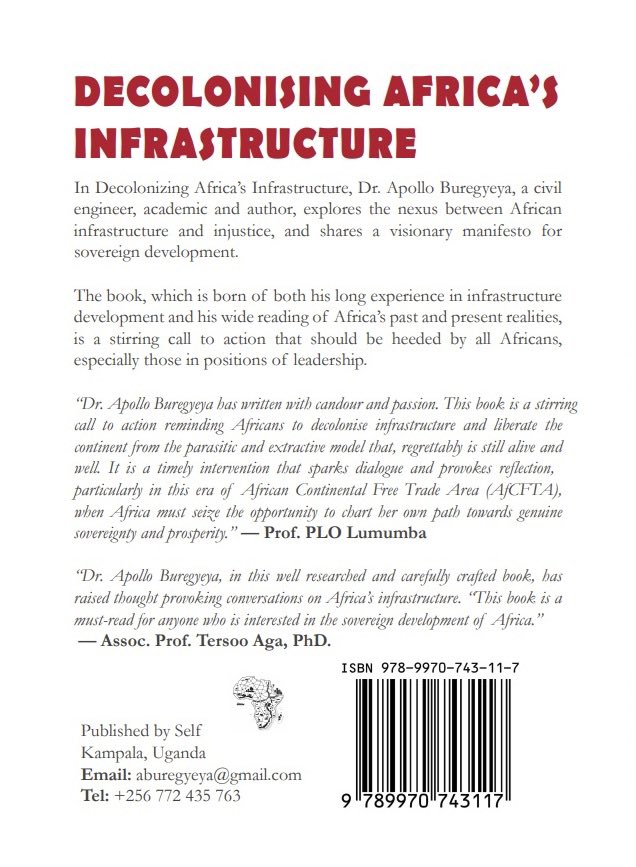
If you want a deeper, African-rooted framework for thinking about systems, power, and why our “development” often serves extraction more than citizens, I unpack these questions in my book, Decolonising Africa’s Infrastructure: Why Roads Still Lead to Ports, Not to People. It is a manifesto for sovereign development, written for Africans who are tired of symptoms and ready to debate causes and fixes. Copies are available in all leading bookshops in Uganda and on Amazon.
@jamesonen I think the real fear is that the processions are formed by people who already have grievances with the system. What if herd mentality takes over? What level of destruction can happen?. The violence is trying to put a lid on a boiling pot. Unfortunately this only raises the temp.
@airtelmoneyug my airtel money account is blocked. Your call center agent was even rude. Says it's because of money I deposited on my phone and I need to physically come to a call center. Really, where is the convenience in your services?.
@newvisionwire Hopefully, his excellency gets to see the state of the Amolatar Dokolo road. There are many priorities, but the government can at the very least maintain it in a motorable state
@Winnie_Byanyima The Express penalty scheme showed us how this usually pans out. If this could affect the elite, like the EPS did, we would see how many would still be cheering not following due process.
@aitajoel@Jkrkaliisa Using criteria to frustrate development for personal gain is one of the biggest killers. NOT following rules, as M7 is doing, is also one of the biggest killers, as it only serves short-term gains and personal interests
@wekesa_amos You are right, but I again ask myself—what does Singapore have? What are the outcomes for Singapore vs. Ug?. What is the differentiator?. Until we get our governance issues right, we won't exploit what we have. And it has to be leaders at all levels, not just M7/Bobi