“Eagle in the Sky.”
Students use basic algebra and arithmetic to configure a UAV, run a simulation, and then watch the result play out on screen.
Their choices decide everything, success, failure, score, and rank.
Better UI and flow. Way better learning!
Well.. first of all, it's damn fun.
Sometimes while building Owster Labs, I forget that I'm building a simulation to teach maths, not an aerospace simulator. The aim was always to make something where maths gets used, not just learned.. but this is turning out to be way too much fun.
With this update, you can work on the aircraft basics yourself. Change the wing area, the size, where the wing sits. So you're free to calculate, make your own plan, and decide how YOUR aircraft lands.
That's the whole idea: every student solves the challenge their own way and picks the approach they think is best. That's real learning.
See you all at IGDC Chennai, 28–29 Oct.
#GDAI #IGDC2026 @theindiagdc@Owsterlabs
Thrilled to share that Eagle in the Sky is nominated for Game of the Year (Serious/Applied) at the India Game Awards 2026!
Students write a flight plan. Physics decides what happens. No joystick. No luck. Just learn, adjust, fly again.
I'll be at #IGDC2026 in Chennai, Oct 28–29. Let's meet!
Presenting Owster Labs’ new simulation module.
This simulation is based on a UAV landing theme. But what makes it different from a normal game?
Unlike a regular game, this module is built around strict maths and physics models. We have run the design analysis through OpenVSP as well as our own maths engine, making the simulation as realistic as possible.
The module is designed for students to learn maths by actually working on a real design problem. Their aim is simple: design the best landing approach and land the UAV in the shortest distance possible.
Once again, Owster Labs is working towards building state-of-the-art simulations that can teach maths while connecting it with real-world applications.
In the learning domain, AI can tell an incredible story, make a beautiful battle animation and can even give a very convincing answer.
But there is one question I keep coming back to:
How do we know the outcome is actually legitimate?
This is the thing we are trying to solve at Owster Labs.
In our Ravenna battle module, students submit their own strategy. We do not simply ask AI who wins.
Their decisions go through a maths engine with defined rules around troop strength, terrain, fatigue, fortifications, timing, river crossings, reserves, casualties and enemy behaviour.
The maths engine produces the outcome.
Then AI helps us turn that outcome into something a student can actually experience: a story, an assessment and a cinematic battle simulation.
AI makes learning more immersive, and Maths gives the simulation its legitimacy.
I think game-based learning will become very big. But if the outcome is random, or just an AI-generated story that sounds convincing, then it does not really teach anything.
There has to be a model underneath it.
That is the gap we are trying to work on.
With this, @Owsterlabs is also opening applications for its initial cohort.
We will select students and take them through a set of modules based on the Eastern Roman Empire, while teaching fundamental mathematics through simulations.
More information soon. DM me if you would like to know more.
@Owsterlabs method for learning maths,
1. See the problem.
2. Write your solution in your own words.
3. The system converts your strategy into the mathematical model and equations.
4. Simulate both your approach and the mathematically derived solution to see what works and why.
We ran 200,000 aerial combat simulations.
The aim was to test my thesis of humanity's Coup d'œil (the ability to instantly understand a complex situation and act decisively without full analysis), or in simple words, asymmetric thinking.
Can we defeat AI in strategy-making and outcomes when the situation is against us in every way?
Can humans beat AI when everything is screaming defeat?
Well, to test this, we ran 200,000 aerial combat simulations.
The scenario was simple:
a. 3 vs 4 UCAV dogfight
b. Same rules, same opponent
c. Only difference was the strategies (GPT vs human)
And surprisingly, we got these results:
a. GPT: 38.14% win rate
b. Human: 40.64% win rate
c. → +2.5% edge (statistically significant)
AI optimised for distance, safety, and perfect timing.
Humans created chaos: split forces, phased attacks, and took risks.
Key differences:
a. 40% fewer missiles used
b. ~2× higher hit efficiency
c. Multi-angle attacks AI didn’t anticipate
AI played “not to lose.”
Humans played “to win.”
This was a very preliminary, base-level simulation, but we kept the maths loop tight. Of course, this will require much better rules and scenario design going forward.
But what if we can train AI using human chaos, human unpredictability and asymmetry? The ability to think beyond constraints and turn defeat into victory.
So I’m proposing something exceptional: Chaos-driven AI.
Teaching AI to think like humans when all hell breaks loose, when defeat seems certain.
Humans have historically mastered turning the tide with smaller forces against much larger ones. What if we can train AI to learn this art and become even better?
The proposition is massive. With the right execution, we could move towards far more capable autonomous UAVs and UCAVs.
More to come.
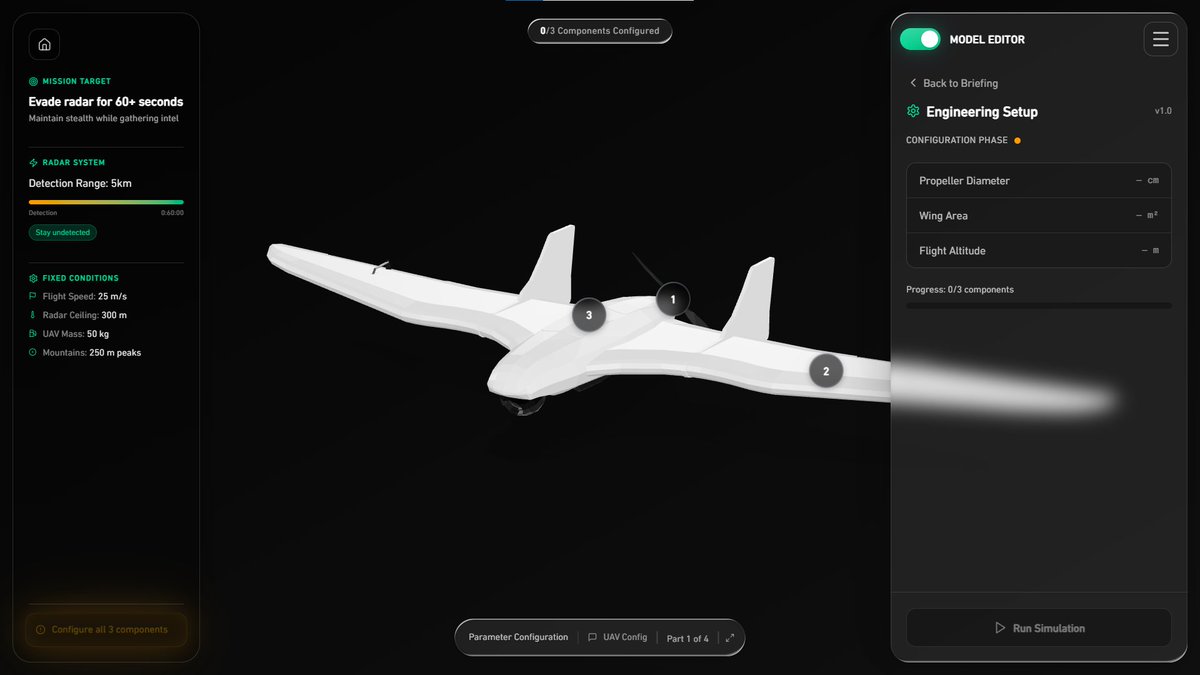
I have updated the mission video, made it crisp and added voice. Plus, the user input section has been enhanced.
In easy words, it will be way easier to use our modules and apply maths to the mission.
How to use it? It’s easy peasy.
Select the module, submit your calculation, and simulate the outcome.
The aim is to fly your UAV below the mountain range and avoid radar. If your maths is sound, you will succeed. Otherwise, either the enemy will find you or you will collide with the mountains. With @Owsterlabs , we will surely make maths less scary.
Well, take a look at our History Track program.
Students will be able to relive famous battles, apply their strategies, and learn from the outcome.
The aim is simple: give them a chance to show their thinking and become smarter.
Understand--submit--simulate the outcome.
For me, turning topics into gamified missions is one of my favorite things. Like this one, where students must find the correct weight for an aircraft to take off with damaged engines. Now go and apply maths.
So yeah, we’re making maths awesome with @Owsterlabs
Using ancient battle scenarios and formations can be a great way to learn logistics, strategy, and human motivation. Unlike other subjects, learning the basics of strategy and logistics can genuinely help students become their best version.
With @Owsterlabs, we are solving this.
The Czech hedgehog.
These crazy structures were used in WW2 to stop enemy tanks. But have you ever thought how something like this could stop such massive vehicles?
How much area do they cover, and how strong do they need to be?
Join Owster labs to know more!
Teaser trailer from our latest module “Eagle in the Sky.”
This module will teach the implementation of algebra and arithmetic, while touching on the concept of radar masking (flying below mountain ranges to evade enemy radars).
The aim is to teach maths through simulation!!
1. Removed the drawing and typing option for solving challenges. Now users can simply select the values needed to solve the situation. Much faster and easier to use.
2. Users can now analyse a 3D model instead of static images. Interaction feels way better.
The aim is simple. Students should clearly understand the challenge or situation first, and then learn the art of solving it using maths. More like first-principle thinking. Even teachers need something to work with, and then break it down to a solution using maths.
Just need to sort out model optimization real quick.
Well, what about using the French Revolution as the backdrop and geometry to find the correct sail area of a galleon? Why focus on speed? Because the Royal Navy is lurking, and the French Armada needs to move fast. Presenting our new module on geometry, where kids can learn how it’s used in real-world scenarios.
It’ll be live in a day or two. #gamebasedlearning #maths
Ok, so it’s the game of packing and distribution now for me.
I think building a library for educational simulations is the long-term goal.
For maths, the best approach is using strong visuals combined with missions.
Wanna learn algebra or trigonometry? You’ll have a place to actually see how these things work in real life.
Wanna learn geometry? Open up the ship simulation, calculate the right sail area for a galleon, and watch how the correct area makes the ship move while a smaller sail slows it down.
Wanna see how trigonometry helps? Open the Titan module, find its height using the tan formula, and check whether your approach was right or wrong. So apart from learning on a blackboard, you’ll have a way to observe it in action, in a fantasy world, I should say.
Welcome to the future of game-based learning.