Here we report the DNA Origami Tension Sensor (DOTS) & measure TCR-pMHC forces in cell-cell junctions! Forces measured using microscopy or flow cytometry! @EmoryChem @YuesongH @salaitalab @EmoryUniversity https://t.co/XmDnPKD6ZV
Here it is, the first bond that strengthens under stress (Nature Chemistry).
Excellent work by Martijn van Galen, Annemarie Bok and Taieesa Peshkovsky, in collaboration with Joris Sprakel @GreenMechanobio and Jasper van der Gucht! @WUR@PCC_WUR@orc_wur
https://t.co/BkFn2mEjvd
New paper alert: A pH-sensitive DNA origami nanoswitch with death receptor ligands demonstrates cytotoxicity in an acidic microenvironment, reducing breast cancer tumor growth with minimal on-target/off-tumor toxicity.
https://t.co/PWCKVkOMQh
Our @ox_DNA /oxRNA models are still not fast enough to capture the timescales of bulk self assembly or large nanostructure folding.A new model (ANNaMO) developed with F.Guerra,@lrovigatti,@floppleton is a step towards more coarse representations of DNA/RNA
https://t.co/cpnJu1mFEW
Our new paper "Inverse design of a pyrochlore lattice of DNA origami through model-driven experiments" is just out in @ScienceMagazine ! We use multiscale modeling and optimization theory to realize one of the main goals of colloidal self-assembly, the pyrochlore lattice.🧵1/7:
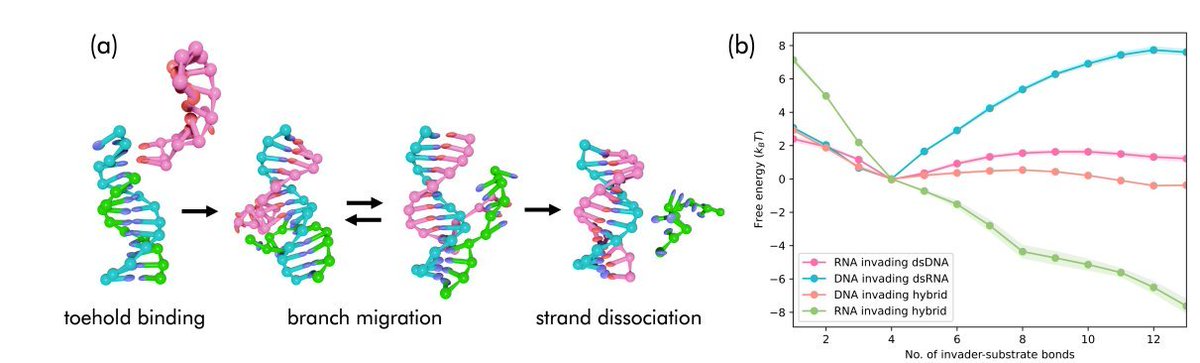
Our new model for DNA and RNA coarse-grained simulations is now out in @JChemPhys :
https://t.co/FapnoqG8ES
It is called #oxNA and includes @ox_DNA and #oxRNA models, and adds support for hybrid DNA:RNA duplexes:
🧵1/4
Can one self-assemble containers the size of cells using a single DNA origami? Well, now we can.
Check out our preprint, where we present the underlying Dipid (DNA origami inspired by lipids) framework(https://t.co/oaUOybQzXC).
(TEM image of a collapsed container)
Spacer-Programmed Two-Dimensional DNA Origami Assembly | Journal of the American Chemical Society @CHNSci #2D#DNA#Origami#Assembly https://t.co/Mya73VlljD