What if privacy became a feature, not a limitation?
Fhenix brings encrypted computation to Ethereum, helping applications protect sensitive data while keeping blockchain interactions useful and composable.
Build openly. Protect what matters. @fhenix
DeFi strategies are valuable. Why should everyone see them?
@fhenix is expanding the possibilities of confidential finance through Fully Homomorphic Encryption (FHE).
@0xAlphaEngine focuses on confidential financial strategies.
Encrypted computation can help protect sensitive trading inputs.
Privacy-preserving infrastructure could unlock new possibilities for AI-driven finance.The bigger vision? Build onchain financial applications without exposing every sensitive detail.
Privacy isn't just a feature. It's infrastructure.
What new possibilities could confidential DeFi unlock? 👀
@deivonchain@Asterix54907294
Privacy is becoming essential infrastructure for institutional DeFi.
@Primus_Labs is working toward a future where data verification and confidential computation can unlock new possibilities for Web3.
Institutional finance needs more than transparency. It also needs privacy, secure data handling, and reliable verification.
That's where privacy-focused cryptography becomes important.
With technologies like zkTLS and zkFHE, Primus explores ways to verify information while minimizing data exposure and support computation over encrypted data.
The Kaito campaign highlights Primus with a 0.3% PRIM allocation:
• 0.24% allocated to creators
• 0.06% allocated to Kaito stakers
Current epoch: October 23 – November 21, 2026.
The bigger picture? Making privacy-preserving infrastructure practical for institutional onchain finance.
Privacy isn't just a feature. It's a foundation for the next phase of Web3.
@xxiang_xie@bitvickyzh
@fhenix is moving toward a bigger vision for confidential Web3.
With 3 additional dApps planned for CoFHE in Q4 2026 and 2 institutional partnerships expected to be announced, the focus is shifting from building privacy technology to expanding its real-world utility.
Imagine DeFi where strategies stay confidential, AI applications process sensitive data, and institutions explore onchain finance without exposing every detail publicly.
The real opportunity isn’t just more applications. It’s making privacy a native part of blockchain infrastructure while preserving composability.
Now, the key question is execution: how quickly will these plans translate into active products, stronger adoption, and lasting ecosystem growth?
@fhenix is building toward a future where confidentiality becomes a feature of Web3, not an afterthought. @deivonchain@Asterix54907294@0xkeksgiven
Privacy is no longer just a feature in DeFi. It’s becoming essential infrastructure. And @fhenix is building an ecosystem around that idea.
Look at what’s taking shape 👇
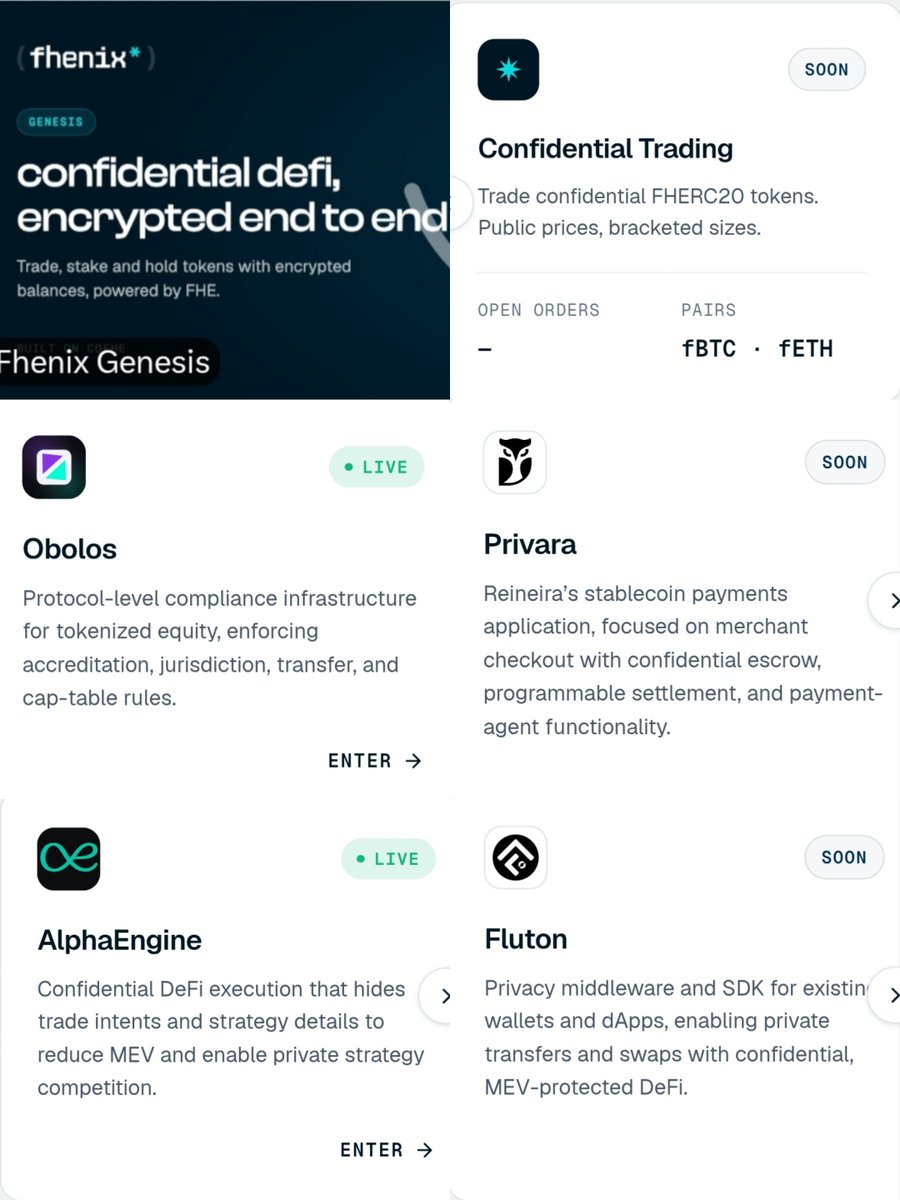
🔹 Genesis: Confidential assets and encrypted balances powered by FHE.
🔹 AlphaEngine: Private trading strategies designed to reduce MEV exposure.
🔹 Obolos: Compliance infrastructure for tokenized equities.
🔹 Fluton: Privacy middleware enabling confidential transfers and swaps.
🔹 Privara: Confidential escrow and programmable merchant payments.
🔹 Confidential Trading: A planned trading experience for confidential FHERC20 tokens.
Different applications. One shared foundation: programmable privacy.
What makes this vision interesting is that Fhenix isn’t simply bringing encryption to blockchain. It’s enabling developers to build applications where sensitive information can remain confidential while onchain functionality stays useful.
Think private trading, confidential assets, compliant tokenization, and more discreet payments.
That’s where Fully Homomorphic Encryption (FHE) becomes powerful: computation can happen on encrypted data without first revealing the underlying information.
The bigger opportunity for @fhenix is turning privacy from a limitation into an entirely new design space for Web3.
The technology is one piece. The ecosystem built on top of it is where the possibilities expand.
@0xkeksgiven@Asterix54907294@deivonchain
Fhenix: Building a Future Where Privacy Meets Blockchain
What if blockchain could deliver transparency without exposing every secret?
That’s the vision @Fhenix is helping bring to life.
Traditional blockchains make transactions and smart contract data publicly visible. While transparency builds trust, it can also create challenges for financial privacy, confidential transactions, and sensitive on-chain applications.
Fhenix is changing the conversation with Fully Homomorphic Encryption (FHE).
FHE enables computations to be performed directly on encrypted data without revealing the underlying information. This opens the door to a new generation of blockchain applications where privacy and verifiability can work together.
Imagine a future with:
🔹 Private DeFi — interact with financial applications while protecting sensitive information.
🔹 Confidential Smart Contracts — process encrypted data without exposing its contents.
🔹 Private Payments — support financial interactions with greater confidentiality.
🔹 Confidential Trading — explore new possibilities for protecting sensitive trading information.
🔹 Privacy-Preserving AI — unlock opportunities to compute on sensitive data while keeping it encrypted.
The real innovation is not simply hiding information. It is making encrypted computation useful for decentralized applications while preserving the benefits of blockchain technology.
Fhenix represents a powerful step toward a Web3 ecosystem where users can have greater control over their data and developers can build applications with privacy at their core.
The future of blockchain shouldn't force us to choose between transparency and privacy.
With Fhenix, confidential computation becomes part of the bigger vision for a more private, secure, and capable Web3. @deivonchain@Asterix54907294@fhenix
PrismaX: Building the Data Layer for the Future of Physical AI
What if the next big breakthrough in AI doesn't come from smarter chatbots, but from machines that can understand and interact with the real world?
That's where @PrismaXai comes into the picture.
AI has made incredible progress in understanding language, generating images, and solving digital problems. But teaching a robot to perform a real-world task is a completely different challenge.
A robot needs more than intelligence. It needs experience.
It needs to learn how humans handle objects, navigate different environments, complete everyday tasks, and respond to unexpected situations.
And behind that learning process lies something incredibly important: high-quality real-world data.
🔹 Why Robotics Data Matters
Imagine teaching a robot to pick up a glass, organize a workspace, or move objects safely in a kitchen.
These tasks may look simple to humans, but for a robot, they involve countless decisions about movement, timing, positioning, and interaction.
The quality and diversity of demonstration data can make a significant difference in how well AI models learn these behaviors.
Without reliable data, even powerful models can struggle when they encounter situations they haven't seen before.
🔹 Where PrismaX Fits In
PrismaX is building a service layer for Physical AI, connecting real-world demonstrations with the teams developing intelligent robotic systems.
Its approach includes teleoperation data, first-person human recordings, and customized data collection for specific tasks and environments.
This creates a practical connection between human experience and machine learning.
Instead of relying only on simulated environments, developers can access demonstrations captured through real human activity and robotic operations.
🔹 A New Opportunity for Human Contribution
One of the most interesting aspects of this vision is the role people can play in developing Physical AI.
Humans don't simply disappear from the process when machines become more intelligent. Their skills, demonstrations, and understanding of the physical world can help robots learn more effectively.
PrismaX is also developing ways for contributors to participate by recording everyday activities or operating compatible robotic hardware.
This opens an interesting possibility: real-world human work can become a valuable part of the AI development ecosystem.
🔹 From Digital Intelligence to Physical Capability
The next generation of AI will need to do more than answer questions on a screen.
It will need to interact with objects, understand environments, perform useful tasks, and operate reliably outside controlled conditions.
That transition requires collaboration between AI models, robotics, hardware, and high-quality data infrastructure.
PrismaX is working on an important part of that foundation.
My perspective: The future of AI won't be shaped by computing power alone. The ability to collect useful data from the physical world and turn it into meaningful learning experiences will matter just as much.
The companies building this foundation today could help shape how intelligent machines work tomorrow.
Physical AI is moving beyond the screen.
And the data that teaches machines how to act in the real world may become one of its most valuable building blocks.
The future isn't just about making AI smarter.
It's about helping AI understand the world we live in. @PrismaXai
The future of Web3 is private by design. @fhenix is advancing confidential computing with FHE, enabling smart contracts to process encrypted data without exposing sensitive information. Privacy, security, and composability can shape a better decentralized future.
@Asterix54907294
Finally back! 🥹
A friend alerted me to the shadowban on my X account, and that was only the beginning.
Bro came through with a strategy to revive the account, and after days of struggling, we finally made it.
WE ARE SO BACK! 🫡🔥
What if privacy became a feature, not a limitation?
Most blockchains offer transparency, but that transparency can expose sensitive financial activity. @fhenix is exploring a different path with CoFHE, bringing Fully Homomorphic Encryption (FHE) into smart contract execution.
The exciting part is that encrypted data can be computed on without first revealing its underlying values. This opens new possibilities for confidential DeFi, private balances, sealed-bid auctions, strategic trading, and tokenized assets.
Dual-Mode Tokens make this vision even more interesting. Imagine one asset supporting both public and confidential balances within the same system, helping users access privacy without unnecessarily fragmenting liquidity across separate assets.
With CoFHE live on Ethereum and Arbitrum, the conversation is shifting from privacy research toward practical applications. The next challenge is expanding developer access, building secure applications, and proving that confidential computation can work reliably at scale.
For me, the bigger vision is simple: blockchains where transparency supports trust, while privacy protects freedom.
The future of Web3 shouldn't force users to choose between verifiability and confidentiality.
That’s the direction worth watching. @deivonchain@Asterix54907294
Shelby is building more than decentralized storage. By combining fast data access with cryptographic verifiability, it aims to empower autonomous AI agents with reliable information, creating a stronger foundation for intelligent, data-driven applications. @shelbyserves
Genesis: Bringing Confidential Assets to Fhenix
Blockchain transparency is powerful, but financial privacy remains a major challenge. Everyday financial activities shouldn't require exposing every sensitive detail publicly. This is where @fhenix is building a different approach with Fully Homomorphic Encryption (FHE).
Let's explore three key capabilities of the Genesis App.
1. Shield Assets 🛡️
Genesis allows users to shield supported assets, moving them into a confidential representation. This helps protect sensitive financial information while interacting with blockchain infrastructure.
2. Hold Encrypted Assets
Traditional blockchains publicly expose token balances. Fhenix uses FHE to enable encrypted balances, allowing supported smart contracts to process values without directly revealing the underlying amounts.
3. Send Confidential Assets 🔄
Confidential transfers aim to protect sensitive transaction details, such as transfer amounts, while maintaining onchain execution. This creates new possibilities for private payments and financial applications.
Why does this matter?
Fhenix is working toward making privacy a programmable feature rather than forcing users to leave the existing blockchain ecosystem. With its CoFHE coprocessor, developers can build applications that process encrypted data while preserving EVM compatibility.
Genesis offers a practical entry point into this vision: shield, hold, and send encrypted assets. The bigger opportunity is an ecosystem where financial privacy and blockchain composability can work together.
Privacy isn't just a feature. It's infrastructure for the next generation of Web3. @deivonchain@Asterix54907294@0xkeksgiven
@fhenix is pushing blockchain privacy beyond transactions. With FHE-powered computation through CoFHE, confidential AI agents could analyze sensitive data and make onchain decisions without exposing underlying information. Privacy may become the foundation of smarter, safer Web3.
Good morning, Shelby fam!
A new sunrise brings new possibilities. Shelby is building a future where AI and Web3 can access data faster, more efficiently, and with verifiable integrity. The future of data is getting exciting! 💗 @shelbyserves
Building a privacy-focused blockchain requires more than technology. It requires an ecosystem @fhenix is creating an environment where developers can build applications that protect sensitive data without sacrificing blockchain composability.
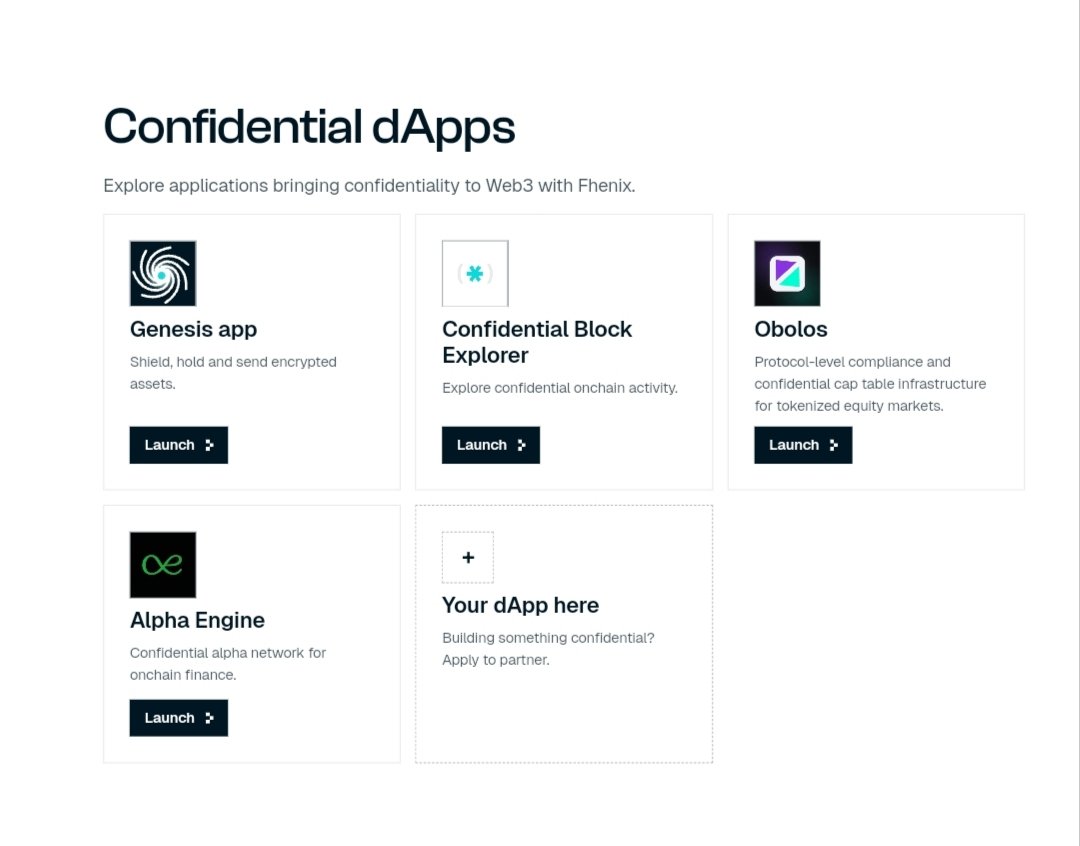
Look at the ecosystem taking shape:
🔹 Genesis — confidential assets and private transfers.
🔹 Confidential Block Explorer — exploring onchain activity.
🔹 Obolos — confidential infrastructure for tokenized equity markets.
🔹 Alpha Engine — confidential onchain finance.
Each project explores a different use case, expanding the possibilities of privacy-preserving applications. The bigger opportunity is ecosystem growth: more developers experimenting, more applications launching, and more real-world use cases emerging around Fully Homomorphic Encryption (FHE).
Strong infrastructure creates possibilities. Builders turn those possibilities into an ecosystem.
Fhenix is building the foundation. The next chapter depends on what developers create with it.
@0xkeksgiven@Asterix54907294@deivonchain
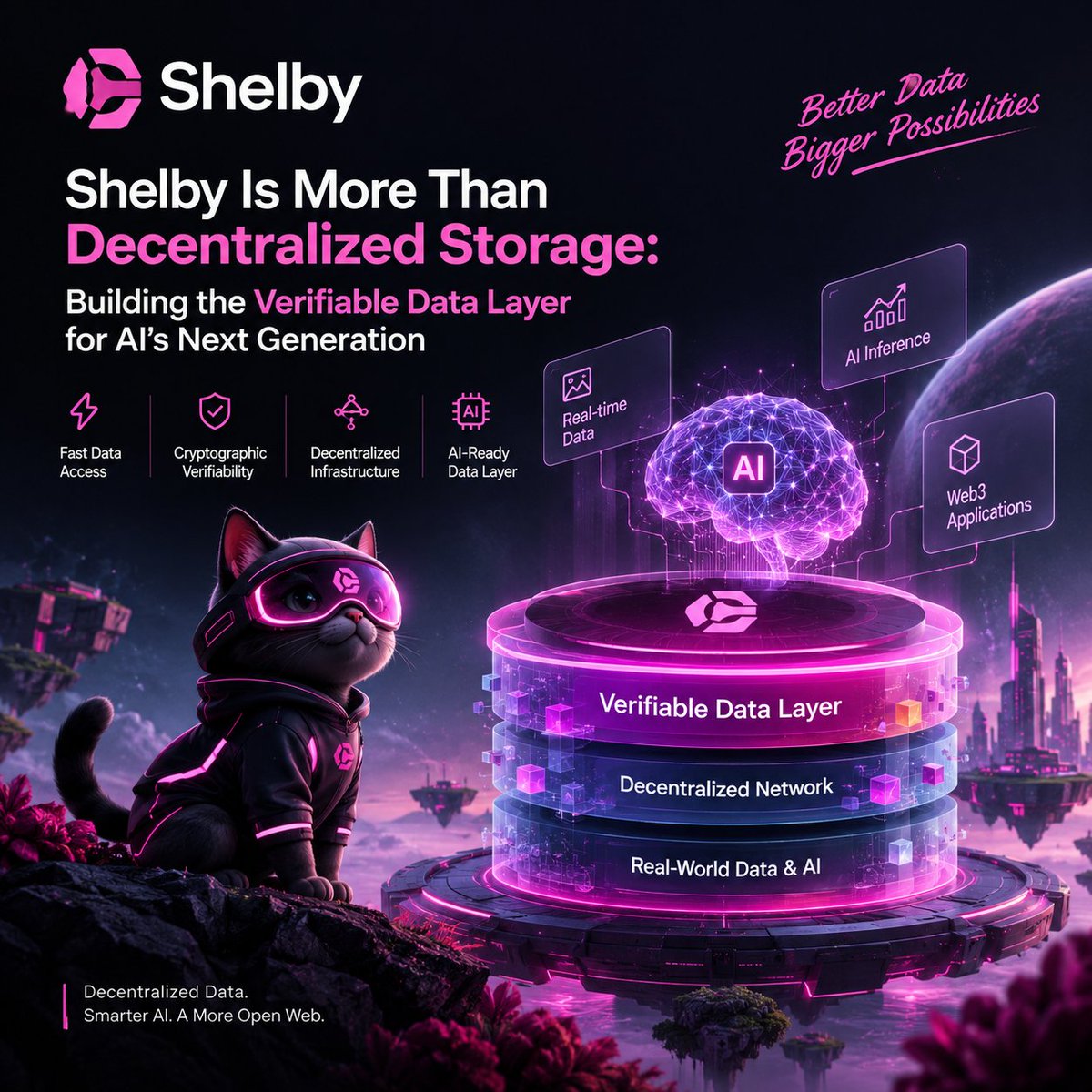
Shelby Is More Than Decentralized Storage. It’s Building the Verifiable Data Layer for AI’s Next Generation.
AI is evolving rapidly, but intelligence alone isn’t enough. Modern AI systems need fast data access, reliable information, and infrastructure that can support increasingly demanding workloads.
That’s where @shelbyserves stands out.
By focusing on high-performance decentralized storage, efficient data retrieval, and cryptographic verifiability, Shelby aims to make data more accessible and trustworthy for AI and Web3 applications.
Think about AI inference, real-time applications, streaming, and data-intensive workloads. In these environments, storing information is only one part of the challenge. Getting the right data quickly and verifying its integrity can be just as important.
Shelby’s vision goes beyond keeping files online. It’s about building a data infrastructure where developers can access the information their applications need without treating storage as an isolated component.
Decentralized data. Verifiable access. Infrastructure built for intelligent applications.
The next generation of AI won’t be defined by models alone. The infrastructure powering their access to data will matter just as much.
And that’s why Shelby deserves attention. @shelbyserves@affinity_matrix