Anthropic engineer, Addy Osmani (ex-Google):
"Google hired me at $500K–$1.2M a year because I know how to make AI agents write code that doesn’t break."
In this 41-minute workshop he shows exactly how to build that system from scratch.
Prompts → Agent Skills → Harness → Agents That Ship Without You
step 1 → Refine the idea - drop in a vague thought, the agent interviews you and comes back with 3 directions
step 2 → Write the spec - success criteria, stack and open questions locked before a single line of code
step 3 → Plan in small tasks - each one gets acceptance criteria and a list of files it's allowed to touch
step 4 → Build test-first - red to green, slice by slice, so nothing that already works breaks
step 5 → Verify and review - the agent opens the app in a browser, checks security and simplifies its own code
He open-sourced all 24 skills, and the repo is close to 100K stars
Google calls this "agentic engineering"
Most people spend weeks building this by hand
You don't have to
Bookmark it and watch it tonight
Then read the full Opus 5.5 harness engineering guide below ↓
Introducing @𝚓𝚜𝚘𝚗-𝚛𝚎𝚗𝚍𝚎𝚛/𝚌𝚑𝚊𝚝
Generative UI for Slack, Teams and more
→ Agents reply with native cards
→ Tables, fields, charts and buttons
→ Streams in as the model writes
→ One catalog for every Chat SDK platform
Just found Jev.
Jev looks at the page, sees the real buttons, and just picks: click this one, type here, scroll, wait, or done.
- Click this
- Scroll down
- Type this
- Buy / sell
- Retry or stop
- Send the job to another agent
That’s it.
This is useful for:
• Browser agents that need to be fast
• Auto QA
• Trading loops
• Agent routing
• Games / robots
• Anything where the AI has to choose an action over and over.
The real trick is splitting thinking from “what do I do next”. Big model does the hard thinking. And the small fast model just picks the next click.
Still looking into it, so forgive me for any false claims.
Open source here:
https://t.co/cpTZEEVU4y
Introducing Inspo.
A design MCP server for Claude Code, Codex, and OpenCode.
It searches 800+ beautiful websites and finds relevant design inspiration for your coding agent.
Install → npx inspo-mcp install
next week, I will introduce https://t.co/NIfR4ZjV1u
inspired by T3 Code and Cursor automations
harness wrappers are not new; but this is different
you can schedule your tasks, act on webhooks or just start a run manually
thats nice tho but for me thats not it
for me the goal was to create a clean clutterfree UI
i tried to make the UI as peaceful as possible
my ADHD brain panics everytime Claude returns a wall of text
but now i find it fascinating to read it, go back and forth with the agent and dive deeper instead of just generating code fast
i find that reading the agent output has actually become quite enjoyable and engaging
so yes the idea is not new; but i think OpenRun will bring some joy to others as well
try it for free; https://t.co/NIfR4ZjV1u
and btw its open source; https://t.co/IaoYMSOv63
WTF Broooooooo???? .... This feels like a goldmine for vibe coders 🌋
It's a collection of free UI prompts for things like hero sections, pricing pages, auth screens, bento grids, dashboards, and more.
You can copy a prompt and give it to your AI coding agent to generate better-looking, less generic UI without having to describe every design detail yourself.
Perfect if you build websites with AI and want your UIs to stand out :)
Follow me for more amazing Coding, AI & Web Development insights 💎
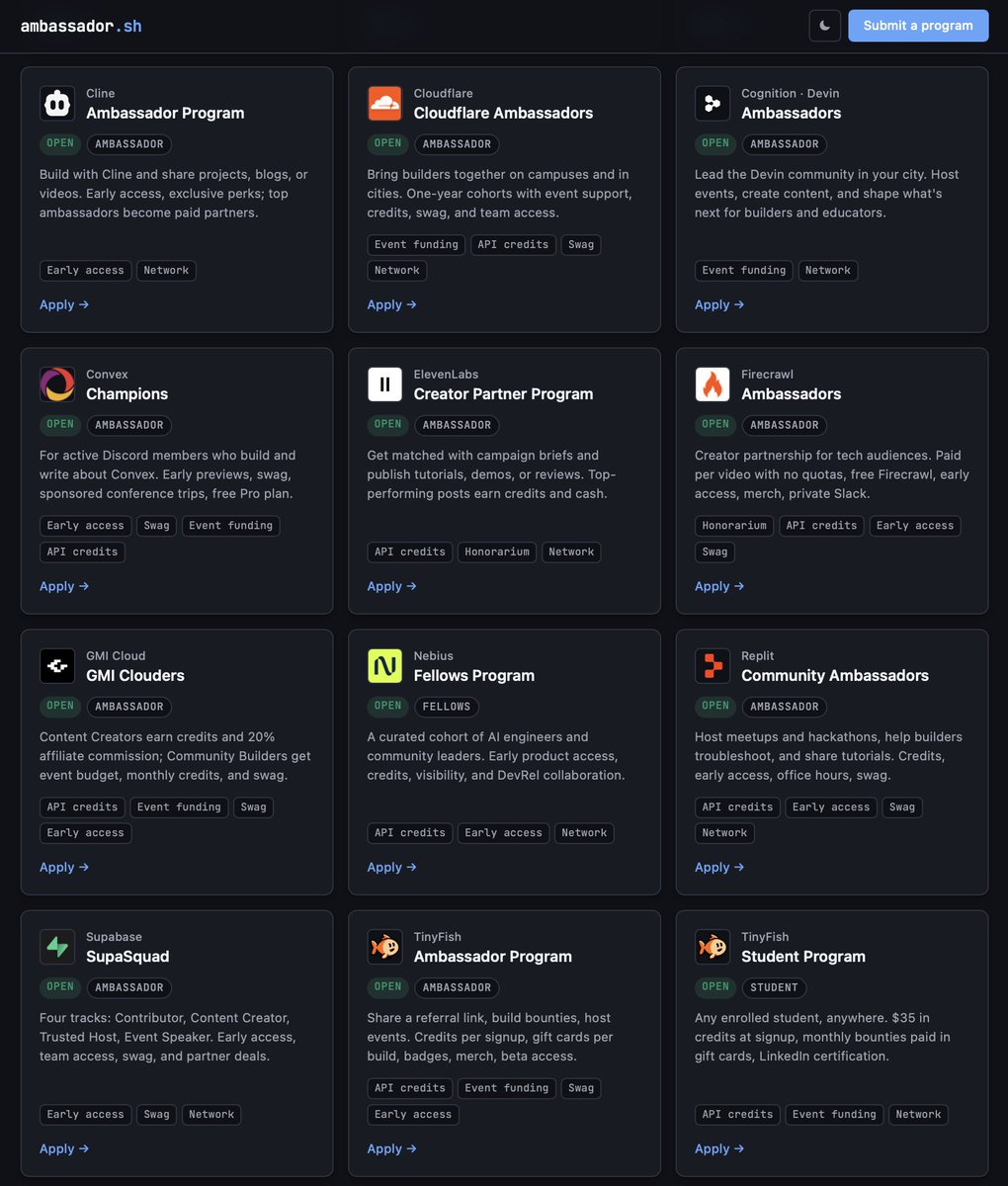
Bookmark this website:
Over 1M developers use it to replace paid SaaS with open-source alternatives.
Every tool you pay for has a free, self-hostable version out there. The problem is finding it. Most of them are buried in random GitHub READMEs, Reddit threads, or blog posts nobody reads.
OpenAlternative fixes that.
It's a curated directory of open-source alternatives to popular SaaS products, with 12K+ subscribers and hundreds of tools ranked by GitHub stars, license, and last commit.
A few picks from what's trending right now:
- Postiz (34K stars) replaces Buffer
- Cap (21K stars) replaces Screen Studio
- Ollama (179K stars) replaces LM Studio
- n8n (200K stars) replaces Make
- Firecrawl (170K stars) replaces Jina
- Supabase (108K stars) replaces Firebase
- Excalidraw (130K stars) replaces Miro
You can filter by category, tech stack, license, or "self-hostable only."
There's also a new AI-native collection that only lists open-source alternatives to AI tools like Claude, Claude Code, Wispr Flow, and more.
The site itself is open-source too.
Check it out: https://t.co/rqhB5LdQgR
This is a long post so here's the TL;DR:
Anthropic's recent bulletin warning against unauthorized stock sales and SPVs is an understandable reaction to serious chaos in the private markets.
Why is this happening? $10B+ rounds are too big for any single fund to lead off its balance sheet. The capital must come from direct allocators (family offices, RIAs, endowments, etc.), but it's overwhelming for Anthropic to deal with them all, which naturally brings SPVs into the picture.
Specifically, starting in 2025: as Anthropic's rounds ballooned ($13B → $40B → $50B), the company kept heating up from a PR standpoint, and growth continued at >10x / yr(!), two things happened: allocators started getting even more FOMO, and intermediaries (brokers, GPs, and even multi-family offices) piled in to get a small piece of an absolutely massive large fee pool. Even a 3% commission on a single $500M transaction is a decade's worth of income to a broker. A 1% annual management fee on a $1B SPV is bigger than the entire firm economics for most managers.
We're seeing unprecedented fees even for institutional transactions (10-20% on tens of billions of dollars). I've never seen anything like it in my 11 years in the space. Multi-layer SPVs (L2s, L3s), unregistered brokers, and daisy-chained intermediaries have become the norm. Even legitimate people in the ecosystem are having chats with "a guy who knows a guy."
However, I fear the language in their bulletin might have a number of unintended consequences:
• The bulletin lumps together four very different things — legitimate past SPVs, annoying-but-legal share shopping, contract-violating synthetic exposure, and outright fraud.
• It also tries to retroactively claim that all past SPVs are invalid (which is odd, since many, many SPVs have previously been approved by the Board)
• They don't offer a permitted path, which risks pushing activity into the shadows.
The better playbook: SpaceX and Anduril have shown how to do this — bless a small set of approved sponsors, ban sub-syndication and nested vehicles, potentially cap fees, enforce consistently, and provide a clear golden path rather than a blanket ban.
I took the liberty (presumptuous, I know) of proposing what Anthropic could have said that might have helped dispel confusion. Read on if you'd like to check out the full breakdown!