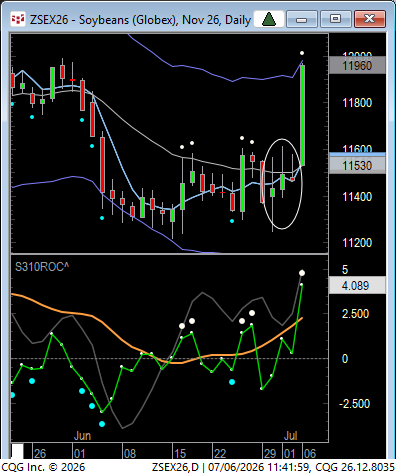
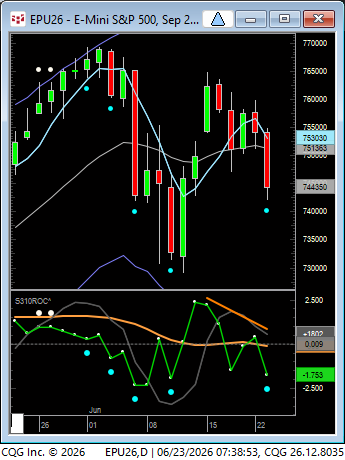
I hope my chart examples thee past few weeks show how much can be done with simply structure (swing highs and lows), combining time frames, and levels (horizontal lines). No gimmicky indicators, no Fibonacci, no Elliot wave, just preparation and KISS. x x x
@LindaRaschke I’m glad you posted this as I always describe myself as a swing trader and people always presume I hold for days when most often it’s a few hours
Swing trading has nothing to do with holding times. You can swing trade on a 5 or 60 minute chart, a Daily or a Weekly. It's trading one swing at a time, using the structure of that time frame, and not projecting multiple waves forward or making "ego" calls.
This was a big trading week for many of us. If you made money, I suggest you take it out of your trading accounts and properly fund your tax account. Trading to grow my personal accounts, not my trading account.
If you want to trade bigger size do so after consistent weeks, but don’t do it just cause you have extra money in your account, it’s a passport to poverty. When it comes time for you to increase your unit size, I found it best to add money that I have earned back into my trading account.
Remember, we are small business owners so we must properly maintain our tax accounts. I am not an accountant, so please consult one that specializes in futures. However, what I suggest you do is put away at least 30% of everything you take out of your trading account into an into a different account that you call “your tax account”. I maintain my tax accounts at a different bank that I maintain my personal account in so that I don’t mess with my tax account.
Proper account management is very important to a long-term profitable career. I don’t see many people talk about it. Please consult a CPA.
Have a great day and a blessed weekend same thing
Newer traders should stay on shorter time frames. Practice execution, practice being nimble in your bias. Time in the market = risk. Get in and after you exit and are flat, there is zero risk. Fewer trades = better. Too easy to get snowblind in the afternoon.
99% of options traders are gambling because they never learned the fundamentals.
This 1-hour Yale lecture changes everything.
In just 60 minutes, you’ll learn more about options trading than most overpriced trading courses ever teach.
No hype. No fake gurus. Just real knowledge.
Book Mark it!!!
Pradeep Bonde (@PradeepBonde), founder of Stockbee, is a mentor to market wizards.
He obsesses over magnitude moves, not duration.
His focus: short, aggressive bursts for maximum impact.
Here's his full playbook in 10 clips 🧵👇
" How to Understand the Market Monitor" spreadsheet is a question I get daily from those with no background in how market breadth works.
https://t.co/pgW8T75HBO
Market breadth is a daily measure of underlying buying or selling pressure. It measures funds buying and selling.
Number one criteria is how many funds own the stock and second how popular it is amongst the Twitter influencers and newsletter writers, it is not about chart pattern only. You need it to be on everyone else radar to buy in next few days
@dxyjay Nothing to discuss that Taylor doesn't already say in his book. It's not a hard science. Do your homework on a walk forward basis. then its only a matter of time that you will be within 70% of predicting the directional bias for the next day or the play of the day,
Learned this rule on the floor 45 years ago and it still holds true 90% of the time (or so it seems): "If a stock does not trade into its GAP area the next 4 days, it can continue in the direction of the gap for 2 weeks. can see how this worked perfecetly the past two months on big blue!
Most traders don't fail because they lack knowledge.
They fail because they don't have rules.
After more than 20 years in the market, I've learned that consistency isn't built on predictions. It's built on doing the same things over and over, regardless of fear, greed or market noise.
My 10 trading rules guide every decision I make 👇
• How I select stocks
• How I manage risk
• How I hold winners
• How I protect profits
• When I stay out of the market
These rules have saved me from countless expensive mistakes.
The biggest lesson? 👉 The market doesn't reward intelligence.
It rewards discipline.
Rules won't eliminate losses.
They will stop small mistakes from becoming account-destroying ones.
What trading rule has had the biggest impact on your results?
I studied economics.
One principle I learned there sounds logical. In trading, I found the exact opposite to be true:
👉 The less I focused on money, the more money I made.
Here's why 👇
1) Money creates emotional decisions
The moment your account balance becomes your main focus, emotions start taking over. You hesitate before entering a trade, sell winners too early, hold losers because you don't want to realize a loss and force mediocre setups because you feel the need to make money today.
Money represents security, freedom and your future. That's why losing it feels so personal. The problem is that emotions and good execution rarely go together.
Instead of focusing on making money, focus on making good decisions.
2) Your account size isn't the real problem
Many traders believe they would become profitable if they only had a larger account.
I don't think that's true.
A small account often leads to overtrading because you want faster results. A large account creates different challenges such as liquidity, position sizing and handling much larger dollar swings.
The account changes.
The psychological challenges remain.
Your process matters far more than the size of your account.
3) Focus on what you can control
Trading is a game of probabilities. I cannot control whether my next trade will be a winner or a loser.
What I can control is my execution:
• Did I wait for an A+ setup?
• Did I follow my entry rules?
• Did I size the position correctly?
• Did I respect my stop loss?
• Did I execute exactly as planned?
Professional traders focus on execution because execution is what creates consistent results over hundreds of trades.
4) Judge yourself by the quality of your trades
One of the biggest mindset shifts in my career was separating a good trade from a profitable trade.
A profitable trade can still be a bad trade if I ignored my rules. A losing trade can be an excellent trade if it fulfilled every criterion in my system.
My goal is no longer to make money on every trade.
My goal is to make as few mistakes as possible. High-quality execution leads to high-quality trading, and over time that usually leads to better performance.
5) Money is the scoreboard
I think about trading like sports.
The scoreboard tells you how well you're doing, but it isn't what you should focus on while you're playing. If you constantly look at the score, you stop concentrating on executing the next play.
Trading works exactly the same way.
If I constantly think about how much money I'm making—or how much I might lose—I become emotional. If I see money as nothing more than the scoreboard, I can stay focused on what really matters: following my process.
The biggest turning point in my career came when I stopped chasing money and started chasing flawless execution.
Once I became obsessed with following my process instead of watching my P&L, my trading became calmer, more consistent and far more profitable.
The money was never the goal – it was always the by-product of executing a great process.
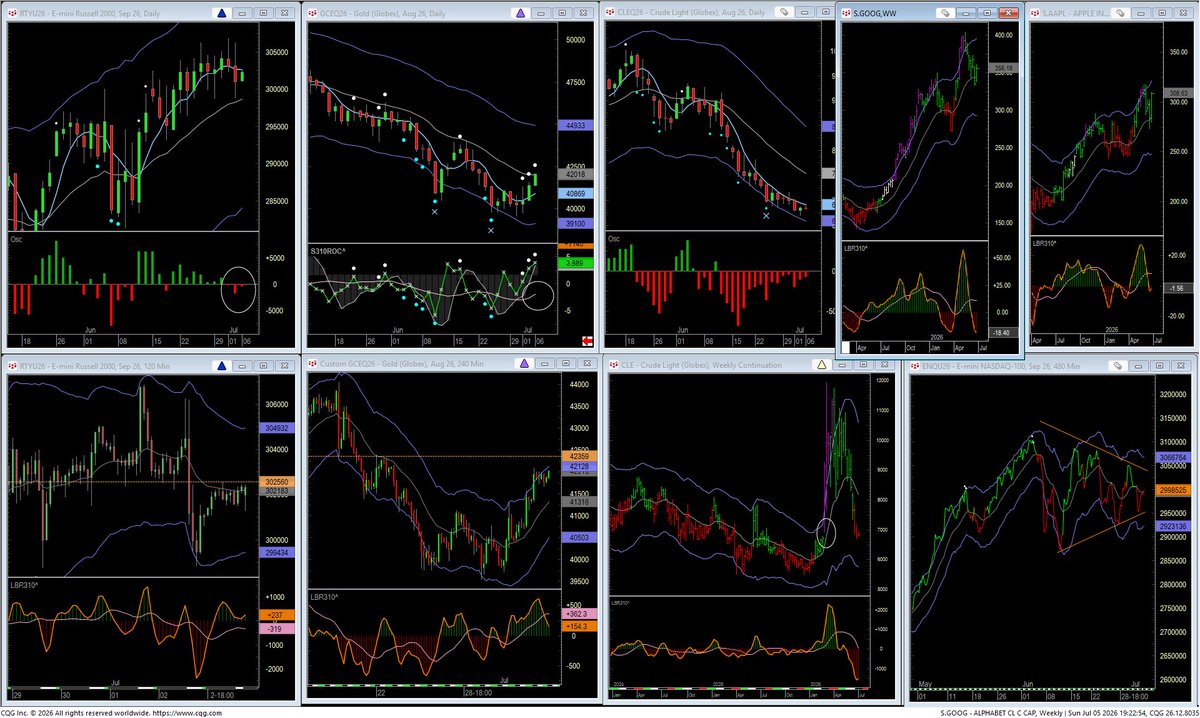
RUS: On 5 SMA Buy, Gold- stay w long-side bias till daily slow line gets above 0, Crude: on X-tended run (16 closes below -stay w short bias...first close back above is still a short), Weekly Buys in shares like GOOG/AAPL can pull NAZ futures out of triangular consolidation.
4 Entry Types Every Swing Trader Should Know
1. PDH Entry
Price moves above the Previous Day’s High. It shows strength continuing from the last session.
2. Pullback Entry Buying a stock that’s already leading when it dips to an EMA, trendline, or support zone. The pullback should be controlled, not aggressive.
3. Pivot Break Entry
Price breaks a level that has been rejected multiple times. This suggests sellers at that level are finally out of the way. A clean breakout candle usually confirms it.
4. Anticipation Entry
Entering slightly before a breakout, usually inside a tight consolidation on a day where price has gone pretty tight, at EOD. The structure should already be strong so the breakout has a higher chance of happening. Gives better risk–reward.
In practical ways if you want to change beliefs :
Acquire new information contrary to your belief system. (e.g. how can some trade without MA)
Deep dive and deep reflection ( study every stock that went up 50% plus in less than 2 months in the last 3 years, see where the move started, how it started, how many days, what sector, and so on)
Engage with people hostile to your beliefs
Join an organization, a club, or forums that challenge your beliefs
Geographical relocation or travel
Find good mentors
Do a course in a renowned institution
Asia opening starts the day more often than not and Sell divergences on short term momentum functions were the primary technicals. Could see this play forming yesterday... ;-)