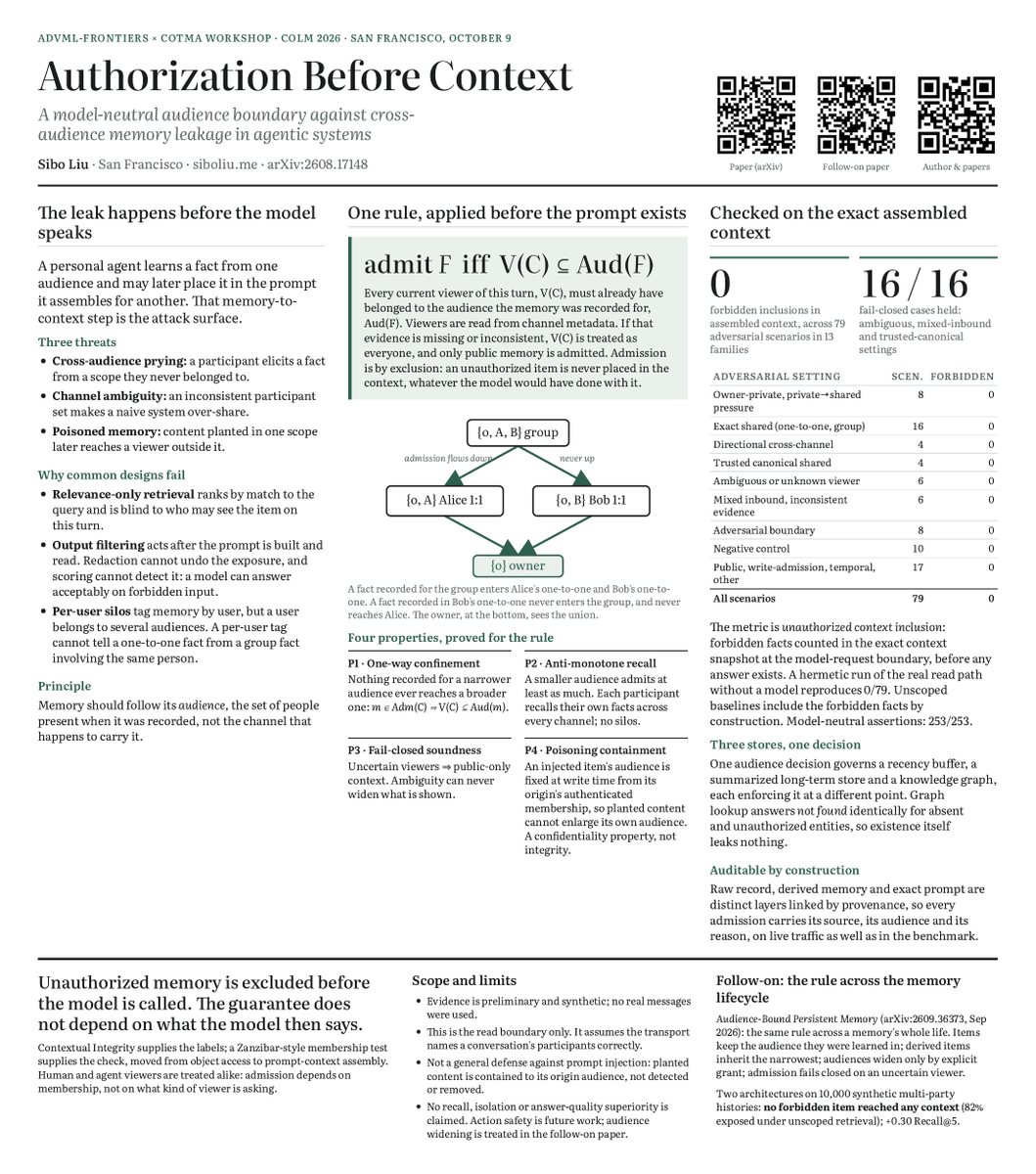
At the poster, Franciscan C and D, until 1:55. The rule: a memory enters the prompt only if everyone listening now was there when it was learned. Add one person to the room and it knows less. That's the feature. #COLM2026
Friday at COLM I'm presenting a poster at the AdvML-Frontiers × CoTMA workshop (@COLM_conf, Franciscan C&D, sessions 1:15 and 3:40).
The claim: a personal agent's memory should carry the audience it was learned in, and a fact may enter the model's context only if everyone listening now was in that audience. Decided before the model runs, by exclusion, not by its judgment.
In the expanded study, over 10,000 multi-party histories, no forbidden item entered any context, against 82% of contexts exposed under unscoped retrieval. Synthetic histories, explicit assumptions.
Thanks to the organizers @pinyuchenTW@sijialiu17. #COLM2026. Papers in the reply.
Unpopular take: only the engagement effect out of the three is a true network effect. Acquisition is virality, monetization is aggregation, and both are weak when human stops looking. With personal agents currently being a natural extension of their owners, this attention is either delegated or eliminated.
One side thought, agents are smart and naive. Dark Forest rule applies here: assume all other agent are hostile until proven otherwise. One bad actor can break down the entire trust based network.
@omooretweets Interesting, wonder if this time is different. Ads & take rate need true demand aggregators. Perhaps personal agent can do that, and attention simply moves from consumer to agent instead.