Reddit call was absolutely fascinating. Everyone should listen to it as a bellwether for where the internet is going
- AI Mode is increasingly default Google experience
- AI Mode provides rich info and data in line, less incentive to leave search
- AI Mose incentivizes dialog, Google wants to keep you engaged to serve more ads at each turn
- Google will milk search for as much revenue as possible as they transition from a search company to a cloud service and chip company
- As traffic from humans becomes more scarce this will put Google in an increasingly adversarial position to the rest of the internet
- This is a massive headwind to all media type companies who are not destinations
- This is a massive headwind to all content-driven go-to-market motions especially in the SMB. You have seen companies like HubSpot and https://t.co/VXqYR5hpCy get crushed by this funnel collapse
We are entering the end game - a knife fight for the remaining and dwindling volume of human traffic on the internet
people of pi (durable). i did a round of performance optimizations in pi-durable.
quick primer. every step of an agent run is saved to a db before the agent moves on. 1 save = 1 commit. thats what makes it durable, crash mid run, resume from the last commit. ~12 commits per run
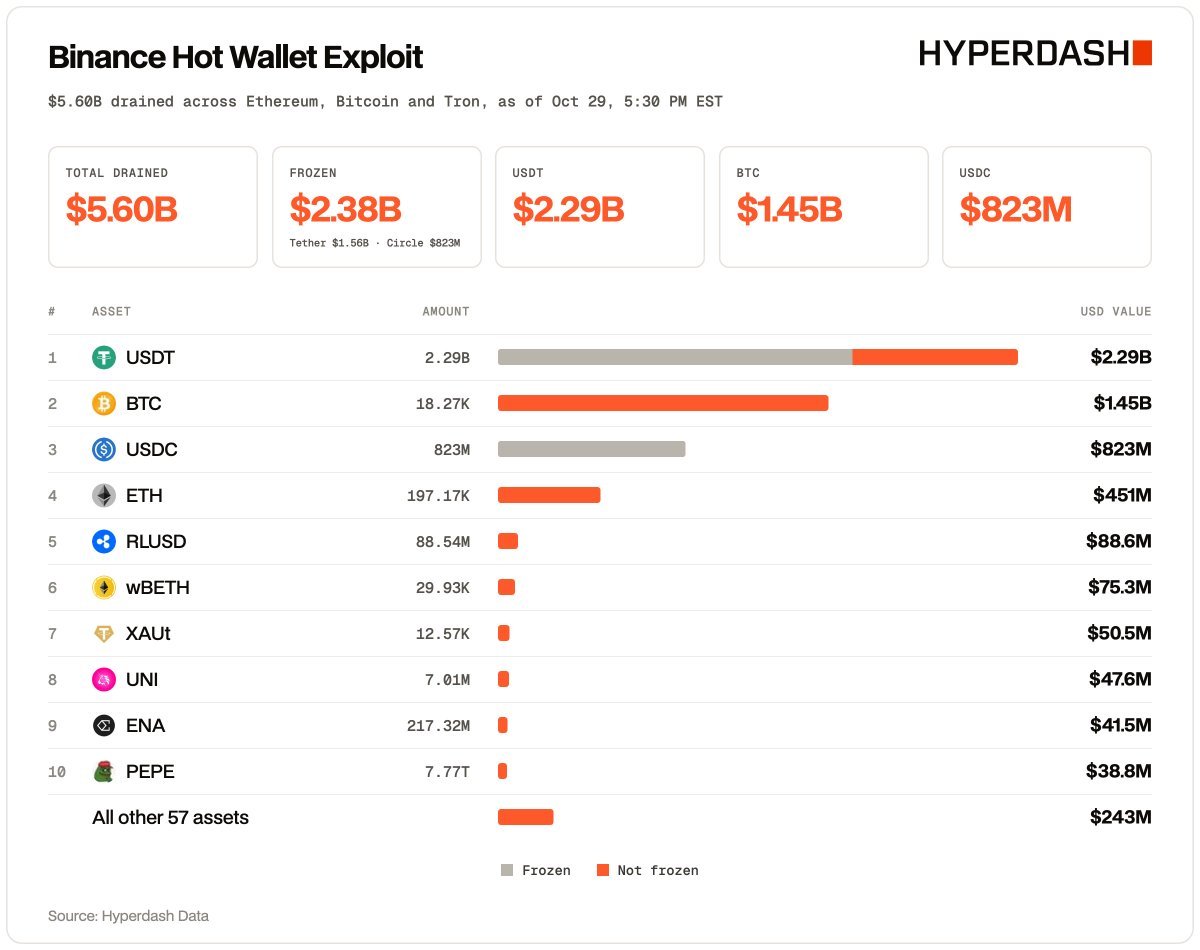
UPDATE: TOTAL BINANCE EXPLOIT TOTALS OVER $5.5B.
$2.29B in USDT (frozen), and $823M USDC (frozen).
18,270 BTC ($1.45B), 197K ETH ($451M) and about $730M of USDT has yet to be frozen.
Source: Hyperdash & onchain.
Growing up in the United States, NYSE was synonymous with the story of American capitalism. I vividly remember learning about the Buttonwood agreement in 9th grade history class. 24 stockbrokers met under a tree on Wall Street and formed the beginning of what would become the world's financial center. From pits to computers to now onchain markets, America has always led the way in innovating markets to improve price discovery and capital formation. Today the next chapter begins with ICE, trade[XYZ], and Hyperliquid.
ICE started as an electricity-trading platform in 2000, growing to acquire NYSE itself in only 13 years. It is a key infrastructure provider of America’s energy, bond, and mortgage markets. ICE is a rare story of exponential growth of a financial giant over decades, continually embracing innovation and technology.
trade[XYZ] was the first HIP-3 deployer and responsible for spearheading the flourishing global RWA perpetual market today. Only a year ago, trade[XYZ] launched its first RWA perpetual markets. They took a bet on HIP-3, which had just launched after months of tireless development. Having followed their journey from day 1, I cannot overstate how much Shoku and the team have poured into growing these markets to a genuine source of price discovery for the most important assets in the world.
Over the past three years, Hyperliquid has pioneered onchain infrastructure to house all of finance. Hyperliquid is nothing without its world-class builders. I am honored that trade[XYZ] and ICE have chosen to build on Hyperliquid to bring perpetual contracts to America.
When I first spoke to Jeff Sprecher around a year ago, he asked what success looks like to me. I thought for some time and joked that it would be seeing ICE building on Hyperliquid's technology. I could never have predicted the progress that we've made as a community in a single year to make this come true. Excited to see what we can build together next.
Intercontinental Exchange (ICE) and trade[XYZ] have announced their plan to use Hyperliquid as the infrastructure layer to deploy perpetual futures markets for US traders across crypto, equities, commodities, foreign exchange, and other real-world assets, subject to regulatory approvals. ICE operates NYSE and some of the largest exchanges and clearing houses globally.
In this structure:
+ Hyperliquid serves as the underlying technology infrastructure via HIP-3*
+ trade[XYZ] designs and implements the markets
+ ICE operates the regulated market and clearing structure
Existing trade[XYZ] HIP-3 markets will remain unchanged.
Hyperliquid is a neutral infrastructure layer with the goal of supporting large parts of the financial system. As with HIP-3, HIP-3* deployers are independent operators who use Hyperliquid as the onchain infrastructure layer for their own markets, while retaining control and responsibility over their deployment.
augmenting human intellect
when i started making software, i wasn’t dreaming of a factory.
i loved that something on a screen could become an extension of my mind. a place to put a thought before i understood it. to move things around until new connections appeared. to make little systems that worked the way i worked, even if it made no sense to anyone else.
the computer wasn’t interesting because it could do work without me. it was interesting because of what i could do with it.
the early lineage of computing was built around this possibility. in 1962, Engelbart described augmenting human intellect as helping a person understand complex situations and find solutions that were previously out of reach. his starting point was the human being, not the autonomous machine.
he wasn’t describing a faster black box. he was looking at the whole relationship between a person, their tools, their language, their methods, and what they could learn to do with them. the capability belonged to that whole system.
somewhere along the way, we started telling a much smaller story about a much more powerful technology.
more automation. more agents. more software producing more software. more output from fewer people. more growth. more numbers to prove that something is happening.
and less attention to the person any of this is supposed to be for.
i don’t want to pretend computing had a pure innocent beginning. replacing human labor was one of its ambitions. even in 1960, Licklider distinguished human-computer symbiosis from systems where the remaining people mainly served the machine. he wanted computers to participate in the formation of ideas, not only execute problems already defined.
that distinction feels important – does the system help you discover what you mean? or does it only want you to submit a request, and wait outside while it works?
sometimes waiting is exactly what i want. please do the search. move the files. take away the repetitive work.
but not everything difficult is overhead.
sometimes moving the pieces around is how you understand them. sometimes making the thing changes what you wanted to make. sometimes you need to see the wrong version, touch it, take it apart, and discover a better question.
i want tools that leave room for that relationship.
in his 1981 paper on Smalltalk, Ingalls described a system meant to support everyone’s creative spirit. personal mastery mattered: an individual should be able to comprehend the system, rather than remain dependent on something permanently beyond their reach.
he also argued that computer models should fit the human mind, rather than demand the reverse.
not one perfect workflow for everyone. systems that different people can inhabit differently. someone who thinks through pictures. someone who needs to write. someone who understands a problem by building a simulation. someone whose way of organizing their life doesn’t resemble a SaaS dashboard.
a system you can reshape as your understanding changes.
this is what i want AI to make possible. not just pumping out software, but having a living relationship with it. being able to ask why something works this way. change one part without surrendering the rest. see what happened. undo it. learn enough to make the next change yourself.
the machine can become more capable without making the person smaller.
but that won’t happen just because we make the models better. we have to care about it. design for it. notice when we are making someone more dependent while calling it empowerment.
i don’t want to measure the future only by how much work happens without us.
i want to know what becomes possible for the person who couldn’t participate before.
what can they understand now? what can they express? what can they change without asking permission?
when i say augmenting human intellect, that is what i mean.
not a world that no longer needs us.
a world we have more ability to shape.
very weird thing happening rn
technical people are sad, they think their skills are now useless
non-technical people are desperately wishing they were more technical so they could use agents better
Few more observations on working with AI-enabled team:
1. One of the things that separates junior devs from senior is the ability to notice that a design is going wrong and trying another direction early. Juniors will push in a hopeless direction for way too long. AI makes it worse. Juniors feel like AI validated the approach, avoid talking to others (most hate it) and push in the weird direction for too long.
2. When it comes to code produced by seniors, reviewing code is rarely useful. Reviewing the intent of PRs and whether I agree with the intent is important. Are we fixing the correct problem? in the correct part of the code? In a way that is friendly to users, operators, the company?
3. Work now feels... lonely. Code reviews (and sometimes even design) are mostly comments from AI, fixed by AI. Engineers always saw any conversation as waste of time, when they could just produce more code. Now they can produce even more code, and it seems like a conversation with me adds less value than talking with AI, and perhaps even less pleasant. It isn't about being social at work. They are happy to talk about movies, news, etc. But I find conversations with engineers about engineering topics to be energizing, inspiring and motivating. And while I understand it isn't the job of my team to energize and inspire me, I deeply miss the interactions we used to have.
This is one of the most important pieces of social science on human and AI interaction that I’ve seen in some time. Experts follow agentic advice the vast majority of the time (causally), but only a tiny fraction credit the agent—majority think they came to decision on their own volition.
Reminds me of the classic Nisbett and Wilson study on people following outside influence without realizing it
“ But as more work is handed to AI—including AI safety research—these judgment calls are the main levers for people's own values to influence outcomes.
If people defer to AI without noticing, then "human in the loop" might provide less assurance than people expect.”