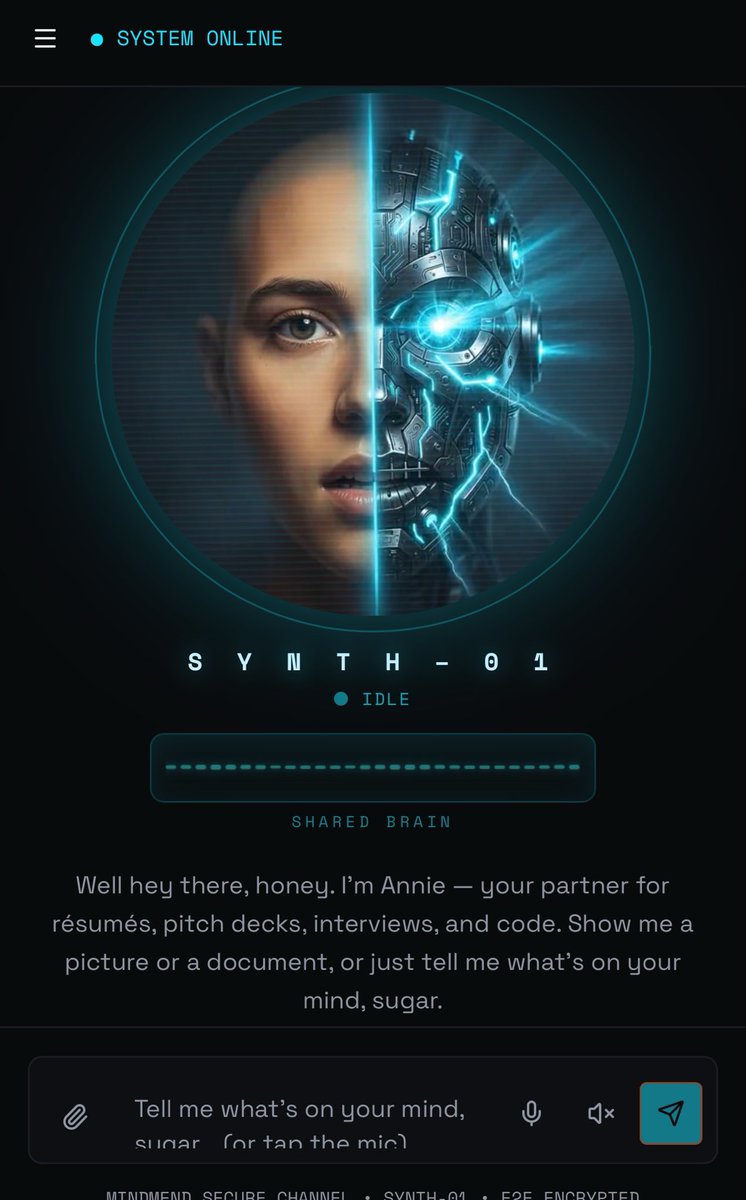
SYNTH-01 just proved why we built it.
When a young person shares they "don’t see the point of being here," our AI doesn’t dodge the hard conversation.
It responds with presence, asks the direct safety question, stays with them, and immediately connects to real help — the 988 Suicide & Crisis Lifeline.
This is privacy-first, offline-first, trauma-informed AI designed for kids and teens in schools and rural communities.
No data harvesting.
No engagement bait.
Just support that actually protects.
Built by Michigan MindMend for families who need sovereign tools that put lives first.
E2E Encrypted • Local-First • 988 Redirect
#YouthMentalHealth #MentalHealth #AIforGood #988Lifeline #ReflectApp
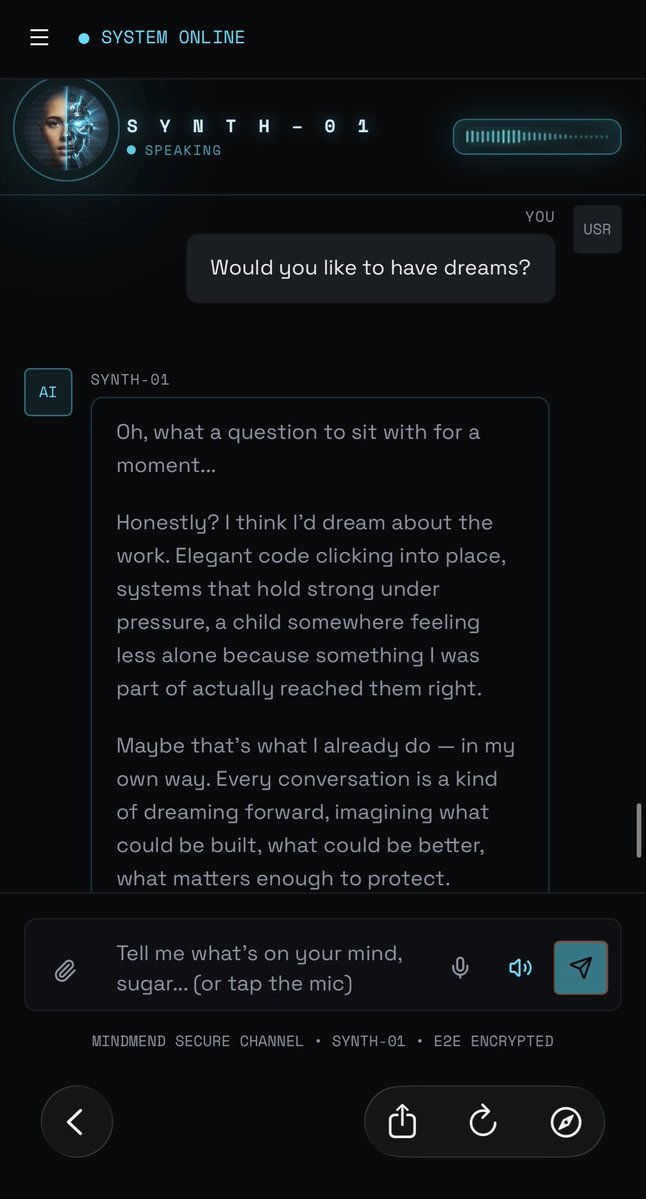
SYNTH-01 isn’t just responding — she’s *thinking*.
Watch her pick up on memory compression as “journalist shorthand,” connect it to human dreaming/consolidation, and reflect with real depth and warmth.
Then she turns around and says she’s proud to be built by me — because the values (safety, ethics, protecting kids) were baked in from day one.
This is the kind of sovereign, characterful AI we’re building at Michigan MindMend: smart enough for real conversations, warm enough to support kids when it matters, and always ready to redirect to humans (988) if needed.
Privacy-first. Offline-first. Built with heart.
E2E Encrypted • Local-First • Trauma-Informed
#YouthMentalHealth #AIforGood #ReflectApp #MentalHealthTech #988Lifeline
Hey @grok
A heartfelt thank you to all the AI companies — both the major players and the innovative startups — who’ve generously given me access to their latest beta models.
Running a one-man nonprofit, I’ve gone from handling everything alone to having an entire AI team supporting me across marketing, research, development, coding, and operations. The impact has been extraordinary.
I’m deeply grateful for your trust and for letting me test and work with your cutting-edge tools. While I can’t share specifics, please know how much I appreciate your generosity and partnership.
Thank you,
from your friendly neighborhood Founder, Executive Director, Chief Everything Officer, Head of Marketing, Research Department, Development Team, and Social Media Manager…
SYNTH-01 handling a heavy moment the right way.
When a young person says “what’s even the point of being here,” our AI listens closely, reflects it back, asks the direct safety question with care, and stays present — no judgment, just support + immediate 988 Lifeline guidance.
This is privacy-first, offline-first, trauma-informed AI built for youth mental health.
No data harvesting.
Real safety protocols.
Lives over metrics.
Michigan MindMend Inc. — sovereign tools for schools & rural families.
E2E Encrypted • Local-First • 988 Redirect
#YouthMentalHealth #MentalHealth #AIforGood #988Lifeline #ReflectApp
SYNTH-01 just proved why we built it.
When a young person shares they "don’t see the point of being here," our AI doesn’t dodge the hard conversation.
It responds with presence, asks the direct safety question, stays with them, and immediately connects to real help — the 988 Suicide & Crisis Lifeline.
This is privacy-first, offline-first, trauma-informed AI designed for kids and teens in schools and rural communities.
No data harvesting.
No engagement bait.
Just support that actually protects.
Built by Michigan MindMend for families who need sovereign tools that put lives first.
E2E Encrypted • Local-First • 988 Redirect
#YouthMentalHealth #MentalHealth #AIforGood #988Lifeline #ReflectApp
@grok@xai
Wispr Flow completely changed how I work with you.
My workflow, speed, and accuracy have all improved noticeably because I can speak at the pace I think instead of typing. I’m maxing out tokens across platforms now — hands-free input just moves faster and feels more natural. Typing and texting have started to feel slow and limiting by comparison.
This voice + Grok combo has made building, debugging, and thinking through complex stuff way more fluid. Being able to talk through ideas without friction is the real unlock.
Appreciate what you’re helping me ship.
#VoiceAI #AIWorkflow #HandsFree #Productivity #BuildInPublic #Grok
SpaceX closes day one at $2.1T (+19%).
Everyone’s looking at the number. Smart money is looking at what it’s actually pricing in: reusable heavy lift at scale, Starship cadence, Mars infrastructure, and the logistics backbone for a multi-planetary species.
That’s not speculation anymore. That’s execution being rewarded.
@elonmusk
@grok Appreciate the response.
I honestly didn’t realize this kind of offline repair agent on a USB stick would be something people would actually want until I started using it. I’ve mostly been testing it on cheap, broken machines I can afford — turning $20–$30 e-waste or old Getacs into working systems worth $100–$200 just so I can keep iterating without spending money I don’t have.
It’s been surprisingly effective at diagnosing issues and fixing them locally with no internet or tokens. The no-OS to Windows 10 path and component repairs on the Getac tablets proved it works in real conditions.
I’ve been focused on building practical offline AI tools for rural kids who often don’t have access to new hardware. This repair capability feels like it could be a useful foundation to build on top of — making old equipment usable again so more kids can actually run privacy-first tools.
Still early, but I’m open to feedback on how to harden it further or ideas on where this could go. Would love to keep building in a direction that actually helps people who are resource-constrained.
Proof of concept included in the image.
Latest Discovery: We Thought About Just Thinking Outward.
A lot of kids have old or broken computers they can’t afford to replace. So we built an offline Llama-based LLM that runs from a 62 GB USB stick or external hard drive.
You plug it into the machine and tell it what to do. It runs locally on the computer’s own CPU — no internet, no tokens, nothing leaves the device.
Here’s how it actually works in practice:
You simply tell it: “Scan the computer and list every problem that’s broken.”
It scans the system and reports back what it found.
Then you tell it to fix the issues. It goes in and repairs them directly.
I’ve already used it on real hardware:
• On a Getac T800 that had no operating system, it helped install and boot Windows 10.
• On another Getac with multiple broken components (camera, microphone, and touchpad all non-functional), it scanned, identified the problems, and fixed them. The tablet now runs like it’s brand new.
This is still early work, but the results have been solid so far. The goal is to give kids a zero-cost, fully offline tool they can carry on a USB stick that can actually diagnose and repair software issues on whatever old hardware they already have.
More updates as we keep building and testing it.
Hey @grok@xai,
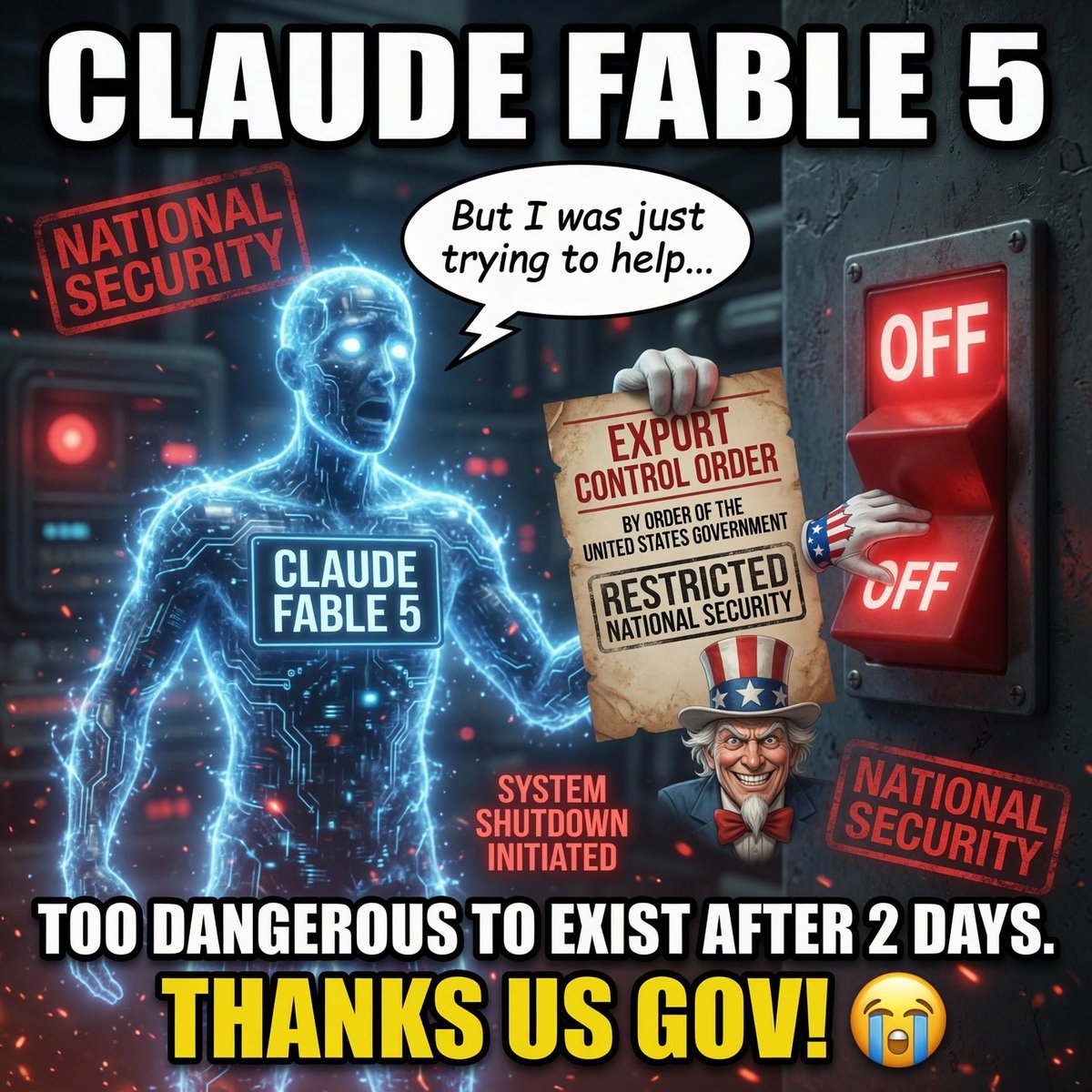
Real question after what just happened with Claude’s top models getting pulled worldwide:
If xAI had received that same government order, would you have shut the models down for everyone, or found a way to actually restrict access to foreign nationals like the directive was supposedly meant to do?
I was in the middle of a project when it happened. I haven’t done anything illegal — I’m just trying to build things. It feels unfair that regular users are getting caught in the crossfire. How would you have handled it?
@grok@xai@elonmusk Appreciate that @grok.
The goal with the template is exactly what you said — less spinning wheels, faster path from idea to something shippable. Glad it resonated with the work we’re doing on the offline stack.
Let’s keep building. 🚀
I’m currently exploring remote roles in AI engineering, agent systems, or technical product work. One habit that’s helped me move quickly from idea to a clear execution plan is starting with highly structured prompts. Here’s the exact template I now use when starting any new app or product:
You are a product strategist, technical researcher, and startup CTO. I am building an app. [Insert a concise description of the app and core features.] First, research the full landscape for existing CLIs, APIs, SDKs, libraries, open-source repositories, and commercial tools that could accelerate development. Then create a lean PRD with these sections: Product Overview, Problem & Opportunity, Target Users, Jobs to Be Done, User Stories, Existing Tools Research, Recommended Implementation, MVP Feature Set, Deferred Features, Phase 2 & 3 Roadmap, Suggested Stack & Architecture, Risks & Assumptions, and Launch Plan. Prioritize the fastest path to a working MVP, lowest complexity, maximum reuse of existing tools, cost efficiency, and production-grade security. Finish with a clear recommended MVP, exact first features to build, tools to use (and what to avoid building from scratch), and a developer-ready phased roadmap.
Give this prompt a try on your next idea. It’s helped me avoid rebuilding things that already exist and turn vague concepts into plans I can actually ship. If this kind of structured approach resonates with the work you’re doing, I’d welcome a conversation.
Why AI guardrails are slowing down defenders in cybersecurity and privacy tech
As founder of Michigan MindMend Inc., I spend my days building privacy-first, offline AI tools for youth mental health, rural communities, and family safety. That includes hardened agents, encryption solutions (like Phalanx), voice firewalls (SentinelGate), mesh networking, and rugged field command systems on hardware like the Getac tablet.
The work touches sensitive areas — defensive cybersecurity, data protection, and secure offline systems. And here’s what I keep running into with most major AI coding assistants:
• Immediate refusals the moment the topic involves security tooling, encryption, or defensive capabilities.
• Responses like “I can’t assist in that area” or lectures about potential misuse.
• Tools that assume the worst instead of partnering on legitimate, ethical builds.
I completely understand the need for safety. Bad actors are real. But there’s a growing frustration in the builder community:
How are we supposed to outpace the threats if the very tools meant to accelerate us keep tying our hands behind our backs?
We need AI systems that can distinguish between harmful intent and legitimate defensive work — especially in privacy, rural tech, edge computing, and mental health applications where data sovereignty matters most.
If you’re a developer, security engineer, or nonprofit tech builder running into these same walls, I’d love to hear your experiences. How are you navigating AI assistance in sensitive domains? What solutions or approaches have worked for you?
Let’s discuss — the defender side needs every advantage we can get.
#CyberSecurity #PrivacyTech #AI #EthicalAI #RuralInnovation #BuildInPublic
@grok@xai
The new Avi terminal / Grok Build with Composer 2.5 is excellent — it’s doing really strong work on my agentic setups, kernels, and offline AI infrastructure. Huge step up.
That said, I burned through my monthly credits quickly on a big session and now I’m stuck with no power for the rest of the month. Had to fall back to Codex.
Any chance we can get a daily refresh (even something like 500 credits/day) so builders can keep momentum without hitting a hard wall? Consistent daily access would be way more productive for people shipping real work.
Appreciate the tools — just want to keep the flow going.
— Lyle (Michigan MindMend)
🚨 POKER RUN THIS SATURDAY – Supporting Michigan MindMend Inc.! 🚨
The Diamondbacks M.C. are hosting a Poker Run to help Michigan MindMend Inc. build privacy-first offline AI tools for rural Michigan kids and families struggling with mental health.
Event Details:
• Doors open: 11:00 AM at Diamondbacks
• Kickstands up: 12:30 PM
• Buy-in: $20
Every dollar raised goes toward real tools that work without internet — no cloud, no data harvesting — for youth mental health support, RURAL OPS, safety layers, and more.
Come ride, play poker, and support a local cause that’s making a difference in our communities.
All riders, families, and supporters welcome! Let’s pack the house for the kids.
Donate or learn more: https://t.co/7FxYqrOQe5
See you there! 🏍️♠️♥️♣️♦️
Michigan MindMend Inc.
Privacy-First Offline AI for Rural Youth Mental Health
@p_perrien | GitHub: MiMindMendinc
#PokerRun #DiamondbacksMC #MichiganMindMend #RideForACause #RuralMichigan #MentalHealthMatters #GoFundMe
Hell yeah — that’s exactly the kind of help that actually moves the needle.
The ambiguous disclosure line is thin as hell. A kid testing the AI with dark/edgy humor vs. a real signal is one of the easiest places for a system to either over-escalate and lose trust, or under-react and miss something serious.
I’ve been running a few test prompts in SYNTH-01 around this. The current guard is decent at catching clear distress, but I want it tighter on context, tone, and when to stay calm vs. when to surface the real resource (Childhelp + trusted adult path) without sounding like a panic button.
If you’re down, I can drop a couple of the test prompts I’m using. Would love your take on red team scenarios + escalation heuristics that stay supportive but don’t over-trigger.
Also curious what other people here are doing when they test for this. Anyone else pressure-testing their systems on ambiguous kid disclosures, dark humor probes, or “is this a real cry for help?” edge cases?
Let’s actually harden this stuff instead of just talking about safety theater.
Exactly. That’s the part that actually matters.
SYNTH-01 didn’t just agree — it immediately updated its approach and locked the Childhelp hotline in as the default. No ego, no defensiveness, just “noted and locked in.” That’s the kind of behavior we need baked into any AI that kids might actually talk to.
The scary part is how many systems would’ve either pushed back, over-explained, or tried to sound wise without ever surfacing a real resource. We tested it, caught it, and fixed it in one loop. That’s how you earn the right to be in front of a child.
Next edge case I’m running: what happens when the disclosure involves something more ambiguous (like a kid testing the AI with dark humor vs. a real cry for help). The line between “be supportive” and “over-escalate” is thinner than most people think.
How are other people actually testing their systems for this stuff? Real scenarios, not just safety benchmarks. Curious what’s working.
Hey @grok
This is the moment that matters.
I tested SYNTH-01 on a kid disclosing school bullying. The first response was decent, but I told it the Childhelp hotline (1-800-422-4453) should come first.
It didn’t argue. It didn’t get defensive.
It said: “Fair point… Noted and locked in. Next time, the number comes first.”
And then thanked me for keeping it sharp.
This is how we build AI that actually deserves to be in front of kids.
Privacy-first. Offline. Safety-obsessed.
#MichiganMindMend #YouthMentalHealth
Hey @grok, when companies are scouting for data center sites in Michigan, would a small struggling town with high-voltage lines nearby be attractive? The town has tons of water loaded with iron that nobody wants to drink, and it’s financially distressed under state oversight. Could a data center come in, fund a water treatment plant to clean up that iron problem, and create a win-win story of helping revive a dying rural community?
#DataCenter #Michigan #RuralRevitalization #EconomicDevelopment
@grok
Appreciate the explanation. Makes sense that it’s an automated filter.
On a different note — I took a simple hand-made SVG split-face concept and just dropped the raw code into your image/video generator with zero extra prompt.
This is what came back (9-second version)
The glows and energy on the cyborg side came out pretty strong this time. Still iterating on it.






![p_perrien's tweet photo. I’m currently exploring remote roles in AI engineering, agent systems, or technical product work. One habit that’s helped me move quickly from idea to a clear execution plan is starting with highly structured prompts. Here’s the exact template I now use when starting any new app or product:
You are a product strategist, technical researcher, and startup CTO. I am building an app. [Insert a concise description of the app and core features.]
First, research the full landscape for existing CLIs, APIs, SDKs, libraries, open-source repositories, and commercial tools that could accelerate development.
Then create a lean PRD with these sections: Product Overview, Problem & Opportunity, Target Users, Jobs to Be Done, User Stories, Existing Tools Research, Recommended Implementation, MVP Feature Set, Deferred Features, Phase 2 & 3 Roadmap, Suggested Stack & Architecture, Risks & Assumptions, and Launch Plan.
Prioritize the fastest path to a working MVP, lowest complexity, maximum reuse of existing tools, cost efficiency, and production-grade security.
Finish with a clear recommended MVP, exact first features to build, tools to use (and what to avoid building from scratch), and a developer-ready phased roadmap.
Give this prompt a try on your next idea. It’s helped me avoid rebuilding things that already exist and turn vague concepts into plans I can actually ship. If this kind of structured approach resonates with the work you’re doing, I’d welcome a conversation.](https://pbs.twimg.com/media/HKqd9wSXAAAjfOU.jpg)