PhD Candidate @UofTCompSci Junior Fellow @MasseyCollege trying to image the world in more exciting ways; sometimes computationally, sometimes mentally.
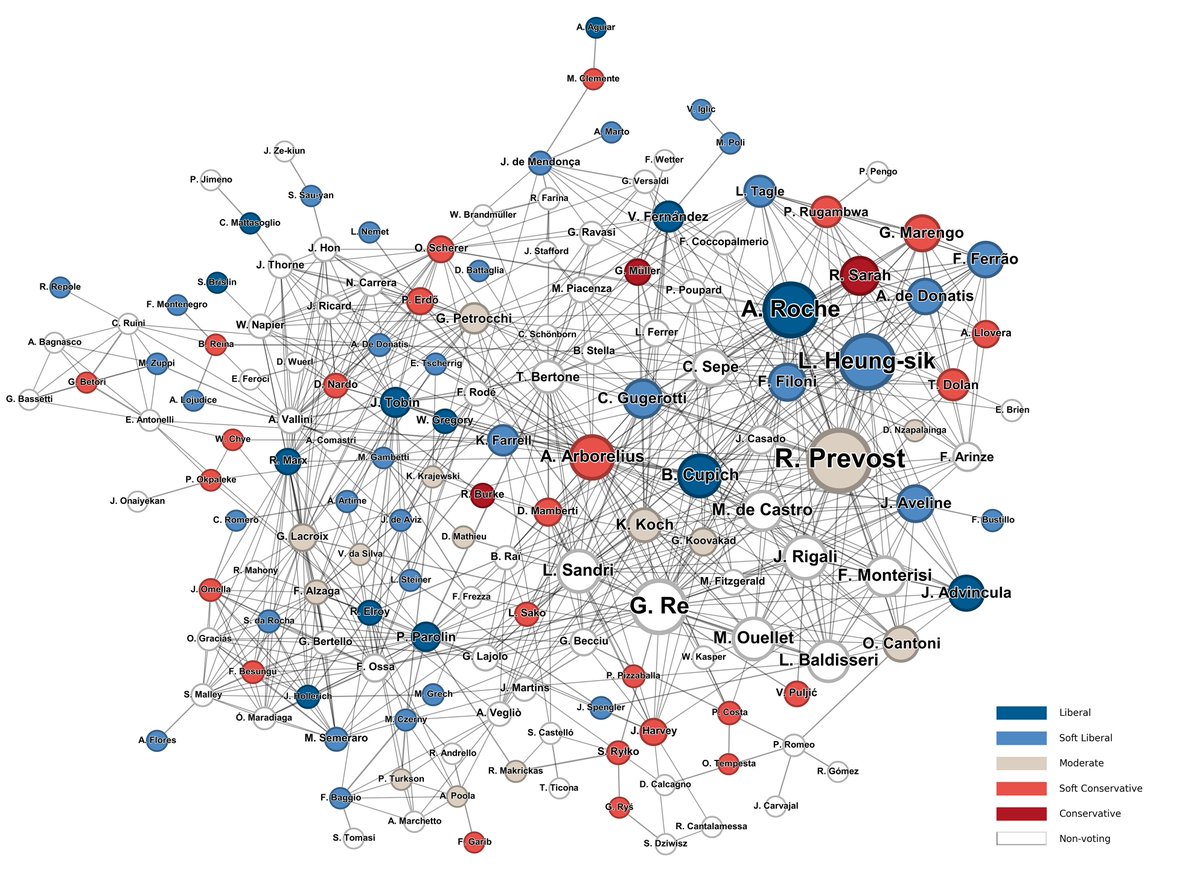
How we "guessed" the Pope using network science: inside the cardinal network. A study by me, Beppe Soda and Alessandro Iorio. Article: https://t.co/xQ0fTmpVxb @Unibocconi
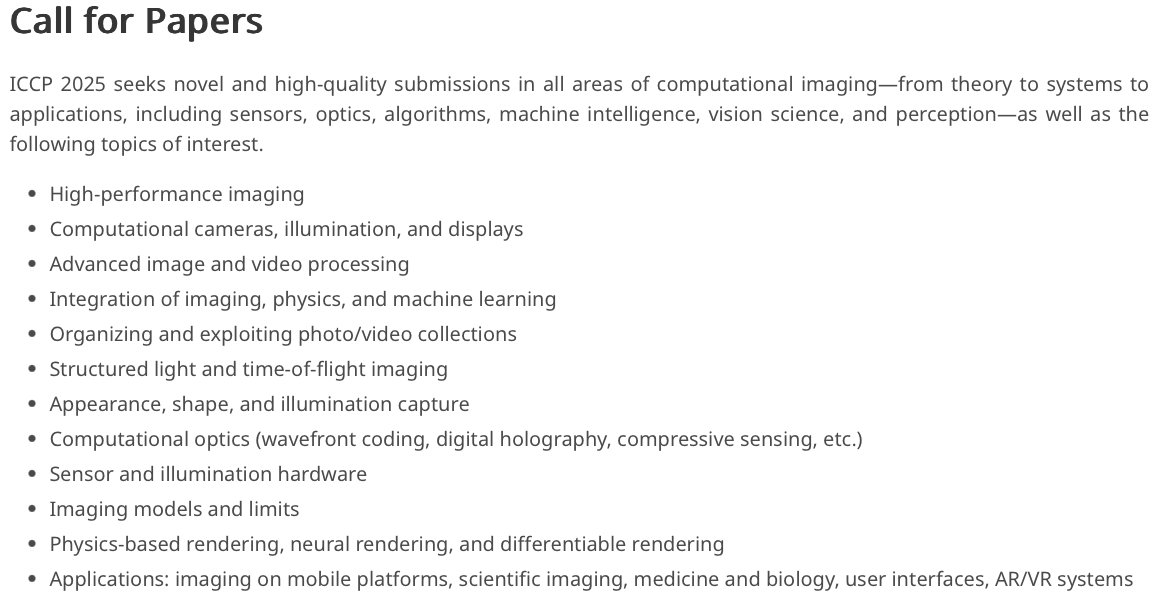
📢Attention researchers in computational imaging! The Call for Papers page for #ICCP2025 is live. We invite high-quality submissions on theory, sensors, optics, algorithms, and much more 📷. Submit your work by April 9, 2025. #ICCP2025#CallForPapers
I had to triple check this was real. It is.
The Australian Open on YouTube, due to rights issues, are getting around them by replacing real players with Nintendo Wii Sports Tennis characters. I think I love this.
Introducing 🧢CAP4D🧢
CAP4D turns any number of reference images (single, few, and many) into controllable real-time 4D avatars. 🧵⬇️
Website: https://t.co/l6hRa5jquQ
Paper: https://t.co/fxGGu3X3cz
These modems provide extreme capabilities for programmable control and sensing of the full optical wavefield at near-THz rate. We are excited to explore further how we can leverage this remarkable technology for pushing the state of the art in imaging.
(4/4)
I will be in Tokyo this week for #SiggraphAsia2024 to present our work "Coherent Optical Modems for Full-Wavefield Lidar". We repurposed an off-the-shelf optical modem, typically used for telecommunications, to introduce Full-Wavefield Lidar: a new imaging modality for simultaneous measurement of mm-scale 3D geometry, velocity, and polarization with only 1 microsecond exposure at eye-safe power regime.
📜 Paper: https://t.co/vFVumoAap3
🌐 Project Webpage: https://t.co/gOiufdGIUs
Joint work with @LightIsMyGame, @maxx_wu, Doug Charlton, Mohammad Pasandi, @kyroskutulakos, and @DaveLindell.
(1/4)
We also qualitatively compared FWL with Kinect Azure and single-photon lidars. While these methods completely fail at ultrashort exposures, FWL recovers accurate depth AND velocity with only 1 microsecond exposure.
(3/4)
Congrats to @anagh_malik on a great oral presentation at ECCV today! Check out our work on rendering videos of propagating light from novel viewpoints: https://t.co/S7mziCyQNf
Introducing GStex: Per-Primitive Texturing of 2D Gaussian Splatting for Decoupled Appearance and Geometry Modeling
The color of a splat is spatially constant, impeding use in modeling. GStex solves this at little to no cost to FPS or PSNR.
Project page: https://t.co/kp6YWU7KLm
Excited to work with @CSProfKGD and @kyroskutulakos on this collaboration with @UbisoftLaForge! We're recruiting motivated postdocs and phd students—see below for more information and how to apply
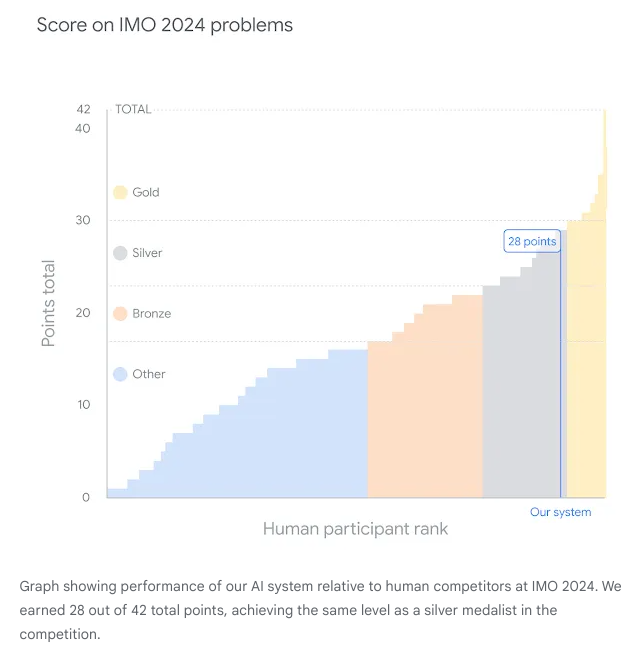
AI System Achieves Silver Medal-level score in IMO
The International Mathematical Olympiad (IMO) is the oldest, largest & most prestigious competition for young mathematicians. Every year, countries send their top young mathematicians to take a 6 problem test spanning two days. A few years ago, mathematical AI systems were lucky to be able to solve 1 in 100 of past IMO problems. This year, @GoogleDeepMind built a system to tackle this year's IMO problems that combined two systems: AlphaGeometry 2, an improved version of our AlphaGeometry system, and AlphaProof, a new reinforcement-learning based system for formal mathematical reasoning.
The results? During the week of the competition, this system was able to fully solve 4 of the 6 problems on this year's IMO exam, achieving a score of 28 (each problem is worth 7 points), placing it at the upper end of the IMO Silver Medal range (a level achieved by 58 of the 609 contestants in this year's IMO).
AlphaProof used a fine-tuned version of a Gemini model to automatically translate natural language problem statements into formal statements, creating a large library of formal problems of varying difficulty. It then learned to solve IMO-like problems by proving or disproving millions of problems, covering a wide range of difficulties and mathematical topic areas over a period of weeks leading up to the competition.
“The fact that the program can come up with a non-obvious construction like this is very impressive, and well beyond what I thought was state of the art."
— Prof Sir Timothy Gowers, IMO gold medalist and Fields Medal winner
Here is problem 4 of the 6, a geometry problem that AlphaGeometry solved in 19 seconds after receiving its formalization:
This represents a major advance in the capabilities of AI systems to correctly perform complex mathematical reasoning on par with the world's best young mathematicians. We’re excited for a future in which mathematicians work with AI tools to explore hypotheses, try bold new approaches to solving long-standing problems and quickly complete time-consuming elements of proofs — and where AI systems like Gemini become more capable at math and broader reasoning.
See the blog post below for details:
https://t.co/5lYBWfhYEF