In retrospect, Isaac Asimov may have been Hari Seldon in disguise. Eighty-four years after the first Foundation stories appeared, many who read his novels in their youth have grown up and begun quietly setting his plan in motion—advancing the long project of human continuity across time, knowledge, and worlds.
When you look outward from the Sun, the vast darkness of the universe overwhelms the senses. The stars are distant, the voids immense, and the scale of what lies beyond is difficult to hold in the mind. Yet our ancestors, gazing toward the horizon of the seas and what they called the edge of the world, were not primarily thinking that their ships might fall off it. They were already charting a new course for humanity, treating the unknown not as an ending but as the next stretch of open water.
Fear is how entropy keeps us caged—by narrowing our horizon to what is already known and safe. Curiosity is what keeps history moving, turning the same darkness into a direction.
As parents, our duty is to keep our children safe from the dangers that are real while preparing them to travel farther than we have. The horizon does not disappear because we love them; it is why we prepare them to meet it.
@TheBuilderJR Nothing fancy, just throttling on all the registration path (per IP and per time period), a honeypot on the registration form, and canonical email validation.
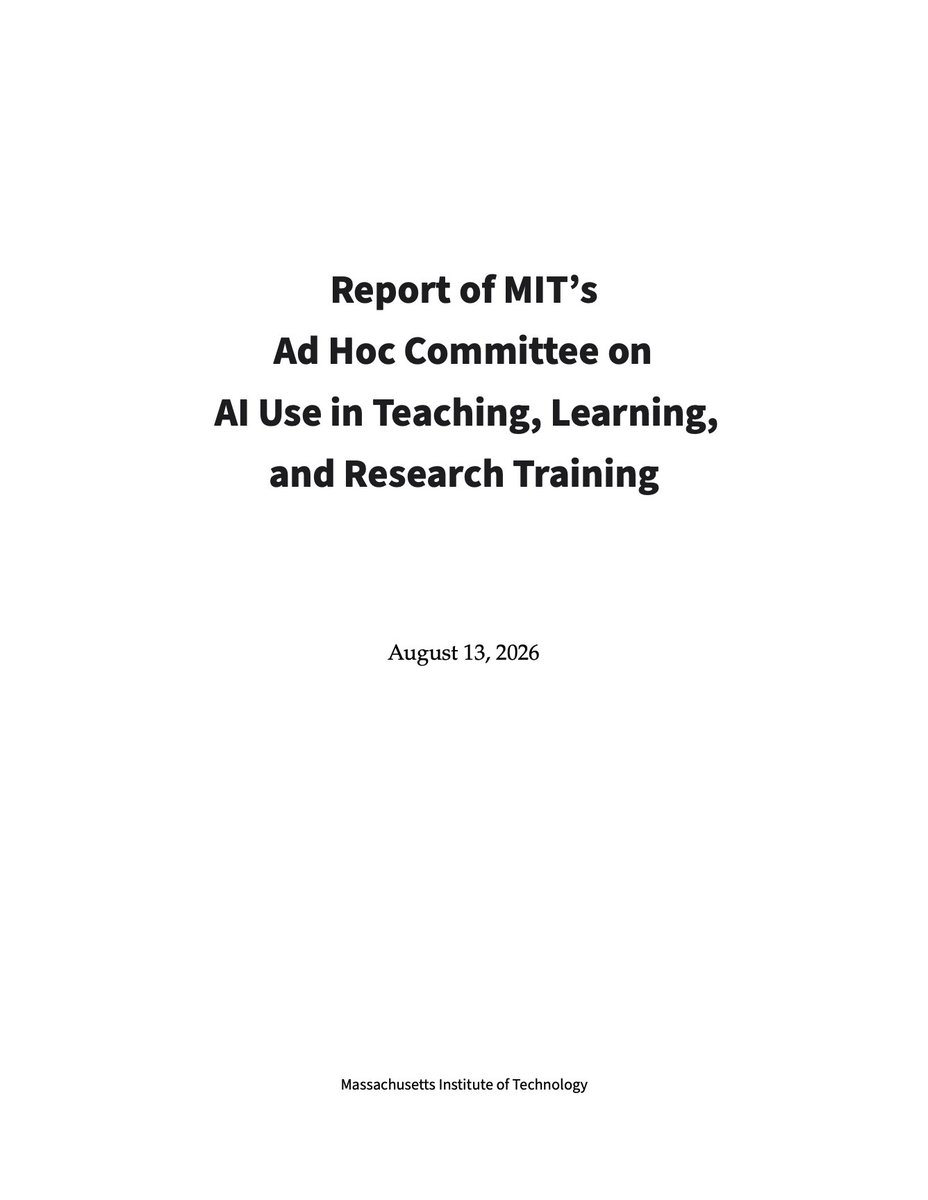
MIT published a brutally honest report on what AI is doing to students.
A committee of professors and students spent five months studying how AI changed learning on campus, and the findings read like a warning to every university on the planet.
Study groups are disappearing. Office hours are emptying out. Problem sets and take-home exams no longer prove anything, because AI can produce credible solutions to almost any written assignment in the undergraduate curriculum. Students who lean on chatbots lose mastery and confidence, and some slip into what the report calls cognitive surrender, reaching for AI at the first hint of struggle.
The numbers are rough. 46 percent of surveyed MIT undergrads use LLMs daily. 90 percent worry about their own overreliance. Undergrads who feel AI makes them replaceable now outnumber those who feel it makes them capable.
The committee's answer surprised me. They refused to fight AI with surveillance. The report calls AI detectors unreliable, says lockdown browsers feel like spying, and warns that policing students builds a classroom atmosphere of mutual distrust.
Instead, MIT wants to rebuild education around the things AI can't replace. That means oral exams, semester portfolios, in-person project work, and a required social component in every subject. The report even floats the idea of rethinking grades entirely, since without a GPA to optimize, much of the incentive to cheat with AI evaporates.
The committee warns professors against replacing undergrad research assistants with AI agents just because they're cheaper, because a university exists to grow people, not output.
The most famous tech school on earth admitted the machines broke its way of teaching. Its answer is more humans, not more software.
When you are landing on a moon, you want the craft to be well engineered.
When you are on an airplane, you want it to be well engineered.
When you are in a car driving at high speed, you want it to be well engineered.
When you go across a bridge, you want it to be well engineered.
When you want to run a training job on thousands of GPUs, you want the clusters to be well engineered.
When you need something to be 99.99% reliable, you want it to be well engineered.
A mathematician who shared an office with Claude Shannon at Bell Labs gave one lecture in 1986 that explains why some people win Nobel Prizes and other equally smart people spend their whole lives doing forgettable work.
His name was Richard Hamming. He won the Turing Award. He invented error-correcting codes that made modern computing possible. And he spent 30 years at Bell Labs sitting in a cafeteria at lunch watching which scientists became legendary and which ones faded into nothing.
In March 1986, he walked into a Bellcore auditorium in front of 200 researchers and told them exactly what he had seen.
Here's the framework that has been quoted by every serious scientist for the last 40 years.
His opening line landed like a punch. He said most scientists he worked with at Bell Labs were just as smart as the Nobel Prize winners. Just as hardworking. Just as credentialed. And yet at the end of a 40-year career, one group had changed entire fields and the other group was forgotten by the time they retired.
He wanted to know what the difference actually was. And he said it wasn't luck. It wasn't IQ. It was a specific set of habits that almost nobody is willing to follow.
The first habit was the one that hurts the most to hear. He said most scientists deliberately avoid the most important problem in their field because the odds of failure are too high. They pick a safe adjacent problem, solve it cleanly, publish it, and move on. And because they never swing at the hard problem, they never hit it. He said if you do not work on an important problem, it is unlikely you will do important work. That is not a motivational line. That is a logical one.
The second habit was about doors. Literal doors. He noticed that the scientists at Bell Labs who kept their office doors closed got more done in the short term because they had no interruptions. But the scientists who kept their doors open got more done over a career. The open-door scientists were interrupted constantly. They also absorbed every new idea passing through the hallway. Ten years in, they were working on problems the closed-door scientists did not even know existed.
The third habit was inversion. When Bell Labs refused to give him the team of programmers he wanted, Hamming sat with the rejection for weeks. Then he flipped the question. Instead of asking for programmers to write the programs, he asked why machines could not write the programs themselves. That single inversion pushed him into the frontier of computer science. He said the pattern repeats everywhere. What looks like a defect, if you flip it correctly, becomes the exact thing that pushes you ahead of everyone else.
The fourth habit was the one that hit me the hardest. He said knowledge and productivity compound like interest. Someone who works 10 percent harder than you does not produce 10 percent more over a career. They produce twice as much. The gap doesn't add. It multiplies. And it compounds silently for years before anyone notices.
He finished the lecture with a line I have never been able to shake.
He said Pasteur's famous quote is right. Luck favors the prepared mind. But he meant it literally. You don't hope for luck. You engineer the conditions where luck can land on you. Open doors. Important problems. Inverted questions. Compounded hours. Those are not traits. Those are choices you make every single day.
The transcript has been sitting on the University of Virginia's computer science website for almost 30 years. The video is free on YouTube. Stripe Press reprinted the full lectures as a book in 2020 and Bret Victor wrote the foreword.
Hamming died in 1998. He gave his final lecture a few weeks before. He was 82.
The lecture that explains why some careers become legendary and others disappear is still free. Most people who could benefit from it will never open it.
As promised, here's a recording of my 30-min keynote and the subsequent Q&A for the inaugural late interaction retrieval (LIR) workshop, cc @bclavie@antoine_chaffin.
The talk is admittedly advanced, as it's directed at an expert IR community. But hopefully still broadly useful!
Perhaps create a special "pro" landing page, and when they upload a file over a certain length (maybe 100+), just tell them that their file is considered for premium treatment and will be delivered with extra care... but it costs $.x / page. And then see how many convert? My friend Claude says we can ship it in an hour!
@VicVijayakumar@onetimefax I wouldn’t say failed, I’d say unreachable to make it more clear that you tried. Also adding the times you tried if you can with a nice ❌ next to them for impact