Studies show family meals are literally linked to better grades.
According to a Columbia University study by the National Center on Addiction and Substance Abuse (CASA), children who frequently share dinner with their families achieve higher grades in school.
The data reveals that teens eating five or more family meals weekly are far more likely to earn excellent marks and demonstrate advanced communication and vocabulary abilities.
This research underscores how routine family engagement fosters a nurturing, stable setting that enhances emotional well-being and self-assurance—vital factors in scholastic achievement.
The advantages go further: shared mealtimes provide a secure forum for self-expression, absorption of family principles, and honing of analytical thinking. Notably, the study also shows that adolescents with more family dinners are markedly less prone to risky activities like smoking or alcohol use. In today’s world of packed agendas and digital distractions, these findings highlight how the straightforward act of dining together can significantly influence a child’s trajectory.
[Columbia University, National Center on Addiction and Substance Abuse (CASA). April 2025]
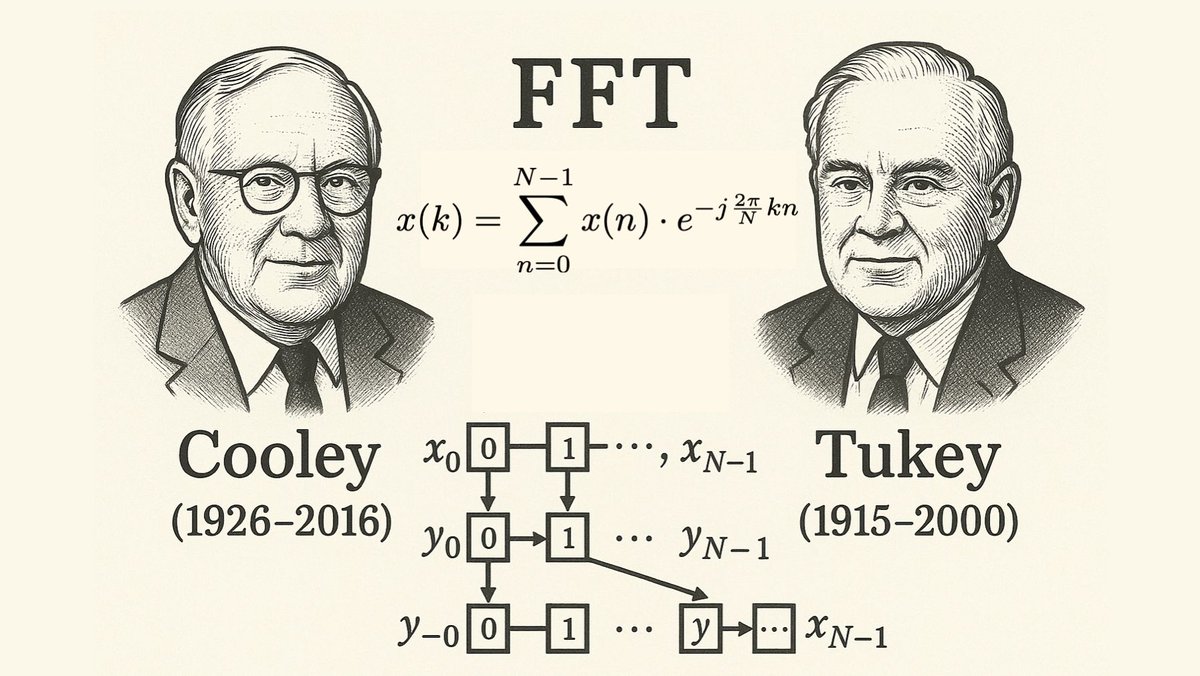
60 years ago this month, the Fast Fourier Transform (FFT) was introduced by Cooley & Tukey (1965) - one of the most important algorithms in signal processing and data analysis.
In 1805, Gauss - studying the orbits of asteroids Pallas and Juno - came up with a method to interpolate their trajectories from discrete samples. What he came up with was mathematically very close to the modern FFT but Gauss never published that work, and didn’t analyze its computational complexity. It predated even Fourier’s 1822 work on heat diffusion - but without the framing or generalization that Cooley & Tukey would bring 160 years later.
In 1965, Cooley & Tukey published their now-famous algorithm that reduced the cost of computing a Discrete Fourier Transform from 𝑂(𝑛²) to 𝑂(𝑛 log𝑛). This leap made real-time signal processing and digital media compression feasible.
From radio telescopes to JPEGs, from audio codecs to quantum mechanics - the FFT is everywhere. It’s one of the most important (and elegant) algorithms of the 20th century - rooted in the genius of Gauss, but brought to life in the computer age.





![Rainmaker1973's tweet photo. Studies show family meals are literally linked to better grades.
According to a Columbia University study by the National Center on Addiction and Substance Abuse (CASA), children who frequently share dinner with their families achieve higher grades in school.
The data reveals that teens eating five or more family meals weekly are far more likely to earn excellent marks and demonstrate advanced communication and vocabulary abilities.
This research underscores how routine family engagement fosters a nurturing, stable setting that enhances emotional well-being and self-assurance—vital factors in scholastic achievement.
The advantages go further: shared mealtimes provide a secure forum for self-expression, absorption of family principles, and honing of analytical thinking. Notably, the study also shows that adolescents with more family dinners are markedly less prone to risky activities like smoking or alcohol use. In today’s world of packed agendas and digital distractions, these findings highlight how the straightforward act of dining together can significantly influence a child’s trajectory.
[Columbia University, National Center on Addiction and Substance Abuse (CASA). April 2025]](https://pbs.twimg.com/media/G5fVMs8XwAAx55P.png)