Impresionante partido de Paulo Dybala vs Fiorentina. Como me alegra verlo bien físicamente y con tanto fútbol todavía por dar. 3 asistencias hoy, una función superlativa para uno de los históricos que tiene la Serie A. Uno de los jugadores que más disfruto ver.
📅 Este miércoles 12 de agosto
😍ME PONGO LA CAMISETA PARA DEFENDER LA CIENCIA ARGENTINA 🧪🇦🇷
🕓 16:00 HS
📍 OBELISCO Y EN LUGARES DE TODO EL PAIS
📢 Defender la ciencia nacional es defender el futuro de la Argentina.
💙🇦🇷 💙🇦🇷 💙🇦🇷 💙
"Hubo una época donde los docentes COBRABAN BIEN, pero bueno, a la gente le gusta IGUALAR PARA ABAJO. Parece que la gente es feliz cuando el otro NO es feliz"
La Negra Vernaci la tiene CLARÍSIMA 🐐🐐
Lo cierto es que, si los jugadores hubieran salido a la cancha con una bandera sobre el cambio climático, Black Lives Matter o en contra del capitalismo, no hubiese pasado nada. El nacionalismo es incomodo porque no simula ni discute abstracciones. Señala enemigos, fronteras e intereses. Por eso molesta tanto, a algunos los nombra y a otros los expone en su frivolidad
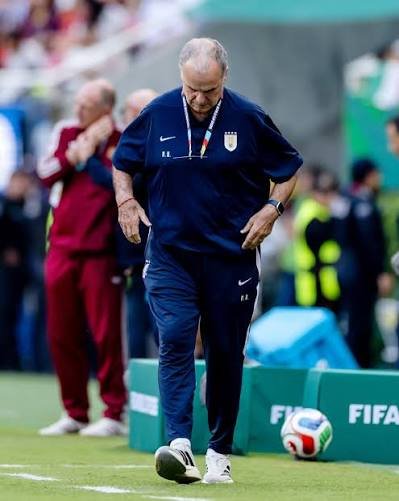
Bielsa did not fail because he tried to change the identity of Uruguayan football.
He failed because he tried to change a paradigm that many people mistake for identity.
And that is where the real problem begins.
In Uruguay, grit, history and the pride of being "el paisito" — a country of barely three million that has never allowed itself to feel small — have often been a driving force. They push us. They give us character. They make us believe we can compete with anyone.
But they can also become a shelter.
Because having an identity is one thing. Using it as an excuse not to evolve is something very different.
“Somos tres millones.”
“This is Uruguay.”
“Nobody gives us anything.”
“Against the world.”
“Knife between the teeth.”
“Going where others would not dare put a boot.”
All those phrases carry enormous emotional power. They are part of the Uruguayan football soul.
But when that narrative starts replacing method, planning, self-criticism and modernisation, it stops being a virtue and becomes a limit.
Bielsa touched that nerve.
He did not come to tell Uruguay to stop being Uruguay. He came to say that history alone is no longer enough. Garra alone is no longer enough.
The world has changed, and you cannot compete against modern football structures by believing that bravery, hard tackles and fierce looks will still win the day.
That is when the resistance kicked in.
But it would also be unfair to place all the responsibility on Bielsa, as if the players had simply been victims of the process.
Because another uncomfortable part of the problem appeared there too: some players were not only resisting a tactical idea. They were resisting a level of demand.
They resisted intensity, discomfort, the loss of certain privileges, changed habits and a methodology designed not to please them, but to push them to their competitive limit.
And that, too, is part of the paradigm.
From what has come out publicly, the conflict was not only about how Uruguay played. It was also about how they trained, how they lived together, how leadership was managed, and how willing the players were to accept a form of authority that was never designed to make them comfortable.
Bielsa may have got things wrong in the way he handled it. Almost certainly. He may have mismanaged sensitivities, timing and senior players.
But the deeper issue remains the same: he tried to install a culture of training, demand and method that not everyone was prepared to accept.
And that leaves another uncomfortable question:
Does Uruguay really want to compete with the world’s elite, or does it want to keep the comforts it has always known?
Because you cannot ask to become a force on the world stage again while rejecting the cost of training, living and competing like the world’s elite.
Uruguayan football wants to grow, but often without the discomfort that growth demands. It wants to return to the top, but without questioning its habits. It wants to compete with the best, but without abandoning certain stories that protect it from looking itself in the mirror.
And Bielsa, with all his mistakes, forced Uruguay to look.
Perhaps his failure was not only a footballing one. Perhaps it was cultural.
He tried to push Uruguay towards a more modern, more demanding and less self-indulgent version of itself, but he collided with an ecosystem that still feels that changing means betraying who you are.
It does not.
Evolving is not ceasing to be Uruguay.
Modernising is not losing the garra.
Changing the paradigm is not erasing history.
The real problem is still believing that the shirt, and the history behind it, can win matches by itself.
Because garra without evolution eventually becomes nostalgia.
And nostalgia does not compete.
It only remembers.
@LUFC@JimenaJuani@BBCLeeds@martitabaires
Otro gran partido de Maxi Perrone, que se acerca al Mundial semana tras semana.
El eje de uno de los equipos que mejor juegan al fútbol en todo Europa. Organiza desde el pase, siempre es opción para dar continuidad… orden, movilidad y claridad.
Hoy brillando vs Juventus. 🎩🇦🇷