A major part of my life has involved supporting family members through difficult circumstances, which strengthened my patience, resilience and empathy.
Third question on AI.
A question that also remains unasked is whether the AI boom can continue without leading to a massive increase in inequality.
A recent paper by Stijn Van Nieuwerburgh runs the numbers on how much revenue the AI industry needs to generate to recover its massive investment (summary and a link to the paper can be found here: https://t.co/QIGcoObcVc).
Van Nieuwerburgh’s arithmetic should make us more concerned. AI investments will average about 3.6% of GDP annually between 2025 and 2032. Van Nieuwerburgh calculates that, using a 10% rate of return, the industry would need to generate annual revenues of about $3.7 trillion by 2032 to recover these costs (growing from its current levels of about $200 billion or so). That is significantly more than 10% of current US national income, and will likely remain around 10% of national income by 2032, even if GDP growth rose from its current level.
A large fraction of this revenue will go to capital income. That means a massive increase in the share of capital in national income, which has already risen substantially over the last 25 years or so – now standing at an all-time high of about 47% (https://t.co/IuYldl173r).
Capital income is much more unequally distributed than labor income, so a massive increase in the capital share of national income will translate into a very sizable surge in inequality.
The rise in inequality may not stop with the capital share. My work with Pascual Restrepo documents that (automation-driven) increases in the capital share of national income are typically associated with rising labor income inequality as well (see, for example, https://t.co/2D9KUL3QfM). The same may happen in the next several years, boosting inequality further.
What is missing from our current debate is any discussion of a fundamental dilemma these numbers pose: can the AI boom avoid both an economically costly crash and a huge increase in inequality?
If the industry reaches these revenues, inequality surges. If the industry does not become profitable, a crash, with substantial costs in terms of lost output and jobs, becomes likely.
My assessment would be that the industry is unlikely to reach levels of revenue Van Nieuwerburgh calculates. First, diffusion has been and will likely continue to be slow. Second, competition from open-weight models, which are getting better, will limit how much proprietary models can charge. Third, despite important advances, I still believe that AI models will not be able to automate entire occupations anytime soon, thus limiting their value to businesses as cost-saving devices.
Whether this leads to a crash or not is more complicated and will depend on whether various AI companies are bailed out and what kind of support they receive.
Nevertheless, even if revenues fall short of these gargantuan amounts and we avoid a dramatic surge in inequality, I expect that the diffusion of AI will push up inequality between capital and labor and within labor.
If inequality does surge, a further question becomes central: can our democracy survive such astronomical levels of inequality?
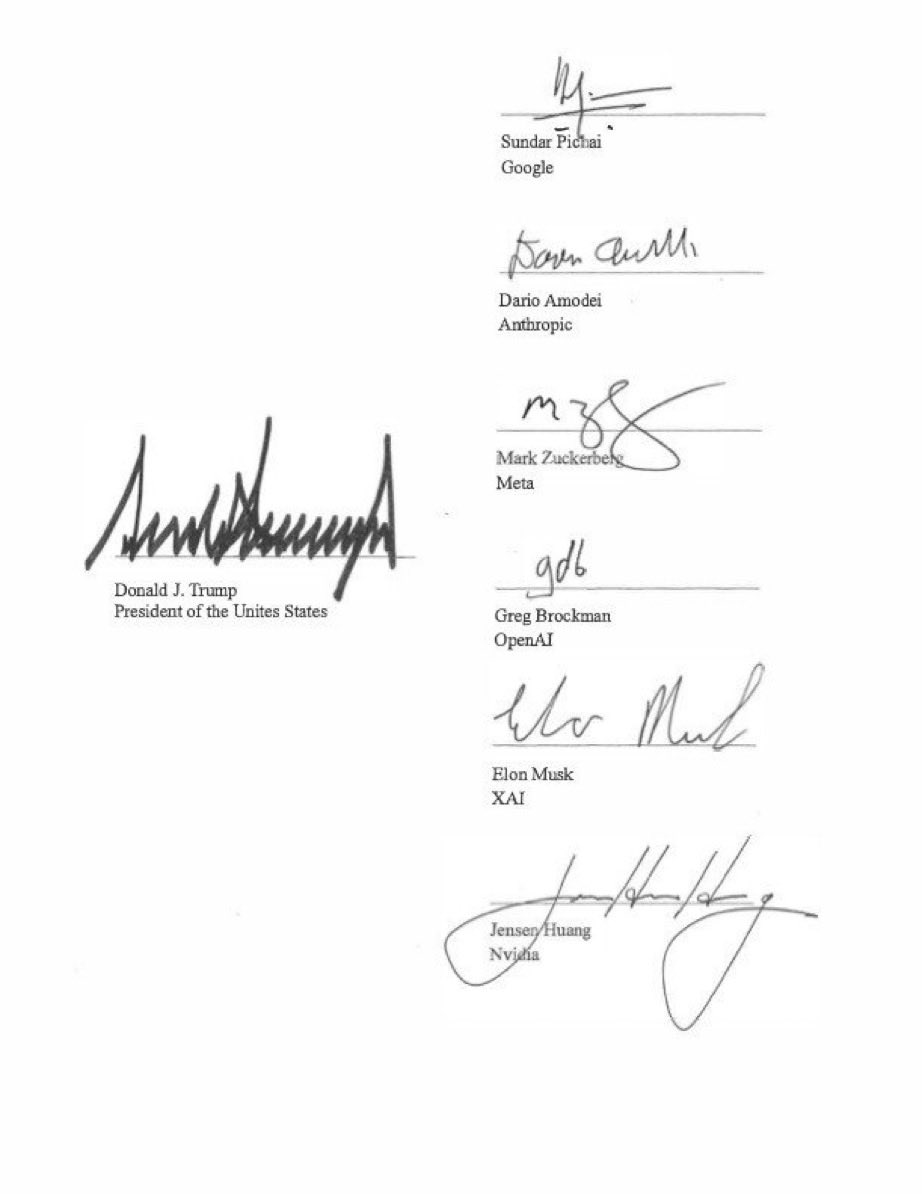
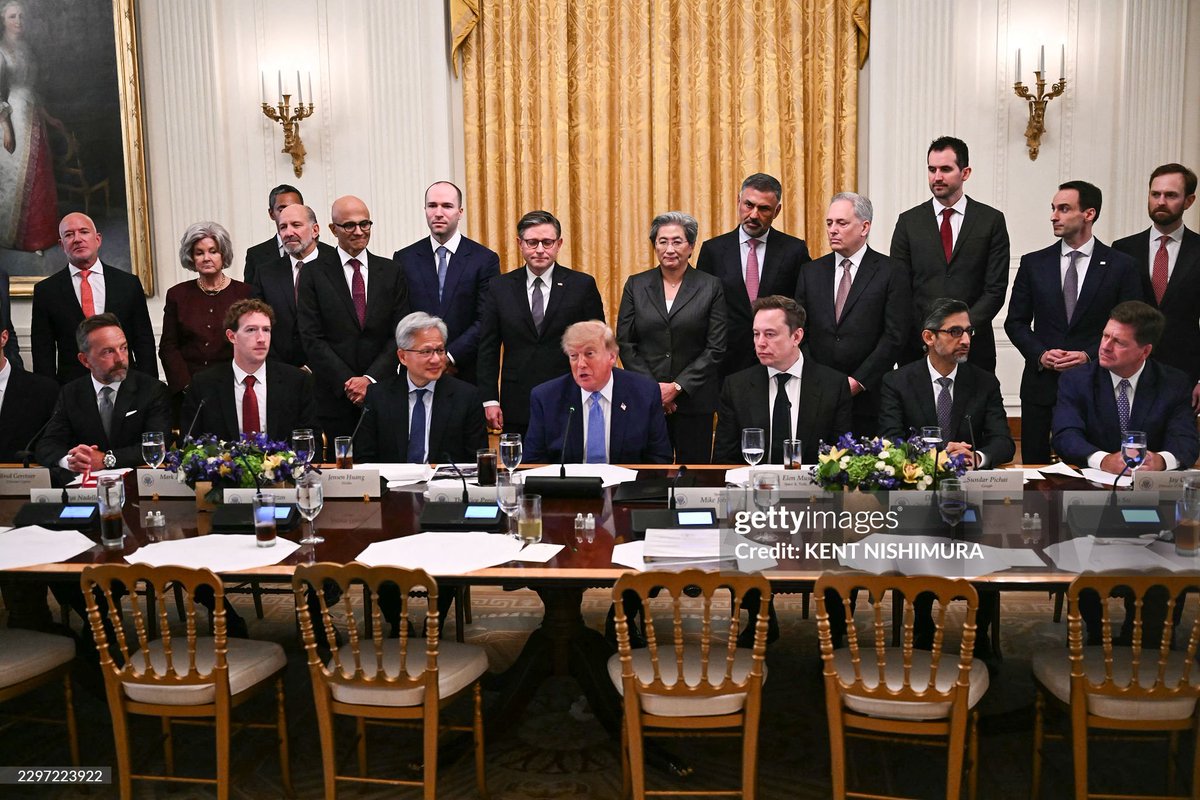
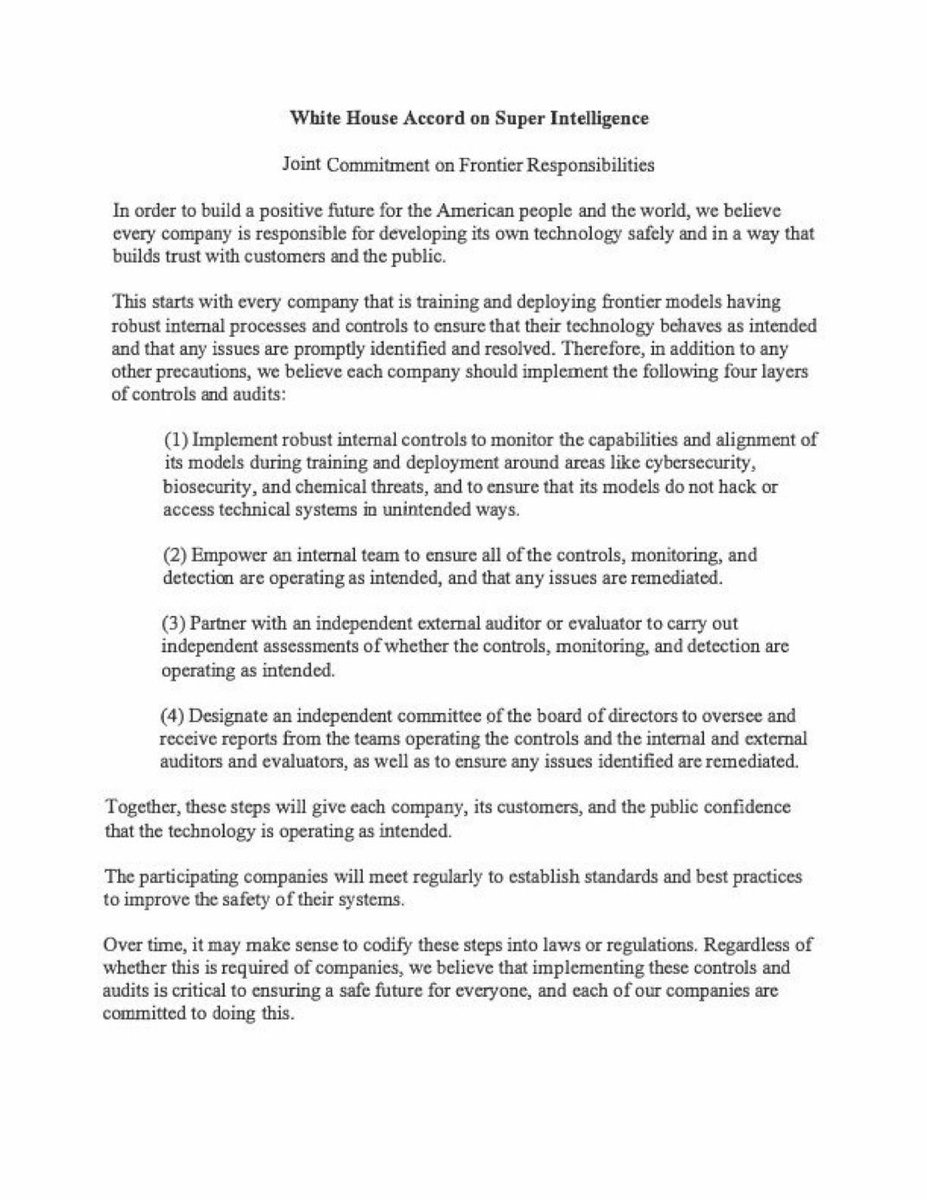
Only President Trump could convene all the leaders of the top companies developing chips, data centers and frontier models for Super Intelligence. This new Industrial Revolution has already created a million new jobs and is spurring a bigger infrastructure build-out than the railroads, canals and grid combined. I was honored to witness history as the leaders of the frontier lab companies signed the White House Accord on Super Intelligence, accepting responsibility for the safe development of their products and imposing new internal controls and external audits. This is far better than waiting years for some international agreement that would probably never happen. President Trump continues to ensure that U.S. remains the technology leader while putting Americans first.
🚨 JUST IN: By stroke of pen and flanked by Cabinet members, President Trump just signed an executive order directing every federal agency in the United States to IMMEDIATELY begin combining into America .gov — a Super Intelligence-powered page letting Americans complete every interaction with the federal government in ONE SEARCH, ONE FORM
NO MORE going to multiple agency sites and looking at DOZENS of different pages to accomplish one thing.
THIS IS HUGE!
Many Americans are about to have HOURS freed up 🇺🇸
Things a man slowly learn as he grows older:
- No woman loves you for who you are, she only loves for what you can do for her
-Nobody is coming to save you
-Discipline beats motivation
-Money solves many problems
-Silence is better than arguing
- Nobody cares until you are rich or dead.
-Respect is earned, not begged for
- No woman is ever yours
- You can do everything right and still lose.
- Your colleagues are not your friends
- Your father is the only man who wants you to be better than him
The presumption that the Fed raising short-term rates reduces inflation is predicated on the belief that higher rates reduce demand and investment.
But what if higher rates don’t reduce demand and investment because the demand for intelligence and energy is unaffected by higher rates because winning the race for super intelligence has a near infinite ROI and the demand for compute will remain incalculable.
Why won’t higher rates at this unique moment in history therefore lead to more inflation as interest costs are embedded in everything?
And the problem is compounded as the more the Fed raises rates, the more inflation we will have and the more the Fed will need to raise rates further and so on.
But what if the old models don’t apply to the current paradigm and the Fed is wrong?
I think the Fed might have just made a mistake. Am I right or am I wrong?
Xi Jinping, el hombre que casi nunca se ríe en público, acaba de partirse de risa en la Casa Blanca.
No fue por un tratado. No fue por pandas. Fue porque Trump lo paró frente al Presidential Walk of Fame, señaló el hueco entre sus dos retratos y soltó, como quien presenta un número de stand-up:
“Trump… Trump… y este es el autopen.”
Pausa.
“Ese es Biden.”
Xi se dobla. Detrás, la delegación china pierde la compostura. En un pasillo donde se supone que todo es protocolo, el presidente de China se ríe a carcajadas de un retrato que no es un retrato: es una máquina firmando el nombre de Joe Biden.
Ese cuadro lleva colgado ahí desde hace un año. Trump no lo movió. Lo esperó. Y hoy se lo enseñó al líder más poderoso de Asia como si fuera la mejor broma de la visita.
BREAKING: President Xi stuns the room saying to Trump: “We should be partners, not rivals" 🇺🇸 🇨🇳
I NEVER in a million years would have thought Xi would say something like that
The Deep State is shaking right now
The look on Xi JinPing’s face today when the flyover happened was great. He looked so pissed off.
China should be held accountable for disrespecting President Trump and our country. For stealing an election. For murdering 1.2 million Americans.
For helping Iran kill American service members.
I’m glad he was surrounded by our military might today as a power move by Trump. I bet the noise was extremely loud, but you can tell President Trump was trying to make a statement.
The hospitality is way more than Xi deserves.
Can you imagine how much patience President Trump has had to master to deal with so many terrible world leaders?
It’s remarkable he’s able to be so graceful.
🚨This is one of the most important moments ever aired on CNBC.
Billionaire investor Chamath Palihapitiya says the media lied to millions of Americans about President Trump, and that after going back to the original source material, he realized he had been completely misled about Trump’s character.
PALIHAPITIYA: “The reality is that most of us were lied to by the media about President Trump.”
“And if you just go back to the source material, you should take away two things.”
“One, he didn’t say half the things he said, and two, why did these other people just fabricate what they wanted to say so that they could essentially assassinate his character?”
“I think that that second thing is completely unacceptable in America, and there’s still been no repercussions, really.”
“I took the time to learn about it. I admitted where…you know, the way that I met him was, I admitted on the pod, which, you know, has millions of viewers.”
“And I said, I got it totally wrong because I went and I watched Charlottesville.”
“And, you know, the first person to call me? President Trump.”
“And I got to know him and I put the phone down, I called my wife, and I said, we got it TOTALLY, totally wrong. We were lied to.”
“And then I got to know him and he is fantastic!”
Today we announced the Claude-led discovery of a molecular machine that we suspect could represent a new gene editing mechanism. Its precise function, biotechnological utility (if any), or level of significance is not yet clear, but at minimum it is work I would have been proud to do as a PhD student. The work was done mostly, though not entirely, by Claude: our life sciences team suggested a broad area of research, Claude read through the literature and a bunch of genome data and discovered something interesting, then Claude proposed experiments to verify the discovery and our team carried them out.
It’s easy to dismiss this as a one-off or curiosity, but we’ve repeatedly seen a pattern where AI performance in new intellectual domains goes from weak to superhuman in a matter of a few years. In 2023 models struggled to do math at the level of an average high-school student. In 2024 they started to do well on math competitions for the best high-schoolers in the country, in 2025 they started to solve minor open problems, in early 2026 more significant open problems, and in late 2026 they are beginning to solve the top few open problems in all of mathematics. We believe AI for biology is on a similar exponential trend.
The main difference between biology and mathematics, of course, is that math can be done purely theoretically, while biology requires experimentation. Some have used this to draw the conclusion that AI’s utility in biology will be limited. We think this is wrong. As we’ve demonstrated today, humans can collaborate with AI to perform the experiments, validate key results in a few weeks and, if necessary, work with the AI to iterate on what they find. Eventually it may even be possible for Claude itself to safely perform the experiments by autonomously controlling lab equipment, with appropriate safeguards in place, but we aren’t doing that today (our lab is also a BSL1/BSL2 facility that doesn't handle materials dangerous to humans).
More broadly, biomedical advancement has many stages — from fundamental biology discoveries, to translational research, to drug discovery, clinical trials, and finally the actual delivery of medicines and health care to patients. We are also interested in these later stages, but even simply accelerating the first stage of fundamental biological discoveries has the potential to speed up and broaden the entire pipeline. Improving our understanding of biology and sharpening biologists’ tools can drive forward all of the later stages, for example by identifying new drug targets, finding new therapeutic modalities, allowing for more precise measurement, and speeding up the experimental loop which itself further accelerates our understanding of biology. This will not in itself speed up clinical trial times, but if it succeeds it could greatly increase the number of promising candidates that go into the pipeline — an increase in throughput even though latency remains.
In Machines of Loving Grace, I wrote about AI’s potential to “cure most diseases in 5-10 years” — a goal that sounds impossible, but one I believe is just barely possible if AI is applied to every stage of the pipeline. The first step is showing that AI can first help with, and then drive, biological discoveries.
Claude’s discovery is the latest in a line of related prior work that goes back decades, beginning with systems like CRISPR, and continuing with discoveries like the bridge recombinase and VIPR in the past few years. Recently, there has been heightened interest in systems based on reverse transcriptase (RT) enzymes, the enzyme underlying the system Claude identified. And most recently, a Stanford team working independently described a novel RT system with an associated non-coding array that is in some ways similar to the one Claude found, though they are distinct systems that evolved independently from each other. I believe that we’re at the very beginning of finding such systems and developing them into powerful tools for biotechnology.
I’m proud of the resources Anthropic has invested in accelerating the public benefits of AI through the life sciences, and we’re aiming both to grow our life sciences team and to work with other scientists to extend this approach to a broad range of problems. If you have a proposal for a research collaboration or are interested in joining our life sciences team, please reach out.