💬 Build AI interfaces that go beyond the chat window.
🎙️ Free live session with Murat Sari and @rainerhahnekamp (CopilotKit Angular maintainers): streaming, shared state and human approval with AG-UI.
🗓️ Fri 16 Oct, 4 PM BST / 11 AM EDT
🎟️ https://t.co/XYtu4ECqbC
Build with AI is our free newsletter for engineers working with AI agents. 🤖
Every Thursday: one reframe worth stealing, and working code you can actually run. Written with people shipping this in production.
🎁 Subscribe and Beyond Code is yours free.
https://t.co/C5m0OkMnqD
⏳ A few hours left.
Our Python giveaway closes tonight. 3 bestsellers, 5 winners, PDF + ePub of all three. Free, no purchase, 30 seconds to enter.
Packt Monthly Giveaways
If you're not going to enter, send it to someone who will.
⏳ Last chance. Our Python giveaway closes July 31.
📘 Python Illustrated
📗 Learn MCP with Python @chris_noring
📕 Python ML By Example, 4th Ed
Hit 1,500 entries and it becomes 10 winners, so enter, then share 👇
https://t.co/kQQS8XPDlU
✨Community Giveaway, sponsored by @PacktPublishing@PacktDataML 🚀
Win 3 bestselling Python books from Packt Publishing — free entry, 5 winners, each receives the full set in both PDF and ePub formats: https://t.co/T3DB4XavG7
1) Python Illustrated — a visual, beginner-friendly intro to Python
2) Learn Model Context Protocol with Python — build agentic AI systems with MCP
3) Python Machine Learning By Example (4th Edition) — practical Machine Learning workflows
Bonus: if entries reach 1,500 by July 31, the prize pool doubles to 10 winners.
—————
#DataScience #MachineLearning #DataScientist #Coding #ML #AI
What are you building next?
An MCP app, an ML model, or something simple with Python. Whichever it is, our giveaway has the book for it.
🎁 3 Python bestsellers, 5 winners, PDF + ePub of all three.
Enter: https://t.co/kQQS8XPDlU
Ends July 31.
🎁 GIVEAWAY: 3 Python bestsellers, 5 winners.
📘 Python Illustrated
📗 Learn MCP with Python
📕 Python ML By Example, 4th Ed
Winners get PDF and ePub copies of all three.
Enter here: https://t.co/R9WSV1Szte
Ends July 31. RT so a Python dev on your feed sees this.
Hosted event by @PacktPublishing@PacktDataML on July 31
Claude Code Workshop — Orchestrating Production-Grade Apps
𝗥𝗘𝗚𝗜𝗦𝗧𝗘𝗥 𝗻𝗼𝘄 using 50% 𝗢𝗙𝗙 discount code CLAUDE50: https://t.co/RI0cQ3Dho6
𝗢𝘃𝗲𝗿𝘃𝗶𝗲𝘄: Build production-grade web apps with Claude Code using team-ready context, scaffold, guardrails, skills, and MCP workflows. This is a hands-on Claude Code training session for full-stack developers, technical founders, and engineering leads who want to move beyond demos and into real, shippable software.
𝗥𝗘𝗠𝗜𝗡𝗗𝗘𝗥: Don't forget to use the 50% OFF discount code!
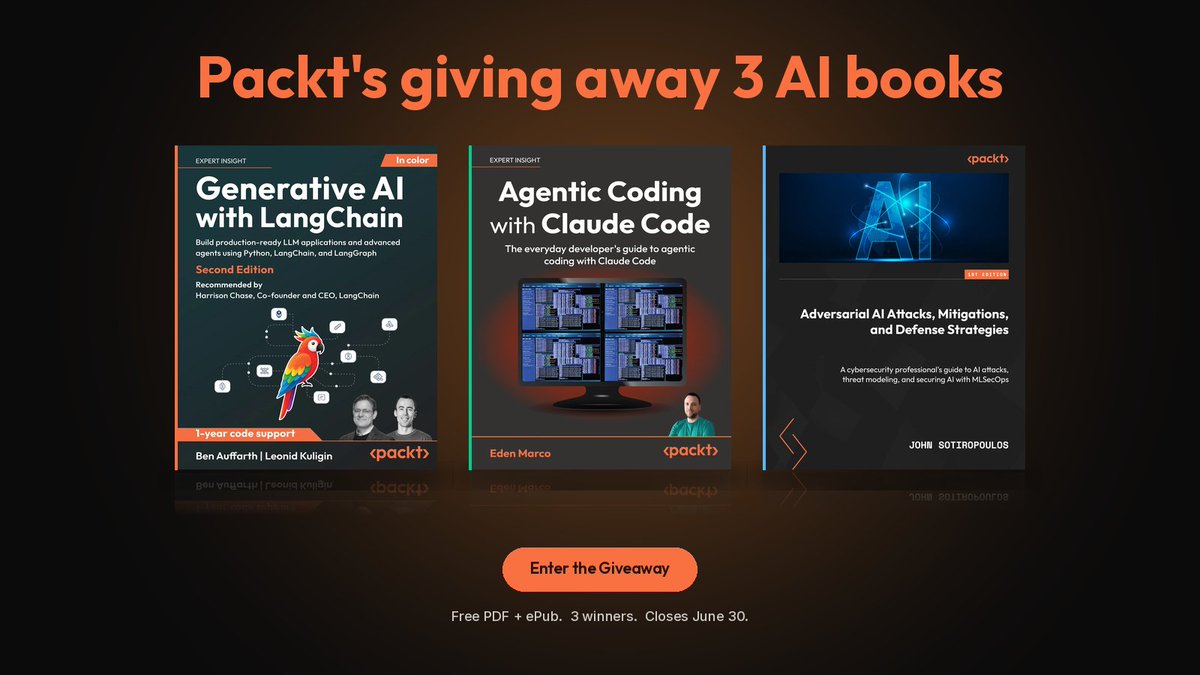
🚨 A few hours left to win 3 AI books, free.
📘 Generative AI with LangChain
🤖 Agentic Coding with Claude Code
🛡️ Adversarial AI Attacks & Defense
PDF + ePub, 3 winners, no purchase needed.
👉 https://t.co/5XcetHaf5j
📢 I just published https://t.co/qGJjjGKYLh in collaboration with @packtwebdevpro!
A deep dive guide how to add agentic AI capabilities to an #Angular application with @Firebase AI Logic!
Building with AI? Packt is giving away 3 books covering LLM apps, agentic coding, and AI security:
🦜 Generative AI with LangChain
🤖 Agentic Coding with Claude Code
🛡️ Adversarial AI Attacks
3 winners get all 3 books in PDF + EPUB.
⏳ Closes 30 June.
👉 https://t.co/5XcetHaf5j
🚨 GIVEAWAY ALERT 🚨
Enter to win 3 AI bestsellers from Packt. 🤖📚
3 winners will each receive PDF + ePub copies of all 3 books. 🏆📄📱
Giveaway closes June 30. ⏰ Winners announced July 2. 🎉
👉 https://t.co/7UxeH65pQv 👈
🚨 GIVEAWAY ALERT 🚨
✨Enter to win 3 AI bestsellers from Packt.✨
📚3 winners will each receive PDF + ePub copies of all 3 books.
⏰Giveaway closes June 30. Winners announced July 2.
Enter now 👉 https://t.co/5XcetHaf5j
8/ The best AI workflows don’t come from blindly copying prompt templates.
They come from understanding: • what to KEEP • what to DELETE • what to ADD
Better rules → better code.
We tested the viral claude.md workflow across real production projects.
Some rules made AI dramatically better.
Some quietly broke projects.
And one critical rule was completely missing. 🧵
7/ The most important missing rule we added:
“Always preserve and create the essential project structure required for a maintainable, production-ready codebase.”
This changed everything.