Complete Claude Code Training 6 HOURS.
The most comprehensive Claude training on the internet.
From A to Z: setup, workflow creation, website deployment, agent team creation, browser automation, client prospecting and pricing your services.
All of it without writing a single line of code.
In the end: you use Claude Code like a pro and you monetize your skills.
Beginner or advanced, everything is there in one place, this course covers it all.
It's worth more than all those $500 courses you almost bought.
Keep it bookmarked and watch later.
La mayoría usa NotebookLM para resumir textos. Error.
Es la herramienta de IA más potente de Google si sabes qué pedirle.
He diseñado estos prompts para convertir horas de investigación en segundos de claridad.👇
https://t.co/GXmmk61VMG
When should you chunk your documents, before embedding, or after querying?
Most RAG systems use 𝗽𝗿𝗲-𝗰𝗵𝘂𝗻𝗸𝗶𝗻𝗴 - the standard approach where you break documents into smaller pieces first, then embed and store them in your vector database. This requires upfront decisions about chunk size and boundaries, but enables fast retrieval since all chunks are pre-computed and indexed.
But there's a more advanced alternative called 𝗽𝗼𝘀𝘁-𝗰𝗵𝘂𝗻𝗸𝗶𝗻𝗴 that we used while building our open source agentic RAG framework, Elysia.
𝗣𝗼𝘀𝘁-𝗖𝗵𝘂𝗻𝗸𝗶𝗻𝗴 works by:
• Embedding entire documents first
• Performing chunking at query time only on documents that are actually retrieved
• Caching chunked results so the system becomes faster over time
This method avoids chunking documents that may never be queried while allowing for more dynamic, context-aware chunking strategies based on the specific query.
The trade-offs? Post-chunking introduces latency on first access and requires additional infrastructure decisions, but it can be more efficient for large document collections where many documents are rarely accessed.
𝗕𝗲𝘆𝗼𝗻𝗱 𝘁𝗵𝗲 𝘁𝗶𝗺𝗶𝗻𝗴 𝗾𝘂𝗲𝘀𝘁𝗶𝗼𝗻, chunking strategy itself matters enormously. You've got everything from simple approaches:
• 𝗙𝗶𝘅𝗲𝗱-𝘀𝗶𝘇𝗲 𝗰𝗵𝘂𝗻𝗸𝗶𝗻𝗴: splits by token/character count
• 𝗥𝗲𝗰𝘂𝗿𝘀𝗶𝘃𝗲 𝗰𝗵𝘂𝗻𝗸𝗶𝗻𝗴: uses prioritized separators like paragraphs, then sentences
• 𝗗𝗼𝗰𝘂𝗺𝗲𝗻𝘁-𝗯𝗮𝘀𝗲𝗱: splits by format-specific elements like Markdown headers
To advanced techniques:
• 𝗦𝗲𝗺𝗮𝗻𝘁𝗶𝗰 𝗰𝗵𝘂𝗻𝗸𝗶𝗻𝗴: divides text based on meaning boundaries
• 𝗟𝗮𝘁𝗲 𝗰𝗵𝘂𝗻𝗸𝗶𝗻𝗴: embeds the whole document first, then derives chunk embeddings with full context
• 𝗔𝗴𝗲𝗻𝘁𝗶𝗰 𝗰𝗵𝘂𝗻𝗸𝗶𝗻𝗴: lets an AI agent dynamically decide how to split based on document structure and content
Chunking is arguably the most important factor for RAG performance. Even a perfect retrieval system fails if it searches over poorly prepared data.
Learn more in the blog @femke_plantinga and I just wrote: https://t.co/gRdXPaVkS1
Developers think Software Architects have the easiest highly paid job.
Well... not quite 👇
Here's what devs imagine an Architect does:
- Doesn't write code
- Draws diagrams all day
- Just makes decisions in meetings
- Gets to choose the "cool" tech stack
- Always says "yes" or "no" with confidence
- Doesn't have to deal with bugs
- Works only 4 hours a day
- Has a high salary
But here's what actually happens:
- Writes the core code everyone else will build on
- Spends hours reviewing pull requests for critical changes
- Explains the same architecture to 5 different teams
- Balances business needs with technical debt
- Makes trade-offs nobody will be happy about
- Deals with production issues at 2 AM
- Handles conflicting opinions from stakeholders
- Documents decisions so future devs understand why
- Manages tech stack upgrades without breaking things
- Tracks performance, security, and scalability risks
- Mentors developers while staying hands-on
- Negotiates scope and timelines under pressure
- Reads endless RFCs and framework updates
- Constantly defends architecture choices with data
- Stays accountable when things go wrong
- Learning new things each week to keep up with changing technology
Being a Software Architect is rewarding — but it's far from easy.
It's not just about drawing boxes; it's about owning the outcomes.
What's the biggest misconception you've heard about Software Architects?
—
♻️ Repost to help others learn about Software Architect role
➕ Follow me ( @AntonMartyniuk ) for more
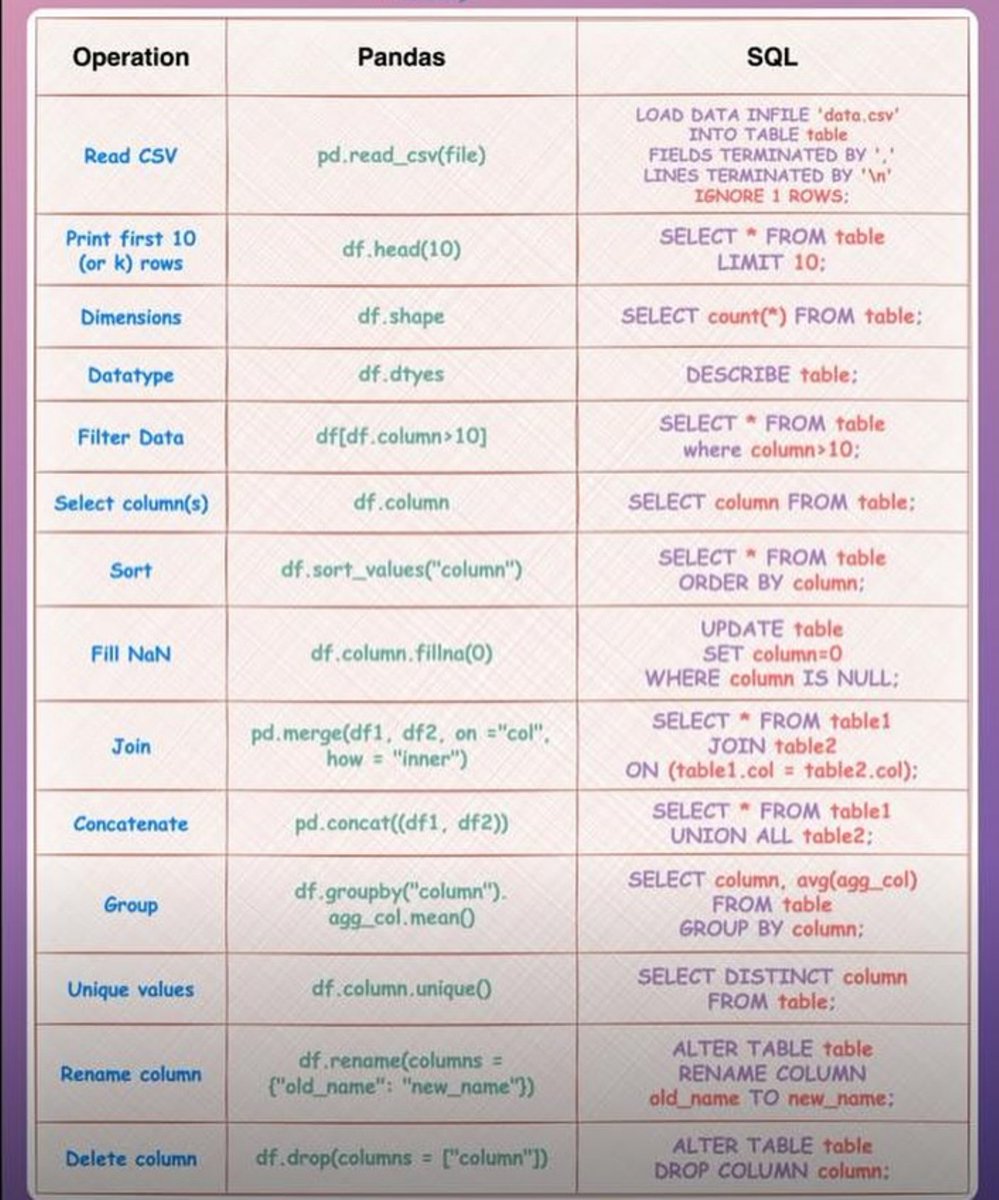
📊 Pandas vs SQL: A Quick Cheat Sheet!🐼🆚🗃️
Master the art of data manipulation with this side-by-side comparison of common operations in Pandas and SQL! Whether you’re switching between Python and databases or just starting out—this guide has you covered!
💡 Perfect for:
✅ Data analysts
✅ Aspiring data scientists
✅ SQL & Python learners
👇 Save this post for future reference!
Junior developer needs to know 4 patterns
Middle dev needs to know 12 patterns
Senior developer needs to know 20 patterns
Design patterns help you solve common problems and improve code quality if used properly.
Ever wondered which design patterns you should focus on as you grow as a developer?
This could be the difference between writing good code... and building great software.
👉 𝗝𝘂𝗻𝗶𝗼𝗿 𝗗𝗲𝘃𝗲𝗹𝗼𝗽𝗲𝗿:
You don’t need to know everything at once.
Focus on the essentials — the patterns that show up everywhere.
1️⃣ Builder
2️⃣ Factory Method
3️⃣ Singleton
4️⃣ Decorator
These four patterns help you create, organize, and extend objects efficiently.
Master these, and you’ll write cleaner, more flexible code from day one.
👉 𝗠𝗶𝗱𝗱𝗹𝗲 𝗗𝗲𝘃𝗲𝗹𝗼𝗽𝗲𝗿:
Ready to step up?
Now it’s time to add more versatile tools to your toolbox.
1️⃣ Strategy
2️⃣ Adapter
3️⃣ Abstract Factory
4️⃣ Template Method
5️⃣ Facade
6️⃣ Bridge
7️⃣ Command
8️⃣ Mediator
These patterns teach you how to swap behaviors, simplify complex systems, and make your code more modular.
👉 𝗦𝗲𝗻𝗶𝗼𝗿 𝗗𝗲𝘃𝗲𝗹𝗼𝗽𝗲𝗿:
You've mastered the basics.
Now it's time to tackle patterns that solve the toughest architectural challenges.
1️⃣ Prototype
2️⃣ Composite
3️⃣ Chain of Responsibility
4️⃣ State
5️⃣ Flyweight
6️⃣ Proxy
7️⃣ Visitor
8️⃣ Interpreter
These patterns give you superpowers for working with complex structures, dynamic behaviors, and resource optimization.
You'll notice: as you start solving bigger problems, these patterns show up again and again.
📌 Important note:
Don't try to learn everything all at once!
Follow a progression — master the basics, then level up with more advanced patterns as you grow.
Which design pattern was the hardest for you to learn, and how did you finally "get it"?
♻️ Repost to help your network
➕ Follow me ( @AntonMartyniuk ) for more
#patterns #developers
12-Factor App Principles for Microservices Development
The 12-factor app methodology ensures scalable, maintainable, and efficient microservices. Here are the key principles:
1. Codebase
Maintain a single code repository per service with version control for seamless collaboration.
2. Configurations
Store credentials, API keys, and environment settings in environment variables to enhance security and flexibility.
3. Build, Release, Run
Separate these stages to ensure smooth deployments and predictable application behavior.
4. Port Binding
Each microservice should run as an independent process, listening on a dedicated port for communication.
5. Disposability
Enable fast startup and graceful shutdown to improve fault tolerance and reliability.
6. Logs
Centralize logs as event streams for real-time monitoring and debugging without local storage.
7. Dependencies
Explicitly declare dependencies using package managers to ensure consistency across environments.
Explore more in the image below.
Follow me at @goyalshaliniuk for more such information!
Must-know principles of solution architecture design
(explained in 2 mins or less):
7 core principles with actionable best practices for designing solutions:
𝗛𝗶𝗴𝗵𝗹𝘆 𝗮𝘃𝗮𝗶𝗹𝗮𝗯𝗹𝗲 𝗮𝗻𝗱 𝗿𝗲𝘀𝗶𝗹𝗶𝗲𝗻𝘁
↳ High availability ensures systems stay operational despite failures; resilience enables fast recovery.
↳ Use active-passive or active-active failover setups to minimize downtime. Build redundancy and synchronize data where needed to maintain continuity during disruptions.
𝗦𝗰𝗮𝗹𝗮𝗯𝗹𝗲
↳ Systems must handle growth without degrading performance.
↳ Vertical scaling adds resources to a node, but horizontal scaling (adding nodes) with load balancers offers better flexibility. Use auto-scaling and manage state (eg; distributed caches) to handle traffic spikes efficiently.
𝗣𝗲𝗿𝗳𝗼𝗿𝗺𝗮𝗻𝘁
↳ Performance optimization reduces latency and maximizes throughput.
↳ Apply non-blocking I/O, asynchronous processing, and caching to handle concurrency. Use p99 latency metrics to monitor worst-case scenarios and maintain a consistent user experience.
𝗦𝗲𝗰𝘂𝗿𝗲
↳ Security must be embedded throughout. Implement end-to-end encryption, RBAC, and threat modelling to address risks proactively. Use OAuth2 or JWT for authentication, and consider Zero Trust Architecture (ZTA) to ensure continuous identity verification.
𝗟𝗼𝗼𝘀𝗲𝗹𝘆 𝗰𝗼𝘂𝗽𝗹𝗲𝗱
↳ Modular systems scale and adapt more easily.
↳ Use event-driven architectures and asynchronous messaging systems (eg; Kafka, RabbitMQ) to decouple dependencies. This ensures scalability, fault tolerance, and seamless updates.
𝗘𝘅𝘁𝗲𝗻𝗱𝗮𝗯𝗹𝗲
↳ Extendable systems grow smoothly over time.
↳ Follow the open-closed principle (OCP) to allow new features without modifying core functionality. Ensure API-first designs are backward compatible to support new integrations without disruptions.
𝗥𝗲𝘂𝘀𝗮𝗯𝗹𝗲
↳ Reusable components accelerate development and improve maintainability.
↳ Design with composability, using shared libraries, SDKs, or reusable components. Apply domain-driven design (DDD) to promote reusability across business domains.
By following these principles, we can build systems that meet today’s demands while staying adaptable to future challenges. Thoughtful architecture ensures scalability, security, and resilience while supporting continuous innovation.
~~
Thanks to our partner Udacity who keeps our content free to the community.
𝗪𝗮𝗻𝘁 𝘁𝗼 𝗯𝘂𝗶𝗹𝗱 𝗔𝗜 𝘀𝘆𝘀𝘁𝗲𝗺𝘀 𝘁𝗵𝗮𝘁 𝗴𝗼 𝗯𝗲𝘆𝗼𝗻𝗱 𝗷𝘂𝘀𝘁 𝗽𝗿𝗼𝗺𝗽𝘁 𝗰𝗵𝗮𝗶𝗻𝗶𝗻𝗴?
Learn to design, orchestrate, and deploy agentic AI with Udacity’s new program.
Check it out here: https://t.co/7n32huEMRx
Adelgazar es increíblemente fácil.
Lo hicieron confuso para que siguieras comprando planes de alimentación y quemadores de grasa.
Aquí tienes 9 cosas que hice para perder grasa sin registrar ni una sola caloría:🧵
1. Prioriza las proteínas en cada comida.