I wrote about the three things clutch performers let go of before they grip anything, and why the word has had you pointing the wrong way: https://t.co/D4eJ8FToAJ
Everyone thinks CLUTCH means you grab the opportunity when the moment matters most. But that's the type of mindset that, more often than not, actually causes you to crash. (1/4)
Under pressure your head keeps running the plan you walked in with, long after the conditions have changed. Letting go of it feels like giving up, which is why almost nobody does. (3/4)
@mary_noelle I'm sure they're in the system, but as I mention in this interview w @johnnassoori how well a tool is used doesn't just depend on the tool itself: https://t.co/PovibxXOM4
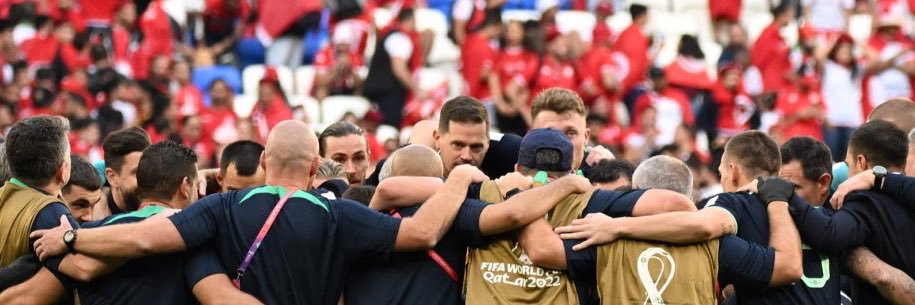
USA wet the bed last night against Belgium on the biggest stage of their lives, at home. The charged home crowd everyone thought would lift them is a big reason they sank. (1/3)
A crowd that size loads the weight of a nation’s expectations onto the home team. I watched the same mechanism play out in Game 3 of the NBA Finals a few weeks ago. (2/3)
european football has spent the past fifteen years solving futbol like chess.
a generation of coaches optimized for pass completion, pressing triggers, territorial control, rest defense, and positional occupation.
the problem of this is that they optimize for what is measurable. depth, the willingness to attack space early, attempt the difficult pass, dribble past a defender, or deliberately create chaos, is a high variance play. it fails more often than it succeeds. if you evaluate players by completion rate, ball retention, or positional discipline, those actions look like mistakes. so they get coached out. eventually, everyone converges toward the same local optimum.
the game becomes increasingly legible. every team occupies similar spaces, presses in similar ways, builds from the back with similar patterns, and minimizes the same risks. systems become better at defeating other systems, but worse at dealing with players who refuse to behave like systems.
south american football never fully abandoned the duel as the fundamental unit of the game. the 1v1 remained sacred. so did the tactical foul, the unpredictable dribble, and the player willing to lose possession five times if the sixth breaks the match open. the objective was never simply to preserve structure, it was to create someone capable of destroying the opponent’s structure.
football is not won by completing the most passes. it is won by scoring more goals than the other team. those are related, but they are not the same objective.
this is the danger of optimizing proxies. when everyone optimizes the same measurements, they stop optimizing for victory itself. they optimize for looking efficient.
italy may have been the first major european football culture to lose part of its identity this way. its historical advantage was never athletic superiority or perfect positional play. it was tactical asymmetry, unpredictability, and an instinct for making matches uncomfortable. as italian football converged toward the same coaching model as the rest of europe, it gradually surrendered the qualities that had made it different.
the broader lesson extends well beyond football. every optimization process eventually risks becoming self-defeating. metrics become targets. proxies replace objectives. variance is mistaken for error. the outliers capable of breaking the system disappear because the system itself learns to eliminate them.
They're developed and coached in very structured environments now, and often play the same way - African / South American teams (and some Asian teams) tend to defend and play differently than the Euro players are used to seeing, and they struggle to adapt to unstructured, unpredictable opponents
"Leadership is about being fearless, which is about staying in the moment."
In his book, Joe Maddon writes about how he created a 'fearless process' to help keep his players in the moment.
I wrote about it here: https://t.co/nsG7HSpyKj
If you have ever rushed a decision just because the deadline was closing and regretted it after, here is why, and the three moves that stop it: https://t.co/IExH9hgic7
The same thing runs in you every time a window starts to close.
A deadline, the last day of the quarter, an offer about to expire, and the clock stops being a clock and starts making the call for you.
(3/4)