A philanthropist has offered $10M to help fund full time Kindergarten in Saskatoon.
Our government to date has not accepted the money because they would have to match it dollar for dollar, and I guess that is not a good investment in their eyes?
Blinded by headlights? 👀🚗 Transport Canada is asking Canadians to weigh in on headlight glare, with a national survey open until April 20.
The shift to brighter LED headlights has raised concerns about visibility at night, especially when glare from oncoming vehicles becomes distracting. The results could help shape future safety guidelines.
Watch more video: https://t.co/eKq0HaVpJC
Your kid's piano teacher was reshaping their brain. A Harvard-led team tracked children from age 6 to 9 and found that kids who practiced an instrument at least 2.5 hours a week grew the corpus callosum (the cable connecting the left and right halves of the brain) by about 25% in the region that handles movement planning. Kids who practiced less or quit showed zero growth there.
USC ran a separate study starting in 2012 that followed children from low-income LA neighborhoods. One group learned violin through the LA Philharmonic's youth orchestra program. A second did soccer. A third had no structured after-school program. Two years in, only the music group showed brain changes: stronger white-matter connectivity, faster maturation of auditory processing, and greater activation in networks involved in decision-making and impulse control. The soccer and no-program groups looked the same on brain scans.
A randomized trial at the University of Toronto tested 144 six-year-olds assigned to keyboard lessons, voice lessons, drama, or nothing for a full school year. The music kids gained about 7 IQ points on average. Drama and no-lessons kids gained 4-5. That roughly 3-point gap showed up across every subtest, including reading and math.
Now the language side. Bilingual kids outperform monolingual kids on task-switching tests (jumping between different sets of rules quickly), and it holds regardless of which second language they speak. Brain scans of nearly 1,300 children and young adults from a 2021 Georgetown and University of Reading study showed that bilinguals kept more grey matter (the layer where the brain's processing cells live) as they grew up than kids who spoke one language.
The long game is where this gets serious. A 2025 Monash University study of 10,893 Australians over 70 found that people who regularly played an instrument had 35% lower odds of developing dementia. Bilingualism shows an even sharper effect. Studies across India, Canada, and the US consistently find that bilingual adults develop dementia symptoms 4 to 5 years later than monolingual adults. A 2024 door-to-door survey of 1,234 people over 60 in Bengaluru, India, found dementia in 4.9% of monolinguals and just 0.4% of bilinguals.
Both piano and a second language work through a similar mechanism. They force the brain to manage competing systems at once, left hand versus right hand, one language versus another. That constant switching strengthens the frontal regions responsible for planning, focus, and filtering distractions, building what neurologists call cognitive reserve: a buffer that lets the brain keep working even as age-related damage accumulates.
Those parents running their kids between piano on Tuesdays and Mandarin on Thursdays were basically running a two-front neuroplasticity program without knowing it.
New headlights are a menace on cars and bikes. Walkers and other drivers have to wear sunglasses or be blinded just because someone else has to make the treacherous Himalayan trek to Costco or soccer practise. Fill out the Transport Canada survey.
https://t.co/0yxMCzN898
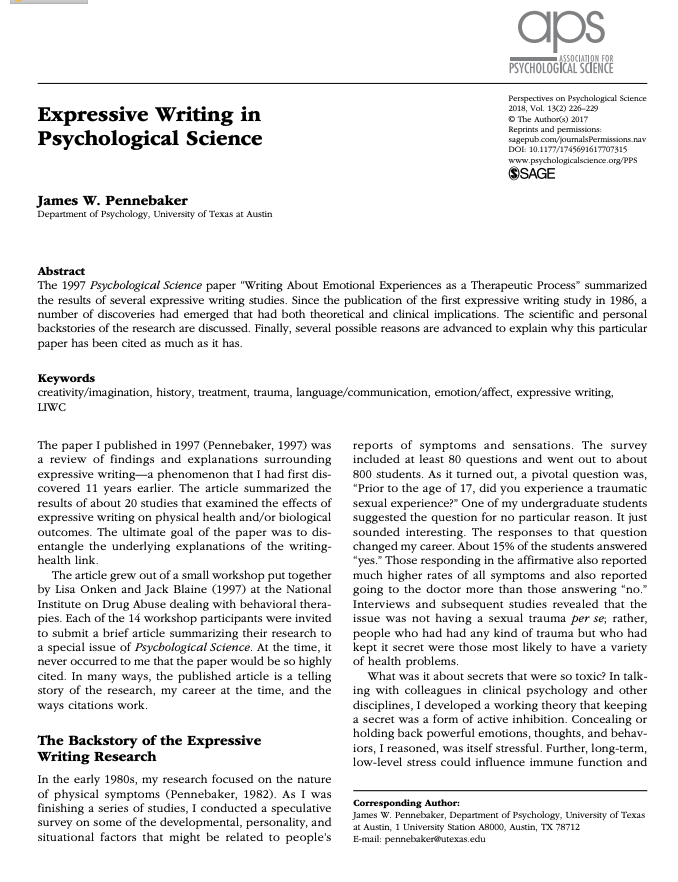
Every writing teacher who told you "be concise" accidentally murdered your best ideas.
In 1987, psychologist James Pennebaker ran an experiment that broke every assumption about how human creativity works. He divided college students into two groups and gave them the same creative writing prompt. Group A had to write for 15 minutes without stopping, elaborating on every thought that surfaced. Group B had to write concise, polished responses in the same time frame.
The elaborate writers didn't just produce more ideas. They produced fundamentally different types of ideas. Brain scans showed their prefrontal cortex entered a state resembling REM sleep, where distant neural networks suddenly started talking to each other. The concise writers showed patterns identical to focused problem-solving mode, which actively suppresses creative connections.
Six months later, Pennebaker tested both groups again. The elaborate writers had continued generating novel solutions to unrelated problems at twice the rate of the concise group. The act of elaborative writing had permanently rewired their associative thinking patterns.
The advice sounds logical. Cut the fat. Trim the excess. Get to the point faster. What they missed is that ideation and communication are completely different cognitive processes, and optimizing for one destroys the other.
When you write elaborately, your brain enters what cognitive scientists call "divergent thinking mode." Each additional sentence forces your mind to find new angles, make unexpected connections, discover relationships between concepts that would never surface in a stripped-down version. The elaboration itself becomes the thinking tool.
Watch what happens when you try to explain a simple concept in 2000 words instead of 200. Your brain refuses to repeat itself. It starts mining deeper layers, pulling up examples you forgot you knew, connecting dots that seemed unrelated five minutes ago. The constraint of length becomes a creativity multiplier because your mind has to work harder to fill the space meaningfully.
Most people reverse this process. They think first, then write down the conclusions. They treat writing as a documentation tool for thoughts that already exist. This kills the discovery mechanism completely.
Real creative thinking happens during the writing, not before it. The elaborate sentences force your brain to search its entire knowledge network for supporting ideas, contradictory evidence, parallel examples, deeper implications. Every time you expand a thought, you're asking your neural pathways to surface material that stays buried when you think in headlines.
Professional researchers figured this out decades ago. They don't brainstorm in bullet points. They write massive exploratory documents where every paragraph spawns three new questions. They let themselves ramble across pages because they know the rambling is where breakthrough insights hide. The connections emerge in the elaboration, not despite it.
There's another layer most people miss. When you write elaborately about a topic, you're not just exploring what you already know about it. You're discovering what you didn't realize you knew about it. The act of expansion forces you to reach into adjacent knowledge areas, pull connections from unrelated experiences, surface insights that were sitting just below conscious awareness.
Pennebaker's follow-up studies revealed something even stranger. Students who wrote elaborately about completely unrelated topics showed improved creative problem-solving across all domains. The cognitive muscle of elaborative thinking transfers. Train it on one subject, and it enhances your ability to find novel solutions everywhere else.
Your brain was designed to think in stories, not summaries.
Feed it complexity and watch creativity multiply.
For Renee Nicole Good
Killed by I.C.E. on January 7, 2026
by Amanda Gorman
They say she is no more,
That there her absence roars,
Blood-blown like a rose.
Iced wheels flinched & froze.
Now, bare riot of candles,
Dark fury of flowers,
Pure howling of hymns.
If for us she arose,
Somewhere, in the pitched deep of our grief,
Crouches our power,
The howl where we begin,
Straining upon the edge of the crooked crater
Of the worst of what we’ve been.
Change is only possible,
& all the greater,
When the labour
& bitter anger of our neighbors
Is moved by the love
& better angels of our nature.
What they call death & void,
We know is breath & voice;
In the end, gorgeously,
Endures our enormity.
You could believe departed to be the dawn
When the blank night has so long stood.
But our bright-fled angels will never be fully gone,
When they forever are so fiercely Good.
Just like that, within hours, the feds have approved 300 firefighters to help protect communities in the North.
Why did it take the Sask. Party nearly two months to ask?
Why did they sit on their hands while entire communities burned?
1/n Sjogren’s is no more a sicca disease than systemic sclerosis is a skin disease. Sjogren's disease (SjD) is a serious systemic disease associated with ↑mortality and ↓↓ QoL. It can impact every part of the body.
A 🧵every rheumatologist should read.
The single most shocking report on Saskatchewan K-12 you've ever read, period.
Stunning and sickening assessment of @SaskParty's education system.
No media coverage.
Zero @Sask_NDP comment.
It's hard to read - but you better.
@SaskTeachersFed - you up?
https://t.co/a5tg9mnu7K
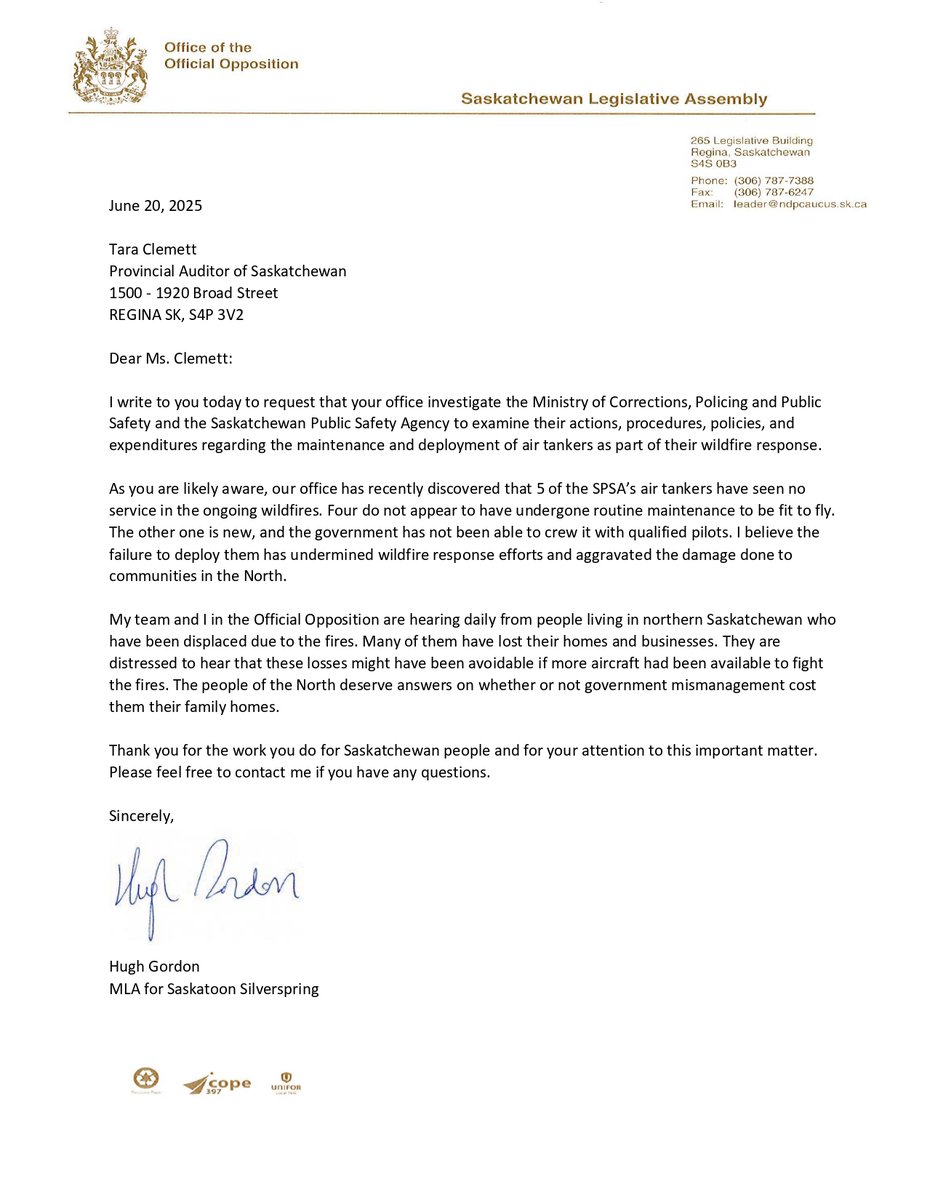
Today, the Saskatchewan NDP is calling on the Provincial Auditor to conduct a full investigation into the Sask. Party's complete failure to maintain the water bomber fleet needed to protect communities in the North from devastating wildfires.
These planes could have made a difference — instead, they sat on the tarmac while communities in the North burned.
The people of the North deserve answers, not excuses.
Earlier this week, we learned that Saskatchewan’s brand-new water bomber was grounded during the worst wildfires in a decade.
And that's just the tip of the iceberg.
Today, we are revealing that nearly half of Saskatchewan’s existing water bomber fleet was grounded — without any public explanation—during what’s been called the worst wildfire season in over a decade.
Our air operation should have had all of our resources at the ready in safe and operable condition
People deserve to know why the Sask. Party government failed to act.
Why they failed to use the tools at their disposal.
And why they failed to be honest with the public about it.
They deserve leadership that has their backs.
Right now, they’re not getting it.
My mom @LandsbergMich wrote columns for decades - changing countless lives with her powerful prose and sparkling arguments.
At 85, goddamn she still has it. Read this piece about her pop-up feminist protest against genocide.
Mom, you’re my hero.
https://t.co/cvDNTez0kS
It’s hard to believe — at a time when Donald Trump is doubling down on tariffs and attacking Canadian industries — that Scott Moe’s response is to sell out Saskatchewan workers and businesses.
This is a complete reversal of what the Premier promised just months ago.
He said he would stand up for Canadian workers. He said he would put Saskatchewan and Canadian businesses first. And now, he has broken his promise and is siding with Donald Trump, a man who constantly threatens to force us to become the 51st American state.
This decision by the Sask. Party will send Saskatchewan jobs and Saskatchewan tax dollars south of the border — at the exact moment our steel industry is being hammered by 50 per cent tariffs.
Scott Moe had a chance to show leadership, and he folded.
What the Ombudsman has revealed this morning reinforces so much of what we’ve
been hearing from thousands of evacuees for weeks:
People being bounced around from agency to agency, with no clear
information. Phone numbers that don’t work, emails that never receive a
response.
More than a week for basic information or support. People sleeping in their
cars and in tents because they weren’t provided proper shelter.
People who have spent thousands of dollars and haven’t been given a dollar
in financial aid. Some stacking on mountains of debt.
People being given vouchers for grocery stores that are 300 kilometres away.
At every turn, pure chaos and callous failure. Anger. Frustration. Hopelessness. And a Sask. Party Government that doesn’t seem to care.
Today, we are demanding Scott Moe and Tim McLeod come forward with an
immediate plan to better respond to this crisis. There can be no further delay. No
further failure. It’s time to show these evacuees some basic human decency.
To the people of the beautiful North, I want you to know that the Saskatchewan NDP
is in your corner.
We won’t stop fighting for you — so you can get the help you need. So you can get
home.
We will recover. We will rebuild what has been lost. The North will endure.
STATEMENT FROM SASKATCHEWAN’S NDP OFFICIAL OPPOSITION ON THE WIlDFIRE DEVASTATION AT EAST TROUT LAKE
The Official Opposition stands in solidarity with the families impacted by the devastating wildfire at East Trout Lake.
The wildfire that began on May 7 in northern Saskatchewan tore through East Trout Lake, resulting in the total destruction of the community townsite and nearby First Nations traplines. Every cabin — gone. In a matter of hours, an entire community was erased. What remains is grief, shock, and deep uncertainty.
Nestled between Clarence-Steepbank Lakes and Gem Lakes Provincial Parks, East Trout Lake is more than a dot on the map. It is a place of personal, cultural, and generational significance for many Saskatchewan families who have called it their home for decades. For others, it was a place of gathering, recreation, and deep connection to the land.
We extend our sincere thanks to the frontline responders whose efforts under difficult conditions are deeply respected. Their bravery and dedication deserve full recognition.
This past week, I met directly with members of the East Trout Lake Community Board to hear firsthand the scale of the loss and the impact on the community. Their message was clear: they feel abandoned.
Since the fire, cabin owners and others in the region have received no information, no outreach, and no indication of what steps — if any — are or will be taken to support recovery.
This lack of communication has only compounded the trauma.
We are calling on the provincial government to acknowledge the scale of this loss, to communicate transparently with those affected, and to deliver a coordinated, timely recovery plan.
As the Official Opposition, we will continue to raise this issue and press for the answers and support that East Trout Lake and the surrounding region deserve.
The community has lost everything. They should not also have to fight for a response.
We urge the government to act.