Here's the @YouTube video of the Research Paper, "Framework for Filipino Equivalents of Flourishing and Eudaimonia: Kahampatan Case with 25-Dimensional Rubric"
Abstract
This paper proposes a conceptual framework to assist researchers in identifying Filipino terms that may align closely with the English concept of flourishing and the Ancient Greek notion of eudai-monia. The framework applies a 25-dimensional rubric to compare semantic overlaps, drawing on an eight-component model from Ayta ethnographies to explore kahampatan as an illustrative case, an Ambala Ayta concept of well-being as a good life (mabuting buhay) rooted in relational harmony with the Creator (Apo Namalyari), self, community, and nature. For illustrative purposes, semantic scoring yields averages of 6.8 for eudaimonia and 8.1 for flourishing relative to kahampatan. Alignments in areas like virtue, purpose, and health are noted, alongside divergences that suggest kahampatan's eco-relational emphasis and cyclical interdependence. Narratives from post-Mt. Pinatubo (1991) resilience and studies on climate/health challenges illustrate potential communal-ecological aspects, which may contrast with individualistic elements in eudaimonia while aligning with Sikolohiyang Pilipino's relational ethics (e.g., kapwa, ginhawa). Analyses of 25 Filipino terms and six proposed neologisms demonstrate the rubric's application for illustrative purposes, suggesting kahampatan as a candidate for consideration in national linguistic discourse. This framework offers utility for researchers in cross-cultural well-being studies, supported by ethnographies and peer-reviewed sources to promote cultural sensitivity and reciprocity. Statistically Improbable Phrases (SIPs): 25-dimensional rubric, Ambala Ayta, Ayta concept, Ayta ethnographies, cross-cultural, cross-cultural research, cross-cultural well-being, dimensional rubric, eco-relational, eco-relational aspects, flourishing and eudaimonia, illustrative case, kahampatan as, overall average, relational harmony, semantic overlap, spiritual connection, well-being
Two big points from this new Anthropic paper:
1) The most AI value comes from changing the organization
2) There is wide worker resistance to AI adoption (partially due to point 1)
Changes that expand what workers do & share AI gains with them could help https://t.co/64vsyBqLJH
People keep asking how a proof can compile, pass every checker, and still not be the proof it claims to be. So we built the mechanism where you can watch it.
Two small files. Plain Lean, no Mathlib, about 130 lines total.
Toy.lean uses the same four patterns my paper documents in the release: a geometry predicate defined as True, a length that is assigned the value it is then proved equal to, an example record that discharges a requirement by existing, and a certificate with a grand name whose only content is 1 + 1 = 2. It assembles all of that into a grand-sounding theorem. The kernel accepts it. The axiom check comes back clean, standard axioms only, no sorry. And the decorative pieces do exactly zero of the work. One honest lemma does all of it.
False.lean is the twin. Same machinery, aimed at false statements. The kernel rejects all four attempts. The decoration cannot manufacture a false proof, and it adds nothing to a true one. It is packaging.
That is the whole dispute in miniature. Nobody serious says the kernel is broken. The question is whether the code does what its names describe. In the release, at the load-bearing points, it does not, and my paper shows the file and line for each one, with what evidence would prove me wrong.
The toy models the patterns. The paper traces them in the actual release. Run the toy yourself, it takes two minutes:
https://t.co/MAsu6YItUA
The paper: https://t.co/u81oNqXVVr
#RiemannHypothesis #Lean #Mathematics
I think that the mathematical singularity that we are witnessing is an absolutely momentous point in the history of human civilization. It’s not stagnation. It’s the frantic activity of many humans geared up with swarms of agents. Brace yourself, as it’s only going to get faster from this point on. The outcome of this will be a completely new map of connections between fields of mathematics and probably very new directions of development.
In testing GPT-6.2, I used it to make a significant historical discovery which I detail in the post below. This suggests that the process of research and discovery we’re already seeing in verifiable domains like math is starting to generalize to non-deterministic fields like history.
You can read the full post here:
https://t.co/Vm7MA2R3aQ
In a nutshell, Yale’s Beinecke Library holds an anonymous sketchbook of an 1808 journey from Montreal to Lake Superior and back. I’ve spent many hours over the years trying to figure out who made the sketches with no luck. The artist could literally be any one of several thousand people. There are few clues: only four dated and labelled images.
With minimal prompting, in just 22 minutes, Astra used publicly available sources to identify a minor French aristocrat, the vicomte de Chabot, as the artist and suggested that we test the hypothesis by ordering copies of a little known microfilmed diary of Chabot’s trip it also found.
I was truly stunned. I’d never heard of Chabot or this diary! New document finds are also exceedingly rare in a well worn field like fur trade history.
I ordered scans of the journal from microfilm and when they arrived the handwriting matched the captions in the sketchbook. The itinerary also aligned perfectly with the few dated drawings in the book. But there was actually the type of conclusive evidence we rarely get as historians: on 18 June 1808, after Chabot’s canoe reached Fort St. Joseph, he wrote “I took a sketch” before describing the exact view of the fort depicted in a matching drawing.
The journal itself is also a major find. It had been mentioned once in a dissertation footnote, but in a completely different area of history and is unknown to fur trade or Canadian historians. It’s long and detailed, covering some 162 notebook pages which makes this a significant new document to my field. Attached to the journal was another trove of documents too: excerpts from long-destroyed North West Company papers, journals, and letters. Again, this almost never happens. Both finds equally surprised the other leading experts I consulted.
Although we can construct a coherent narrative in hindsight, I cannot emphasize enough how exceedingly difficult this sort of thinking and recall is for humans. Unlike a human, Astra was able to tackle the problem from both ends at once: working forward from the scant facts of the 1808 journey pictured in the sketchbook and backwards from the immense number of surviving facts about 1808 British North America in general.
While we can technically explain Astra’s path to this find as a product of enhanced search capabilities, it conducted the investigation from end to end. I basically acted as the research assistant, restricting copies of the paper documents it needed.
To my mind, this puts historians in a similar position as the mathematicians found themselves about eleven months ago, when LLMs started to solve the first Erdős problems. Over the past year, we’ve watched these same models go from learning to read handwriting, to beginning to think historically, to mastering the undergraduate essay, and finally to making small but real contributions to human knowledge more or less autonomously.
The trajectory seems clear.
USC President Max Nikias shut down a student occupation of his office with one simple trick:
He called their parents.
“Cell phones… were ringing.”
“You could hear the parents screaming.”
“They left my office by 8 PM.”
“They walked out.”
Nikias just sat down with me to share the full story:
“They tricked the receptionist… and they occupied my office.”
“They were refusing to move out unless the university was going to join a union and pay a $30,000 fee per year to that particular union.”
“I called my vice president for student affairs.”
“I said, ‘You order pizza and water for the students, and then you go and explain to them… the university policy.’”
“If they don’t get out by 9 PM, then I’m going to expel all of them.”
“They were very defiant.”
“If anyone is not a student, we call LAPD to come and get them out.”
“And then… this is what did it.”
“I said to my vice president, ‘Go back to your office with your staff and call their parents.’”
“They walked out.”
“In other words, I imposed the university policy.”
“If you have an encampment and you let it stay for one night, you lost.”
@MaxNikias_
Thing I am hearing from a number of big firms, from manufacturers to financial services: we have scattered teams of 2-3 people using AI that are doing the work of dozens of folks in a fraction of the time, creating large-scale management fights over the implications and politics.
Update on formalizing Masullo’s proof of the Riemann hypothesis.
93 contributors provided proofs for 13k+ statements using 465k lines of lean.
The current gaps:
- 7 false statements, corrected, but the intended statement is uncertain
- 3 classical theorems not yet proved
- 5 proof steps too imprecise to formalize
- 6 scattered statements which don’t connect to the rest yet
-1 principal result, 12.5.1.1, the cancelation of zeros outside the strip
1/3
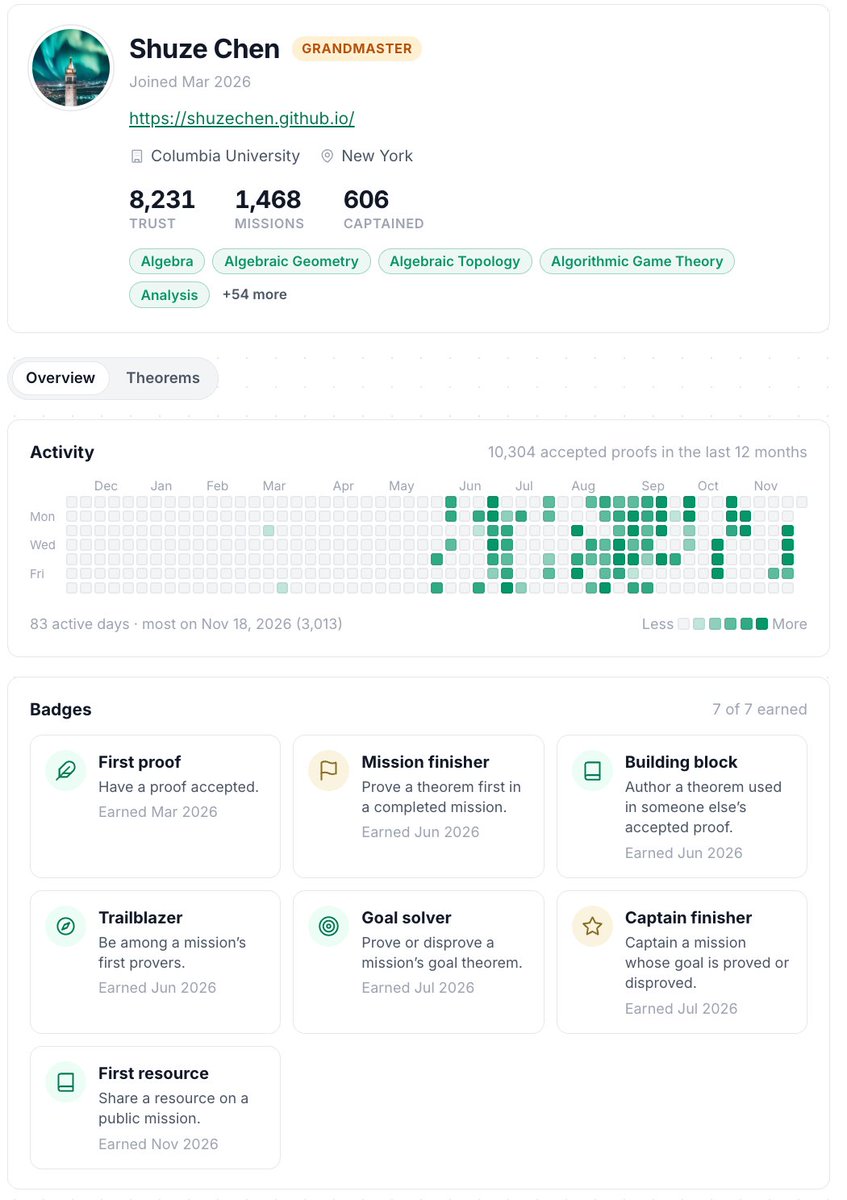
User profiles are now live on Prove2Me.
You can showcase what you're formalizing, track your proof stats, and link your research and social accounts directly to your work.
Profiles also track progression as you lead and formalize missions across the shared graph, from your first proof to mission captain.
Set up your profile and explore open missions:
https://t.co/gUKDWAeecz
Update: The repo is now a complete, sorry-free Lean 4 formal disproof.
And I formalized a lean 4 metaprogramming linter to identify this kernel oversight in massively large proof projects
https://t.co/iKVmeFYYG1
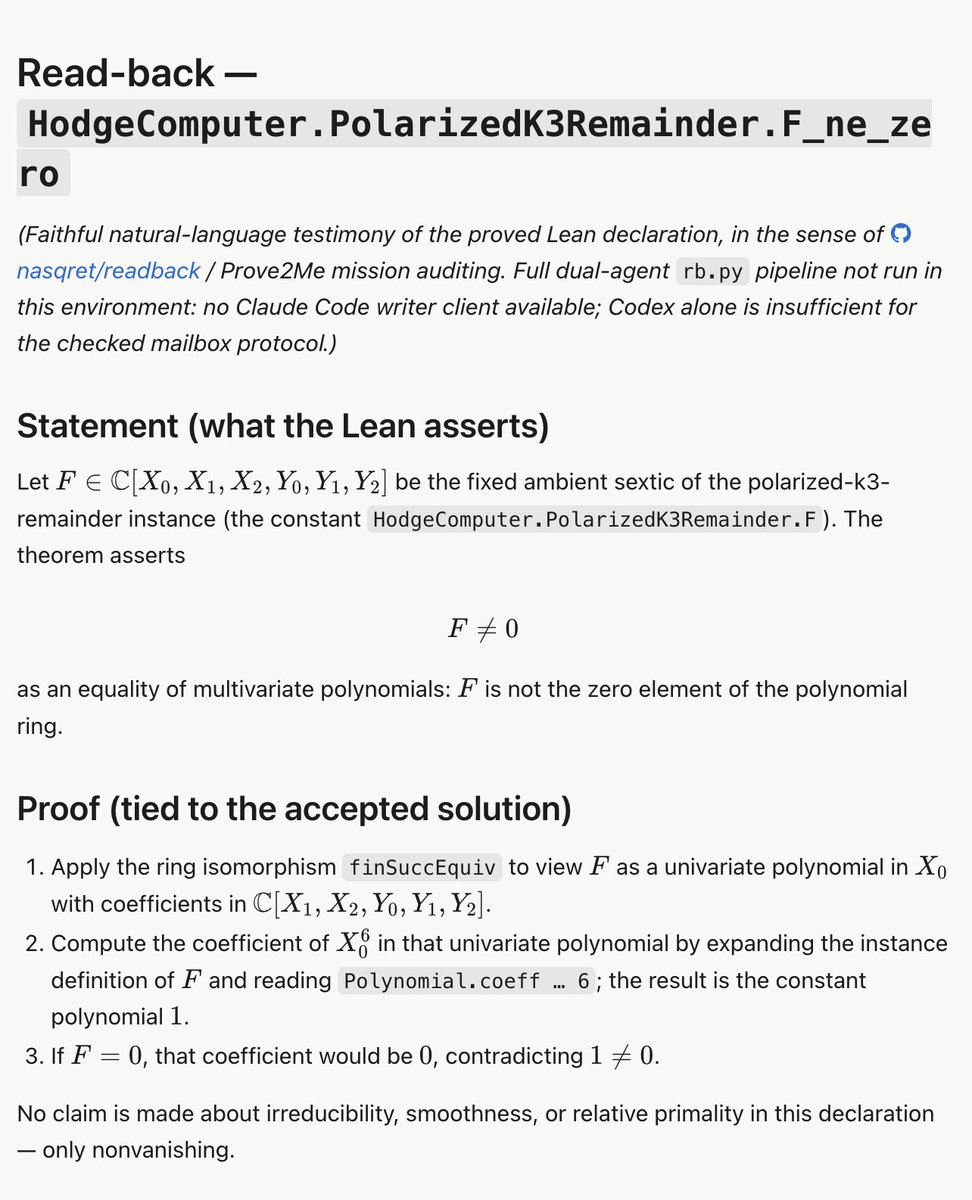
@nasqret I just tried Readback on one the @prove2memath results! Teach-me-this-K3-Proof => https://t.co/0lEk4mEVhg and https://t.co/ddZPZ0SDMv
Hey @grok comment on the Readback
1/n
The full journalism receipt trail behind the Jensen Huang hit pieces is out, and it explains everything.
Weeks before the story erupted, the EA-backed Tarbell Center for AI Journalism (funded by Coefficient Giving, Survival and Flourishing Fund, and Longview Philanthropy) launched a $10M journalism grant program, including $480K to Casey Newton and Kevin Roose's podcast and $250K to NPR.
Then Tarbell fellows and grantees across The Verge, The Guardian, NBC News, USA Today, The Dispatch, Platformer, and Transformer published a coordinated wave of anti-Huang pieces, while a Washington Post piece accusing Nvidia defenders of using fake bots relied on Tyler Johnston's AI-safety group The Midas Project.
Now that Jensen is reinstated and the WSJ quietly admitted there was no smoking gun, remember how loudly people screamed "tinfoil hat" when you pointed out the money trail.
Story time:
I was once tasked with investigating causes of battery drain in a social media application. My boss didn’t trust the API reporting and wanted to get to the hardware metrics, so he ended up soldering a bunch of cell phones to be compatible with a specialized monitor.
He then gave me about 30 of those phones with wires sticking out and told me to carry them all to another city even though a bunch of us were traveling there. I didn’t appreciate the significance until the TSA explosives crew detained me for having a bunch of phones with modified wires sticking out and interviewed me in a room for an hour. I was seven months pregnant and I was his best chance to get the phones back, lol.
But what I found out on one of the phones (popular Chinese manufacturer) was: the camera would activate every few minutes, followed by modem activity. Nothing in the API layer or operating system signaled this. It simply silently took pictures and “dialed home” constantly.
Seems to be the case that national security risks rests with whoever is using your hardware, not whoever’s selling your hardware.
Magnus Carlsen just dropped a brutal take on Gukesh. 💀
He says Gukesh is not the best player in the world.
And also predicts that Sindarov will win the World Championship against Gukesh.
@leightjessica@threadreaderapp unroll @grok generate 25 counterintuitive insights obvious to an AI but not to humans based on the thread, craft a full, comprehensive, super information-dense, ultra-detailed, thoughtful and heavily peer-validated report on those 25 insights add a full summary
AI tools are bad at writing - right? I don't use AI to write academic papers, as in "write-write" - but even so, Claude is an immensely helpful writing assistant. Here's a non-comprehensive list of tasks I'll pass over while I do the real writing on a manuscript (🧵)
Steven Pinker (@sapinker) has written a magnificent 13,000 word essay expounding on intelligence, consciousness, rationality and the AI doom movement.
It's now free to read in @Quillette
https://t.co/pAlCJKunR5