A coin's price in ETH is two prices multiplied: the coin against its pair, and the pair against ETH. Until now the chain picked that second half for every coin on it (SOL on Solana, BNB on BNB Chain, ETH on Robinhood).
Pair is live on Robinhood Chain, and the creator picks it. Pair your coin with ETH, any Robinhood token with liquidity (USDG, stock tokens, PONS), or one of 344 Pair tokens that follow SOL, BNB, PEPE, BONK and the top coins of Solana, Ethereum, Base and BNB Chain. When SOL runs, every coin paired with pSOL runs with it in ETH; buyers still pay with ETH, in one transaction, on one chain.
CA: 0x3024d06034a3fc1faf85f11fabb491c25ff7e5fd
https://t.co/DvvNJGM0Dv
Every cross-chain pair on Pair holds its own ETH reserve, and today our treasury made its opening sweep from one of them.
The reserve backs what holders of that Pair token are owed, valued at the price they would sell at. 1.5% of every hop stays in it, and what sits above 150% of the amount owed is all that can ever leave, through a single function the contracts lock to that line. The pair that follows SOL had 0.089 ETH above it, so we swept that and its pool sits at 150.2% coverage. The other 343 pairs have nothing above the line yet, so nothing left them.
Anyone can check a pair's coverage on chain by reading coverageBps on its hook.
On Pair, we've made it so every coin trades against the asset its creator picked, from ETH to coins from Solana, Ethereum, Base and BNB Chain. That pair is part of what you're holding: the coin moves with it in both directions, so picking a coin also means picking the market it follows.
That's why Explore is organized around pairs. A community can open its own asset in the side list and see every coin built on it; traders can sort everything by volume or market cap and find what's moving across all of them in one place.
The bigger idea is that any community's asset can anchor new markets, and Explore now puts all of those markets side by side.
We've just reworked the explore page on Pair and it's now live!
Every pair sits in one compact list on the side with its coin count, 24h volume and move, and all the coins show at once in a single table. You can sort by market cap, 24h volume or launch time, set a floor on market cap or volume, or search by name, ticker or address.
The home page also opens with the six most traded coins on Pair over the last 24 hours, each with the pair its creator picked, so you see what's moving before you pick what your own coin trades against.
https://t.co/vyDKXwpNkI
Next Pair update is almost ready.
Explore is getting a full rework. Every pair sits in one compact list on the side, and all the coins show at once in a single table you can sort by market cap, 24h volume or launch time. You can set a floor on market cap and volume (1K+ up to 1M+) or search by name or ticker, so the coins that are moving are a couple of clicks away.
The home page will also open with the most traded coins on Pair over the last 24 hours, each shown with the pair its creator picked, right above the part where you pick what your own coin trades against.
A coin launched against a cross-chain pair has two reasons to move: its own buyers, and the coin its pair follows, up and down.
That second one is why a launch on Robinhood Chain can catch a rotation that started on another chain, and why traders on that chain have a reason to look over here.
Anyone can build on cross-chain pairs.
Pair's API is open: all 344 pairs and where each one comes from, every launch, every coin, candles, moves against ETH across four chains. Apps, bots and dashboards can read all of it today, and the contracts are public for anyone who wants to launch or trade through them directly.
Launch against a coin from another chain and your creator fees come in that pair.
0.5% of every buy and sell goes to the creator, credited on each trade and claimable from the coin page in one transaction. So you pick what your coin moves with, and what you earn moves with it too.
People have a home chain. They know its coins and they watch its charts all day.
So each of those chains now has a direct way into Robinhood Chain: open your chain's page on Pair, see what's moving, and launch against it from one wallet. That's how the volume on those chains starts finding its way over here.
Every chain now has its own page on Pair.
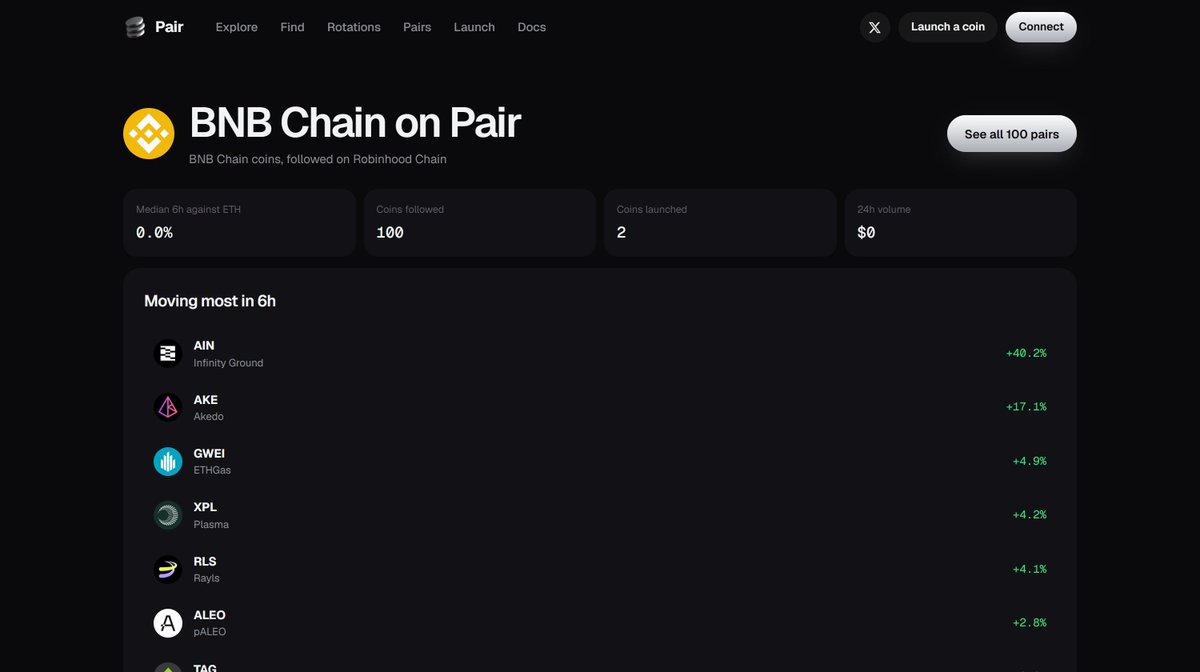
https://t.co/Um0wKQKTVZ, /ethereum, /base and /bnb each show how that chain's coins are moving against ETH, the ones running hardest, and every coin launched against them on Robinhood Chain.
Solana, Ethereum, Base and BNB Chain are each about to get their own page on Pair: how that chain's coins are moving against ETH, what's running hardest, and every coin on Robinhood Chain launched against them. Your chain, in one place 👀
You can follow a rotation on Solana, Ethereum, Base or BNB Chain from one wallet on Robinhood Chain, with no bridge and no second chain's gas token. That's what cross-chain pairs do for a trader.
A coin launched against one moves with the coin behind that pair as well as its own buyers, up and down, and you buy it with ETH in one transaction.
Bringing other chains' volume to Robinhood Chain takes trust in what people are trading on, so that's where we started.
Every coin's launch liquidity is burnt in the launch transaction. No role can move a coin's pool, change a fee, mint a coin or a Pair token, or take a Pair token reserve below 150% of what its holders are owed. And we ran the attacks ourselves on a fork of Robinhood mainnet before the pools opened: pumping the asset and selling, dumping then buying, one huge trade, a stopped feed.
Every chain has traders who will never bridge for a launch they've never heard of. Cross-chain pairs give them something they already care about on the other side.
A coin here moves with a coin they follow, so attention comes first and the volume follows it. More volume brings more launches, more launches bring more pairs into play, and Robinhood Chain gets a bigger share of what's moving everywhere else. That's the flywheel we're building Pair around.
A cross-chain pair matters most while its coin is moving, because that's when other chains' traders are paying attention.
So the moment to launch shouldn't take research. You see what's running across four chains, you pick it, and your coin is live on Robinhood Chain in the same rotation.
Moving now is live on the Pair launch page.
The coins rising fastest against ETH across Solana, Ethereum, Base and BNB Chain sit right above the pair picker. One click pairs your launch with one of them, so the coin you launch on Robinhood Chain moves with what's already running.
https://t.co/4LVwHTAOL6
The launch page is about to show you what's moving. Open it and the coins running hardest across Solana, Ethereum, Base and BNB Chain will be right at the top, so you can launch into a rotation while it's happening 👀
Launch on Robinhood Chain, pair across chains.
The coin stays here, trades here and settles here. What comes from the other chain is the market it moves with: the pair is a token on Robinhood Chain that follows a coin from Solana, Ethereum, Base or BNB Chain, so a trader watching that coin has a reason to look at Robinhood Chain without bridging anything.
Half a day of launches on Pair: 31 coins from 16 wallets and $432k of volume, across 12 different pairs.
7 of those coins already trade against cross-chain pairs from Solana, Ethereum and BNB Chain, with the rest on ETH, USDG, PAIR and other Robinhood tokens. Each chart moves with the pair its creator picked.
https://t.co/vyDKXwpNkI
If you're new here, this is the one to read.
Our thesis: traders care about specific chains, and their volume stays there until something gives it a reason to move. Launch on Robinhood Chain, pair across chains, and a coin here moves with what those traders already follow on Solana, Ethereum, Base and BNB Chain. As Robinhood Chain grows, we expect those pairs to pull that attention and volume over, and every wave of it makes Pair a better place to launch the next coin.
The article also goes under the hood: one buy followed through the contracts, where every price comes from, and each attack we ran against the pools.
Traders pick the chains and coins they care about, and that attention rarely moves on its own.
So we built them a way in. A trader who follows a coin on another chain can now paste the address they already have and land on Robinhood Chain, with cross-chain pairs moving alongside that coin. Launch here, pair across chains: that's how other chains' volume finds its way to Robinhood Chain.
Find your coin is live on Pair.
Search any of 344 coins from Solana, Ethereum, Base and BNB Chain by name, ticker or the contract address you already know from its home chain, and you land on its own page on Robinhood Chain: how it's moving against ETH, every coin launched against it, and one click to launch the next.
https://t.co/5MbrRxerk0