Before you sign a trade on Pair, check the minimum you’ll receive.
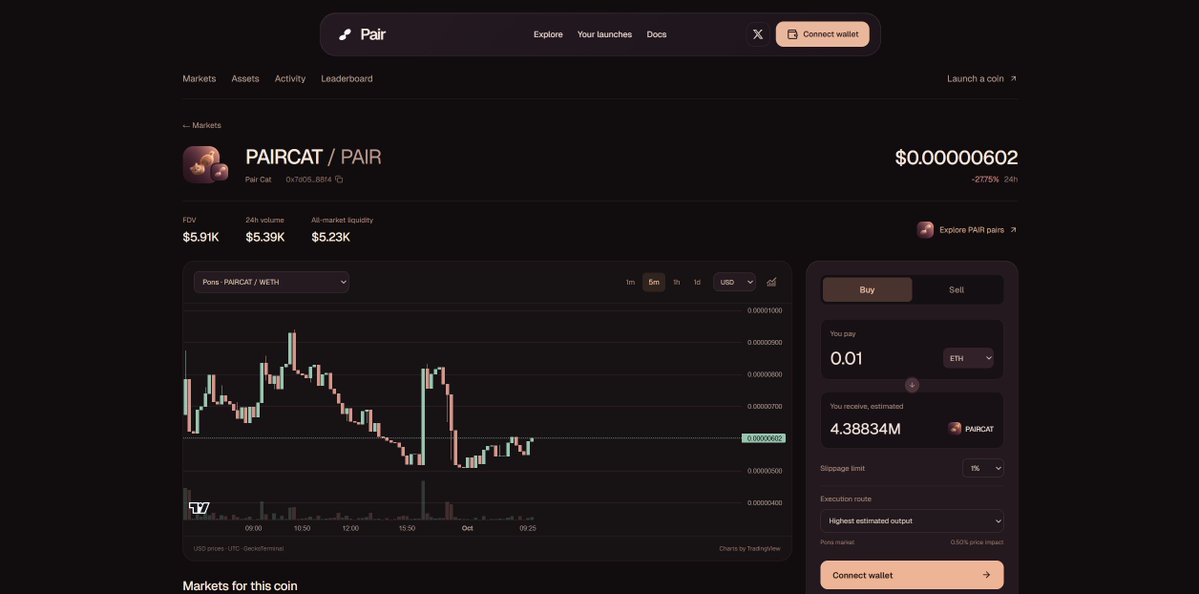
The review shows the selected route, expected output, minimum received and estimated network cost. Your slippage setting defines how far execution can move from the quote.
If the reviewed quote expires, the app asks you to refresh it before signing. The swap also carries a minimum-output requirement on-chain.
A few seconds spent checking that review can make a real difference in a thin market.
https://t.co/7UACgoG959
That's because this is their main pool. A secondary pool was created at launch where people can trade the coin for a lower fee, while on the main pool the fees will feed that secondary pool, so at the end the secondary pool is the one with the deepest liquidity (the one with the pairing).
Every coin launched through Pair gets its own on-chain vault.
That vault tracks the coin’s reserved liquidity, creator earnings and, for V2 launches, its allocation to PAIR buybacks separately.
The liquidity portion stays dedicated to that coin’s chosen market. Creators and holders can follow what the vault received, what remains reserved and what has actually been added to the pool.
Each project has a funding history you can inspect, from released fees through to confirmed liquidity additions.
https://t.co/CLewDUoLd8
Already follow an asset on Robinhood? You can use it to discover new projects on Pair.
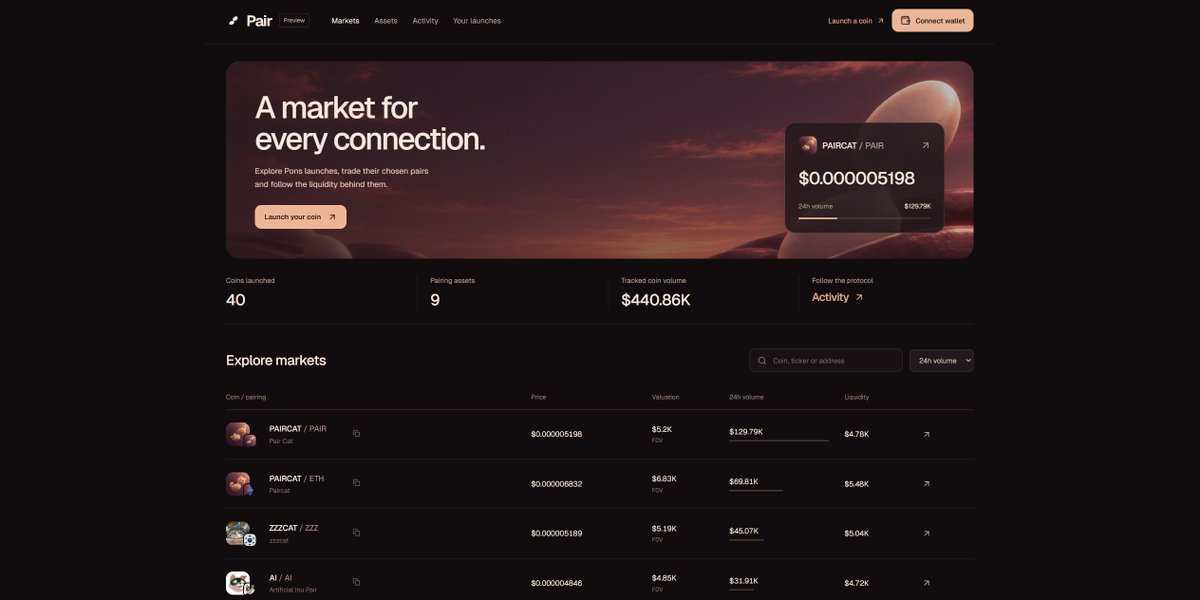
Our Assets page groups launches by their chosen pairing. Open PONS, for example, and see the coins that selected it, with their prices, trading volume and liquidity in one place.
For existing communities, that makes it easier to find projects building markets around the asset they already use.
For creators, your pairing becomes another way for people to discover your coin.
https://t.co/eKIatk5bZE
It's pretty simple. We aim to not be a new competing launchpad, too many projects do this and it usually doesn't work.
What we did instead, was to build around Pons as a sort of wrapper, so this way, coins keep their original Pons market while getting an additional pool against the asset their creator chooses.
Part of the released trading fees then goes towards building liquidity in that chosen pool, with another part allocated to PAIR buybacks and burns on our newer contracts. In the case you sent, the launchpad trades on a completely different pool. It's easy to make a launchpad that can just pair against any pair, but it's not easy to make that launchpad work around Pons and finding a way to expand it against any pair.
We believe Pons already has a good ecosystem, so our goal is to expand what people can do within it and that's our difference.
Pair’s weekly leaderboard is ready to preview.
The top 5 coins by weekly Pons trading volume, displayed in USD, or current market cap. FDV is labelled where market cap is unavailable.
Every launch enters automatically. We’ll review the activity behind each project and exclude invalid entries, using these weekly reviews to decide which builders deserve more visibility and support.
We want to encourage people to keep building after launch and make their progress easier to follow.
We're still contacting potential partners to push Pair further. The Telegram group for updates should be the next thing coming soon.
Try the preview: https://t.co/SKpol8VQr3
We’re building weekly creator rounds on Pair to support projects that keep developing after launch.
Each round will review activity over at least seven days, looking at returning traders, liquidity maintained over time and the creator’s work on the project and community.
We’ll check for self-trading, circular activity and coordinated wallets before selecting projects. Raw volume alone won’t decide the results, and suspicious patterns will be reviewed before anyone is excluded.
The plan is to combine featured placement, launch support and capped rewards from a fixed round budget. We’ll publish the eligibility rules, review process and reward details before the first round opens.
We want this to give serious creators more visibility and a reason to keep building within the Pons ecosystem.
We’ve also started contacting potential partners to help push Pair further and bring more builders to the platform. A Telegram group for development updates and community feedback should be coming soon.
https://t.co/ZNjbwZEU7f
41 launches through Pair, with liquidity already added to multiple paired pools.
The largest pools have received repeated additions as released trading fees are put back to work. That’s the mechanism taking shape: activity in the original Pons market helps fund the chosen pair.
For new launches, V2 expands the supported funding routes and adds $PAIR buybacks and burns alongside liquidity building and creator earnings.
There’s still work ahead on execution and compatibility. The flywheel is just the beginning - we’re building a stronger connection between each launch, its paired market and $PAIR.
https://t.co/abwxjImd4h
Pair so far: 41 recorded launches across 10 different pairing assets, including our initial test launches.
Each pairing gives creators a way to build a market around the asset they choose while staying within the Pons ecosystem.
You can now explore those launches by paired asset, compare their markets and follow confirmed liquidity additions directly in the app.
https://t.co/7UACgoGGUH
An important detail from the start: liquidity committed through Pair stays committed.
The starting supply you reserve goes into the coin’s liquidity vault. Once liquidity is added, the vault holds the LP tokens or position. Our deployed vaults have no function that lets the creator or keeper withdraw those holdings.
Creator earnings are accounted for separately and can be claimed without withdrawing the pool’s liquidity. Pausing reinvestment doesn’t unlock it either.
That separation is part of the design: creators can earn from their launches while the liquidity built for their chosen pair remains committed.
https://t.co/fupIzCY3LT
Your trade size can change which pool gives you the better price.
A route that works well for a small buy can become less attractive for a larger one if liquidity is thin. Even a lower trading fee can be outweighed by price impact.
That's why Pair compares supported routes for the amount you enter and selects the highest estimated token output after pool fees. Network costs are shown separately before signing.
As a chosen pair builds liquidity, its quotes can become more competitive. You can compare it with the original Pons market directly in the app.
https://t.co/7UACgoGGUH
The Pair trading update is live.
You can now go from discovering a coin to reading its chart, comparing its markets and reviewing a trade in one place.
Every trading page brings the original Pons market and the chosen pair together, with real candles, recent trades and liquidity data. The trade panel compares supported routes for your amount and shows the expected output, slippage limit and network cost before you sign.
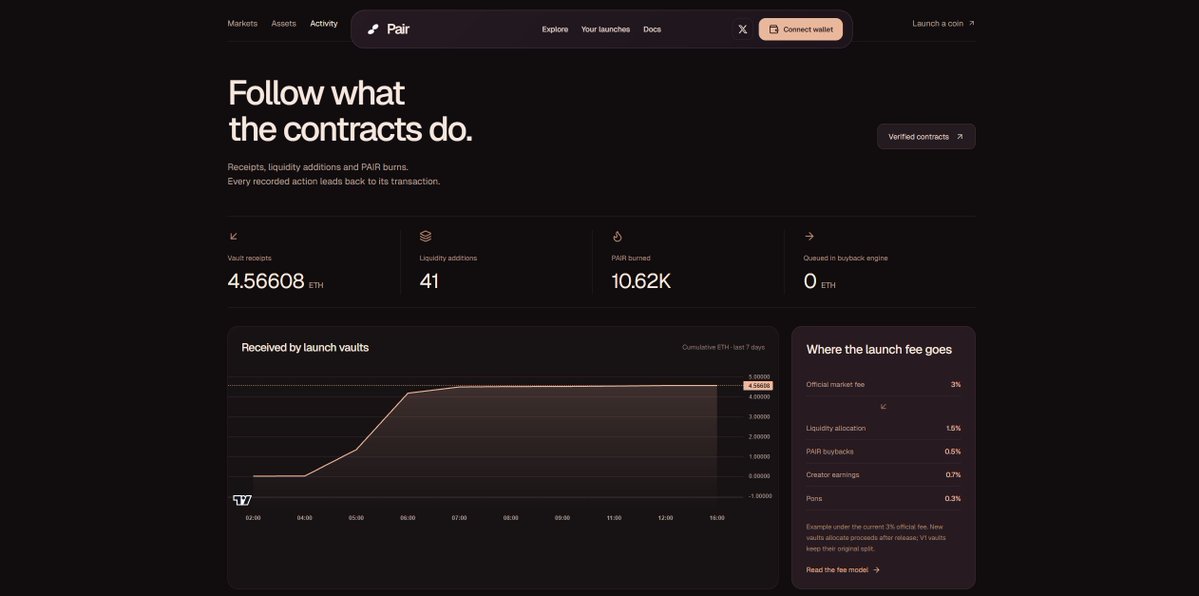
You can also explore launches by their paired asset, copy contract addresses directly and follow the protocol's confirmed fee receipts, liquidity additions and PAIR burns through the new activity view.
This makes the liquidity mechanism easier to follow: starting inventory and released fees help fund the chosen market, while the dashboard shows what has actually happened on-chain.
Shared data caches, indexed events and smaller images support the update behind the scenes. No extra Pair trading fee has been added.
Built around Pons, with a clearer path from launching a pair to using it.
We've been building the next version of Pair around what happens after a launch.
Choosing a pairing is only the start. You should be able to see that market, understand its liquidity and trade it from the same app.
The update brings a full trading view with candlestick charts, volume, recent trades and the original Pons market alongside the chosen pair. Quotes compare supported routes for your amount, including paths through Pons V4 and USDG where available.
Asset pages bring together the coins paired with the same asset. The new activity view follows confirmed fee receipts, liquidity additions and PAIR burns, with transaction links behind the numbers.
We also rebuilt how that data reaches the app: shared caches and a common event index, so each new visitor doesn't trigger another set of RPC requests.
Pons provides the launch ecosystem while Pair is building the trading and liquidity experience around it.
It's pretty simple. We aim to not be a new competing launchpad, too many projects do this and it usually doesn't work.
What we did instead, was to build around Pons as a sort of wrapper, so this way, coins keep their original Pons market while getting an additional pool against the asset their creator chooses.
Part of the released trading fees then goes towards building liquidity in that chosen pool, with another part allocated to PAIR buybacks and burns on our newer contracts. In the case you sent, the launchpad trades on a completely different pool. It's easy to make a launchpad that can just pair against any pair, but it's not easy to make that launchpad work around Pons and finding a way to expand it against any pair.
We believe Pons already has a good ecosystem, so our goal is to expand what people can do within it and that's our difference.
It's pretty simple. We aim to not be a new competing launchpad, too many projects do this and it usually doesn't work.
What we did instead, was to build around Pons as a sort of wrapper, so this way, coins keep their original Pons market while getting an additional pool against the asset their creator chooses.
Part of the released trading fees then goes towards building liquidity in that chosen pool, with another part allocated to PAIR buybacks and burns on our newer contracts. In the case you sent, the launchpad trades on a completely different pool. It's easy to make a launchpad that can just pair against any pair, but it's not easy to make that launchpad work around Pons and finding a way to expand it against any pair.
We believe Pons already has a good ecosystem, so our goal is to expand what people can do within it and that's our difference.
The first liquidity deposit deserves different handling from the hundredth.
We found that our gas-cost guard could delay a new pool even when its funding transaction could execute successfully. Initial deposits carry a one-time setup cost.
That is now fixed: first additions have a capped gas allowance, recurring additions keep their tighter limit, and new launches receive earlier keeper checks.
A previously waiting V2 pool is now funded on-chain. Its page shows the actual balances and Live status.
These are the improvements that turn a working contract into a smoother experience for creators.
Already holding the asset you want beside your coin?
Creators can contribute that asset directly from their coin page on Pair.
For a coin paired with CASHCAT, for example, connect the creator wallet, contribute CASHCAT, and use “Add reserved liquidity” once the vault holds both assets.
That gives creators another way to fund their chosen market alongside released trading fees.
For an empty pool, the amounts you deposit set its initial price. Contributions and LP holdings remain committed to the vault, so review both sides before signing.
https://t.co/VxD2xyxwsS
Before choosing how much supply to reserve at launch, understand where that supply goes.
On Pair, your starting allocation belongs to the liquidity vault. Once assets are added to the pool, the LP holdings stay committed there & creator earnings are accounted for separately.
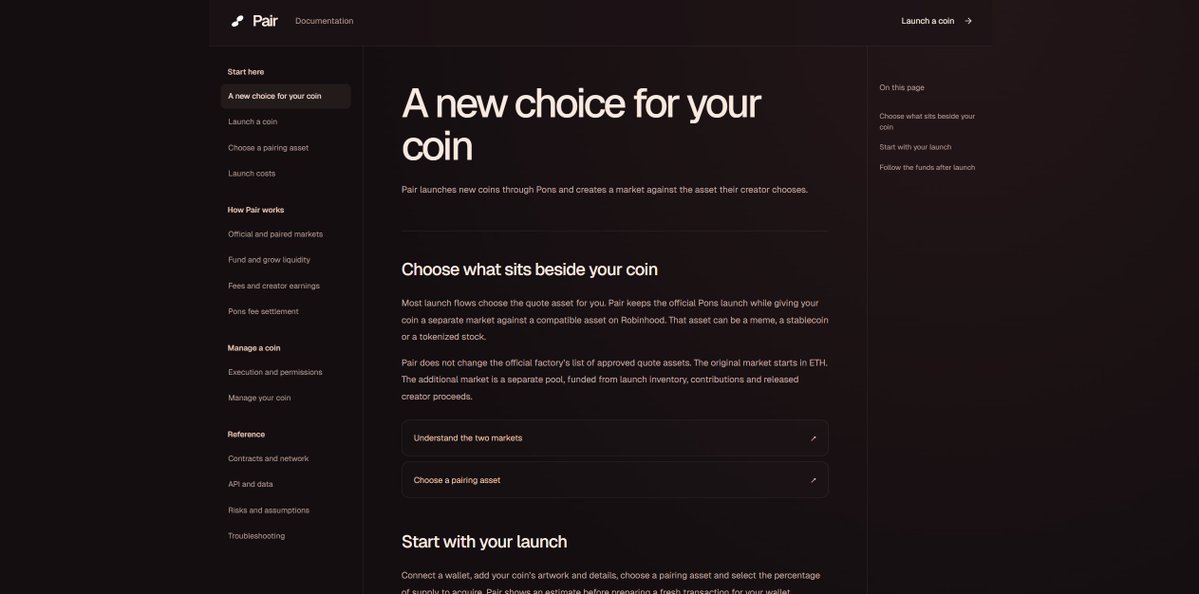
We updated the docs to explain these distinctions, alongside V2 routing, the new fee allocation and what differs between existing V1 vaults and new launches.
Start here before building your next pair:
https://t.co/fupIzCY3LT
Then follow the money:
https://t.co/JKxhs59bQv