I write this message not only as a parent, but as a voice carrying the daily struggle of families raising autistic children who simply want what every child deserves — the right to learn with dignity, stability, and inclusion.
On paper, inclusive education exists. Policies speak of equal opportunity. But on the ground, the reality is painfully different.
Every academic year, I am forced to live through uncertainty and fear, waiting to know whether my child will even be allowed to continue in her school. Instead of planning her education and growth, I must repeatedly plead, justify, and prove her worthiness to remain enrolled. The process is exhausting, humiliating, and emotionally devastating for both parent and child.
Schools often lack training, resources, and accountability when it comes to inclusion. Parents are left alone to negotiate, request accommodations, and endure subtle or direct rejection. There is endless waiting, repeated meetings, and emotional strain — yet no real mechanism to protect the child’s right to education.
Inclusion should not depend on a school’s willingness or convenience. It should be a guaranteed right supported by clear policies, trained educators, and enforcement at the ground level.
The struggle is real. The helplessness is real. And the silence around it is equally real. @EduMinOfIndia@CMOMaharashtra@PMOIndia@PMOIndia_RC
Meet the new ‘autistic’ Barbie, designed with unique traits! Join @VibhaBMadhava and guest Dr. Nidhi Singhal as they discuss her impact on autism awareness and inclusion in India.
https://t.co/hKiv6SgRAS
When a computer tracks the Indian classical dancer in this video, it picks up perfect circles, triangles, and curves in every movement. There are exactly 108 of them. All 108 were written into a manual over 2,000 years ago.
That manual is the Natya Shastra. Six thousand verses, written somewhere around 200 BCE. It describes 108 specific dance movements for Bharatanatyam, one of the oldest dance forms in India. Each movement spells out three things: where your hands go, what angle your body holds, and the exact path your legs trace. Roughly 150 step combinations grow out of those 108 base movements. A trained dancer spends years learning 70 to 80 of them.
Watch the dancer's legs in the video. The bent-knee squat creates a diamond shape. Palms together make a triangle. When researchers plotted these positions in three dimensions this year, they found the moving body carves out twisted spirals and bowl-shaped curves, the kind of shapes you see in an engineering textbook, not a dance studio. Every limb holds a specific angle and moves a measured distance.
The rhythm is math too. A 7-beat song gets filled with dance steps of 3 and 4. Scale that to 35 beats and the groups of 3 and 4 repeat five times. Choreographers work out these splits in their heads while performing live. All 108 movements are also carved into the stone walls of a 12th-century temple in Tamil Nadu called Chidambaram, many panels still carrying the original Sanskrit description next to them. A choreography textbook in granite, still legible after 900 years.
A 2013 study put 25 people on a walkway rigged with motion-capture cameras. Every human stride has two parts: when your foot is on the ground and when it swings forward. The ratio between those two parts came out to 1.620. The golden ratio is 1.618. Your foot lifts off at 61.8% of every step you take, and it has done this your entire life. A Bharatanatyam dancer takes that same built-in proportion and amplifies it across 108 movements, each one tracing shapes that were set down in writing over 2,000 years before the tracking software in this video existed.
There was a time when Uttar Pradesh was routinely placed in most backward state lists, almost by default. Today, the numbers tell a different story.
1. UP’s GSDP is projected at ~₹36 lakh crore in 2025–26, growing at around 12%, with an 8-year CAGR of ~10.8%, outpacing the national average.
2. The state budget has more than doubled, from ₹3.47 lakh crore (2016–17) to nearly ₹9 lakh crore now in less than a decade.
3. Per capita income has doubled, from ₹54,564 in 2016–17 to nearly ₹1.1 lakh.
4. Over ₹3 lakh crore has been paid in sugarcane compensation in nine years, compared to ₹2.1 lakh crore in the previous 22 years.
5. On development indicators too, progress is visible. In the SDG India Index, UP moved from 29th place in 2018–19 to 18th in 2023–24.
Strangely, for a state so often discussed for its problems, its improvements don’t receive proportionate attention. Maybe steady progress is less dramatic than crisis headlines. Or maybe some narratives are simply harder to update. Either way, something is changing in UP, and it’s worth noticing.
Imagine your mother is due for a total hip replacement. On the way to the OT, you learn the orthopedician operating on her had scored 4/800 in the PG entrance. Would you still have the courage to let the surgery proceed?
This is no longer hypothetical. An MS Orthopaedics seat at a govt institute in Rohtak was allotted in the third counselling to a candidate with just 4/800. At a premier Delhi medical college, a Gynaecology seat went to someone who scored 44/800, and a General Surgery seat was filled at 47/800.
It’s high time patients started asking about the NEET PG scores of their doctors. Your health should not be left at the mercy of social justice or buisness policies of the republic.
After unveiling a college building in Yamkeshwar, Pauri Garhwal, Yogi Adityanath spent a night at his ancestral village, Panchur.
He spent time with children of his family.
Yogi is chief minister of India’s most populous, powerful state.
And yet, notice the family’s simplicity.
Meet Jitendrasingh Rathod, a security guard at SVNIT College, Surat.
For years, he has quietly collected photos of Indian soldiers and martyrs, preserving their memories with discipline, pride, and deep respect, without ever seeking recognition.
Just 10 days before Republic Day, while on night duty as a security guard at a wedding function, he received an unexpected call directly from the PMO. He was invited to attend the Republic Day Parade in Delhi.
It was a once-in-a-lifetime honour, but his financial condition was fragile. He had just ₹102 in his bank account, and even arranging travel to Delhi seemed impossible.
Though hesitant, he honestly shared his situation with the PMO official.
They acknowledged his sincerity, arranged flight tickets for him and his wife, booked a comfortable stay, and ensured he could attend with dignity.
What a beautiful gesture @PMOIndia ❤️
जटाटवीगलज्जलप्रवाहपावितस्थले
गलेऽवलम्ब्य लम्बितां भुजङ्गतुङ्गमालिकाम्।
डमड्डमड्डमड्डमन्निनादवड्डमर्वयं
चकार चण्डताण्डवं तनोतु नः शिवः शिवम्॥
'कर्तव्य पथ' पर अध्यात्म एवं सनातन संस्कृति का जयघोष...
#WATCH | Odisha: The first 'supermoon' of 2026 was seen in Puri, also known as the 'Wolf Moon'.
During this astronomical event, the moon will appear 30% brighter than a typical full moon.
I knew nothing about this extraordinary marvel: the ‘Sikkim Sundari’
Thriving at staggering altitudes of 4,000–4,800 meters, this "Glasshouse Plant" stands like a glowing tower against the mountains.
Its life is a masterclass in patience.
It is monocarpic, which means that it lives as a small rosette of leaves from 7 to 30 years (!!) quietly storing energy.
Then, in one final, heroic act, it shoots up to 2 meters tall, blooms into a magnificent pagoda, releases its seeds, and dies.
It’s the stuff of poetry, yet my school biology textbooks (from ages ago, of course!) never mentioned it, even while describing flora from halfway across the world.
I wonder if current Indian school curricula finally reference this local legend?
One more reason to explore the heights of Sikkim…
(Video Courtesy @GoNorthEastIN )
#SundayWanderer https://t.co/FiZENN31Iz…
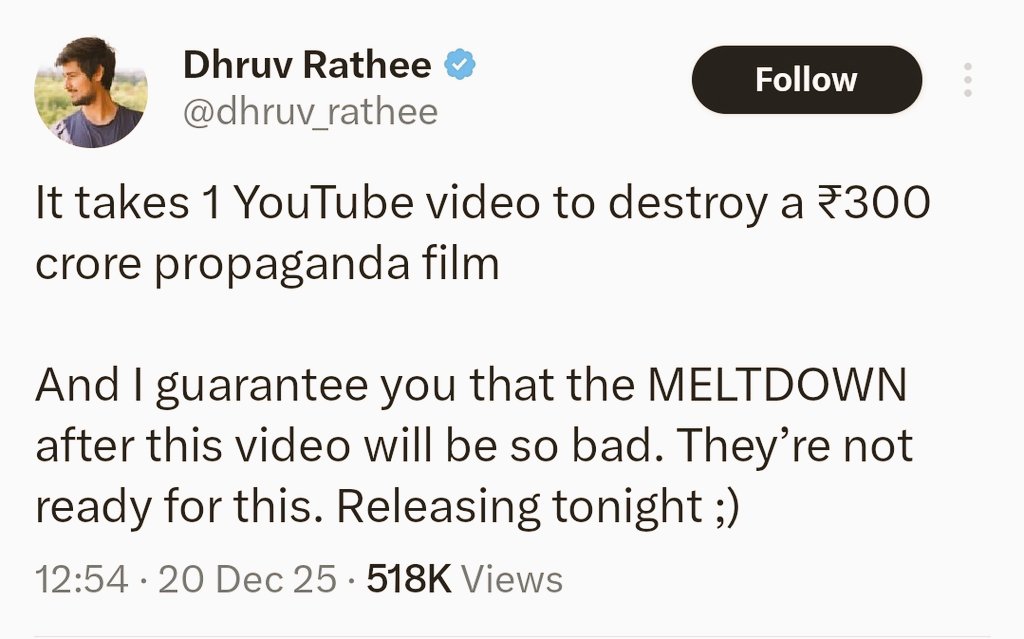
He is right. The cinema world is shivering. The tremors can be felt even before the video is out.
I went to PVR this morning to watch Dhurandhar, but they said they have cancelled all the shows because Rathee's video is coming. It’s happening pan-India.
The makers are recalling all the prints from cinema halls, and they’ll dump them in the Ghazipur landfill. Aditya Dhar is planning to quit filmmaking and shift to Mozambique, where he’ll run a chicken pakoda shop to earn a living. Akshay Khanna is planning to apologise for acting in this movie. Sanjay Dutt will return to the underworld, Madhavan to Dubai, and Rampal to Pakistan to avoid making movies henceforth.
This is the end of the nationalist cinema era. The catastrophic butterfly effect of this video is already unfolding even before its release. Studios are panicking, directors are hiding, actors are reassessing their life choices.
What will happen once the video is actually out? Total annihilation, presumably. I wouldn’t be surprised if it leads to nothing short of Modi’s resignation and the permanent shutdown of Indian cinema itself.