🚨BREAKING: In a HUGE blow to Donald Trump, the House has PASSED the War Powers Resolution - 215-208 - which will require Congress’ say over the Iran War.
🚨 Bitcoin just dropped from $74,000 to $67,500 in 48 hours. On no real news.
One thesis that fits the data:
The exit liquidity rotation has begun.
In the next months, four companies are raising over $350 billion in fresh equity:
– SpaceX IPO: ~$75B
– OpenAI raise: ~$100B
– Anthropic raise: ~$100B+
– Google net equity issuance: ~$80B
That money has to come from somewhere. Existing portfolios. Risk-on capital. Cash.
Bitcoin is the most liquid risk-on asset on earth. Selling it is the fastest way to free up dollars without triggering tax events on long-held equity positions.
If the most religious Bitcoin holders – the corporate treasuries, the funds, the whales – are even partially rotating to participate in the largest IPO cycle in history, you don't need a news catalyst to explain the drop.
You just need the supply curve to flip.
This isn't bearish on Bitcoin long-term. It's a sign that the entire risk-on crowd is preparing to absorb the largest equity issuance year since 2000.
When the marginal Bitcoin holder needs to be on a SpaceX cap table, Bitcoin goes down for reasons that have nothing to do with Bitcoin.
The exit liquidity avalanche doesn't just hit overvalued stocks.
It hits anything liquid.
ByteDance has published a paper that should make every NVIDIA investor sweat.
They trained an AI that writes CUDA better than humans experts.
They call it CUDA Agent.
And it completely rewrites the economics of AI hardware.
They built a massive agentic reinforcement learning loop. The AI writes a kernel, compiles it, profiles the hardware, analyzes the bottlenecks, and rewrites the code until it's flawless.
It learned how to optimize memory access patterns and hardware tiling strategies that traditional compilers miss.
The results are staggering.
On the industry-standard KernelBench, CUDA Agent completely destroyed traditional compilers.
It delivered code that runs up to 3.2x faster than PyTorch's native execution.
On the hardest, most complex models, it beat the strongest proprietary models in the world—including Claude Opus 4.5 and Gemini 3 Pro, by 40%.
It didn't just match human experts. It started discovering optimizations that static compilers literally cannot see.
Here is why this is a massive threat to NVIDIA.
NVIDIA's dominance relies on the fact that CUDA is incredibly hard to master. Developers get locked in because optimizing code for other chips is too painful.
But if an AI agent can autonomously generate hyper-optimized hardware kernels...
You don't need a team of $500k a year CUDA engineers to build world-class infrastructure.
And if an AI can autonomously master CUDA, it can master AMD's ROCm. Or custom silicon.
The impenetrable software wall protecting NVIDIA's monopoly just got breached by a reinforcement learning loop.
If anyone can automatically squeeze maximum performance out of any chip...
Hardware becomes a commodity.
What if AI is actually creating more jobs than it is replacing?
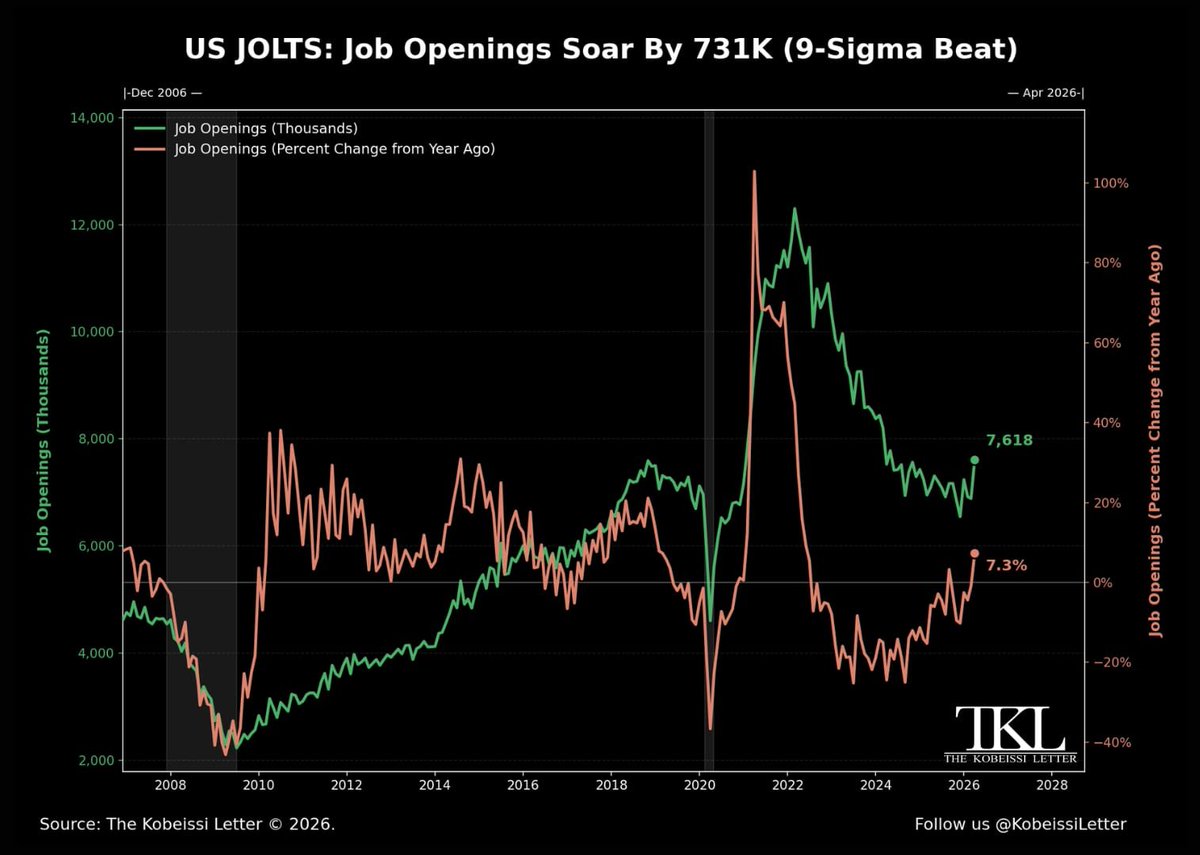
The latest JOLTs data showed that US job openings surged by a massive 731,000 jobs in April.
Markets were expecting no change, resulting in the largest beat in JOLTs history.
As a result, available employment hit 7.6 million for the month, the highest since May 2024.
And, job openings in the professional and business services sector surged by a massive 668,000.
The labor market's bull case from AI is underpriced.
What most people already understand, even without the economic terminology, is that firms like BlackRock operate less like investors and more like modern feudal landlords.
They buy essential infrastructure,water networks, ports, energy grids, data centres, and other public necessities, often using vast amounts of borrowed money and paying prices that ordinary market participants cannot match.
Once the acquisition is complete, the debt is pushed onto the acquired company itself.
The result is simple: the public pays.
Consumers repay that debt through higher water bills, rising energy prices, increased fees, and declining service quality.
The infrastructure becomes a cash-extraction machine.
Profits flow upward to shareholders and executives, while the financial burden flows downward to households.
When the model inevitably breaks down, the consequences are socialised. Communities are left with crumbling infrastructure, polluted rivers, and failing services.
Thames Water's £14 billion debt mountain and repeated sewage scandals are a stark example of what happens when financial engineering takes precedence over public stewardship.
The executives who loaded the company with debt have already collected their bonuses.
The investors have already taken their returns.
And when the system finally reaches breaking point, taxpayers are expected to pick up the bill.
Privatise the gains.
Socialise the losses.
That is the business model.