PALEODEM is an @ERC_Research Consolidator Grant project, under the European Union’s Horizon 2020 Research and Innovation Programme (N. 683018). @ua_universidad
🎆🎆🎆
Hear hear my friends!
The insanely talented @LiuhuayingYang has created a wonderful interactive that provides the most fun introduction to ABM ever seen on this planet.
Send it to anyone who wants to learn more about ABM: your students, professors and even your mum! 😅
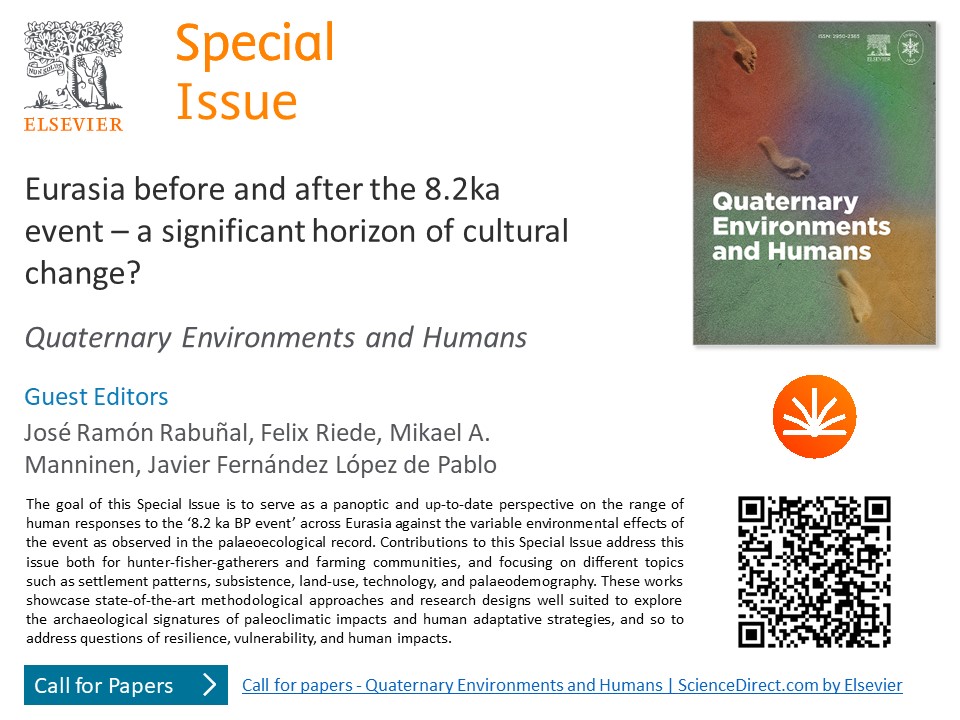
🚨Call for Papers🚨
📊Working on the impacts of the 8.2ka BP event on human socio-ecological systems?
📝Consider submitting a paper to our VSI in #QEH "Eurasia before and after the 8.2ka event – a significant horizon of cultural change?"
🔗https://t.co/TQvxOFjjnj
📢Are you interested in Late #Mesolithic technological change? Check out our #OA paper from ERC @paleodem_eu project in @14Cjournal. We have used Bayesian chronological models to estimate the beginning of trapeze industries in the Iberian Peninsula ➡️https://t.co/6iWtpFMMao
📢Contrato postdoctoral en zooarqueología y tafonomía. El INAPH @UA_Universidad avala una solicitud de investigador/a postdoc, en Zooarqueología y Tafonomía, para la próxima convocatoria APOST2023, Mod. B de la @generalitat valenciana📩[email protected] 🗓️10/11/2023
¡Descubren un campo de dunas de la Edad del Hielo en Villena!
El estudio, coordinado por el investigador de la UA Javier Fernández-López de Pablo, identifica por primera vez sedimentos de arenas con rasgos periglaciares alterados por el hielo.
Más info en https://t.co/NWdedpw7dh
📢Paper alert from @paleodem_eu
Sand-dune #paleosol sequences spanning the Last Glacial to the Late Holocene have been discovered in an interdisciplinary study of the Villena dune field (SE Iberian Peninsula) ⬇️
https://t.co/7tPKNjAbaU
#Paleodem has collaborated in a new broad-scale database on #lithic#technologies between ca. 15 and 11 ka in Europe @ERC_CLIOARCH, @ARCHAEOfelix @ScientificData, and many others:
https://t.co/Nf4KhKuqeJ
Publicado un trabajo que integra la evidencia geoarqueológica y contextual para aclarar los factores involucrados en la formación de los 🔥mesolíticos e inferir patrones de ocupación dentro del yacimiento de El Arenal de la Virgen (Villena, Alicante).
https://t.co/56SDDJpTJr
(3/3) Sedimentary and soil data revealed favourable paleoenvironmental conditions during Mesolithic occupation characterized by increased moisture, temperature and vegetation cover, contrary to the Pleistocene and Middle Holocene periods pre- and post-dating the human settlement.
📢 Paper alert 📢#Mesolithic#hearth pits from open air #campsite of El Arenal de la Virgen (Spain) excavated during @paleodem_eu project fieldwork
https://t.co/DbLYLKN9ff
Follow 🧵
(4/4) Structures from Phase 1 are interpreted as a possible oven and a dumping feature linked to single/occasional use events. Hearth-pits from Phase 2 were related to combustion and dwelling areas subject to recurrent occupation episodes and disturbance.
📢 New papers about #Mesolithic open air #campsite of El Arenal de la Virgen excavated during
@paleodem_eu project fieldwork https://t.co/DbLYLKMBpH
A thread (1/4)📷
(3/3)Our results distinguish two different Mesolithic occupation phases, dating to 9.3–9.1 and 8.6–8.3k cal a bp respectively, consisting of combustion features and lithic scatters. The second Mesolithic phase ended during the onset of the 8.2k cal a bp climatic event.
📢 New papers about #Mesolithic open air #campsite of El Arenal de la Virgen excavated during @paleodem_eu project fieldwork
https://t.co/La8tnn9GQM
A thread (1/3)🧵
(2/3) Multi-scalar geoarchaeological and archaeo-stratigraphic studies, coupled with palaeobotanical analysis, were used to design an extensive radiocarbon dating programme and produce different Bayesian chronological models at the Mesolithic site of Arenal de la Virgen (Spain)