Traditional, or Old-Style, Kachina dolls were simple carvings given to #Hopi children to teach them about their culture and the Kachinas that would be visiting during an upcoming ceremony.
Scavenger kachina doll by late Hopi carver Jocelyn Vote.
The #Zuni people believe carved stone fetishes carry their own unique set of attributes and can aid or impart these qualities to those who carry them, such as providing guidance, protection, or healing.
Buffalo fetish by Zuni carver Tony Mackel.
Did You Know...? Corn is a common symbol used in #NativeAmerican art, as it is a widely harvested crop for many tribes.
Earrings are #Zuni made, artist unknown.
Many of the pieces of pottery from #Acoma Pueblo incorporate “fine line” designs, which are long lines drawn closely together, signifying rain falling from the sky and, in some cases, water.
Seed pot by Acoma potter Ruth Aragon.
For the #Zuni, the Sun symbolizes abundance, continuity, stability, positive energy, hope, happiness, and peace.
Earrings are Zuni made, artist unknown.
The color of #turquoise varies greatly, ranging from off-white to dark blue and can be nearly 200 different shades of blue and green, depending on the mineral content of the host stone.
Cuff bracelet is #Navajo made, artist unknown.
Three parrots and various weather patterns, including polychrome clouds and rain, cover this gorgeous, large handmade wedding vase by Acoma potter Beverly Garcia.
https://t.co/z5tNZIigNi
The #Navajo are the largest federally recognized Native American tribe in the United States. Their reservation is spread out through out the four corners of Arizona, New Mexico, Utah and Colorado.
Did You Know...? The oldest pottery unearthed in North America was discovered on Stallings Island in the Savannah River near Augusta, Georgia.
Jar by #Acoma potter Eric Lewis.
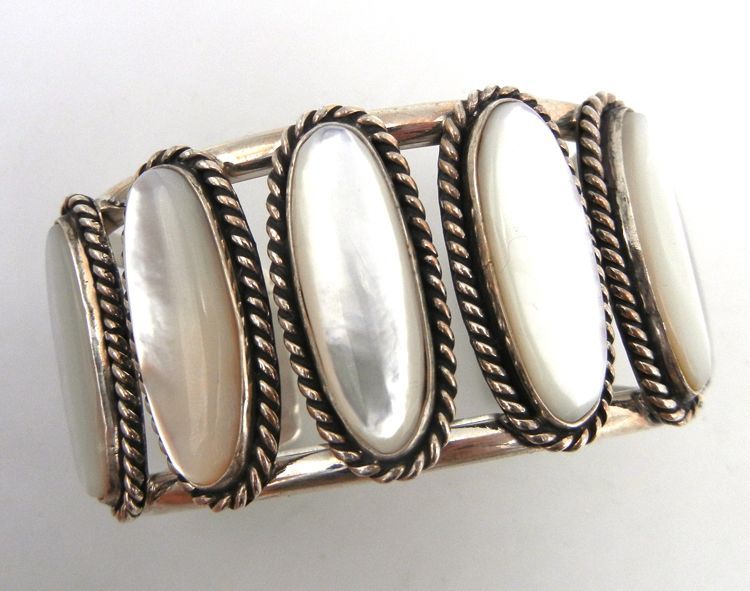
Mother of pearl is said to stimulate intuition, sensitivity, imagination, and adaptability and help with clarity in decision making.
Cuff bracelet by Navajo silversmiths Leonard Platero, Jr. and Racquel Hurley.
Present in virtually every #NativeAmerican tribe, the feather symbol is universally recognized as a representation of trust, strength, wisdom, freedom, and honor.
Pendant by #Navajo silversmith June Delgarito.
Coral's persistence in rising from the sea is said to give it the power to aid its wearer in travel, health, and protection.
Cuff bracelet is #Navajo made, artist unknown.
A #turquoise stone thrown into the water or air, according to #Navajo tradition, could help connect one, in prayer, to the Creator of rain or the Wind Spirits.
Pendant is Navajo made, artist unknown.
Some #NativeAmerican potters use temper, which is material mixed in with the clay used to prevent pottery from cracking when it is dried or heated. Common tempers include bone, wood ash, and sand.
Vase by Santa Clara potter Alvin Baca.
Central to #Hopi religion, Kachinas are supernatural beings believed to live on the San Francisco Peaks (Nuva'tukya'ovi)near Flagstaff, Arizona.
Eagle kachina doll by Hopi carver Floyd Nutumya.
Did You Know...? During the Pueblo Revolts, #Jemez Pueblo lost most of its traditional pottery styles. Originally they made fine line black designs on white, but modern Jemez potters each follow their own ideas.
Turtle figurine by Jemez potter Scott Small.
#Rhodochrosite is believed to aid the wearer in self-identity and internal strength. It is also worn to heal deep trauma and bring internal calm.
Pendant is #Navajo made, artist unknown.