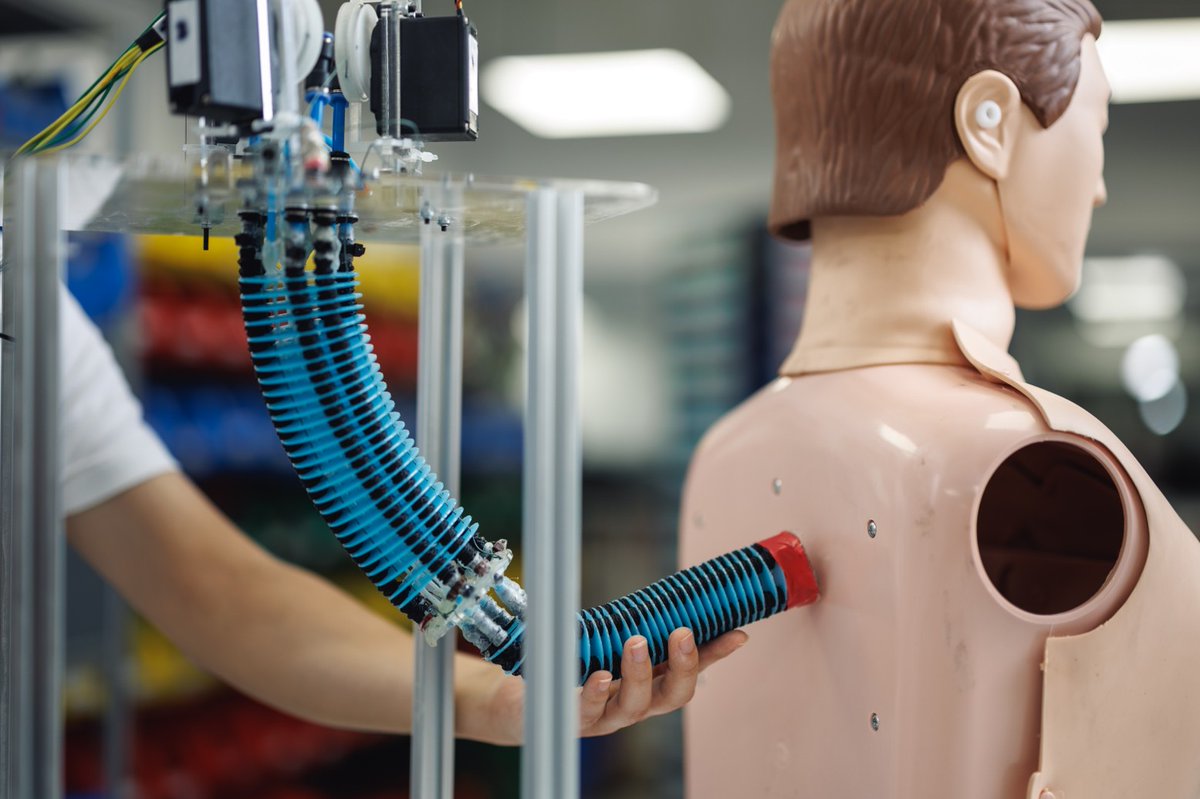
WSU researchers built a 3D-printed beating heart model with soft, tissue-like properties and pneumatic actuators that simulate realistic contraction.
https://t.co/c50kmfXAD3
A recent study shows how AR combined with AI achieves precise tumour border visualisation during oncosurgery, giving surgeons spatial information that was previously only available in pre-operative imaging.
https://t.co/rfdYgbwarG
#PALPABLE#AugmentedReality#TumourDetection
🔬A new analysis maps the R&D trends in robotic tactile sensing for 2026: emerging force, vibroacoustic, and audio sensors enabling quantifiable tissue characterisation.
https://t.co/QKnVXKCpXl
PALPABLE & @SWAG_project_EU show how soft robotics is moving closer to real-world impact. Both projects highlight how flexible, human-centred innovation can improve the way technology interacts with the body.
https://t.co/JzuhlL6DZT
A recent study introduces GenForce, a framework that allows tactile sensors to “learn” force sensing from each other, reducing the need for repeated calibration and data collection.
Read more here: https://t.co/y0NLIpiQ0h
🌐Researchers at @Cambridge created a tactile sensor that improves detection limits by 10x over existing flexible sensors, using graphene sheets, deformable metal microdroplets, and pyramid microstructures inspired by human skin.
https://t.co/yHOyuPdJrj
A recent review charts the rapid adoption of soft robotic tools in surgery flexible instruments that can navigate tight anatomical spaces, conform to tissue surfaces, and reduce the risk of accidental damage compared to rigid alternatives.
https://t.co/iCrTcMWW1b
New research shows robotic palpation devices can now locate a 2cm tumour embedded at 5mm depth in the lung subpleural region, enabling objective, data-driven decisions during surgery.
📰 https://t.co/9OzwfMSC19
Traditional visual methods often fall short due to tissue deformability. Recent research demonstrates that robotic systems can use haptic exploration to estimate tissue stiffness (Young's modulus) in real-time. https://t.co/c9FD1P8rLt
Robotic surgery delivers visual precision, but surgeons still operate without a true sense of physical touch.
The absence of haptic feedback remains a documented clinical limitation in Robotic-Assisted Surgery (RAS).
https://t.co/wWAWCN0QGX #PALPABLEproject#RoboticSurgery
A feature in @The Lancet Digital Health highlighted that the lack of haptic feedback in robotic-assisted surgery remains a primary limitation, restricting a surgeon's ability to assess tissue compliance during minimally invasive procedures.
🔗 Read more: https://t.co/eCVep4Iy8C
🔩 Precision Robotic Manipulation in Action
Robotic hands are now performing high-precision assembly tasks — such as screw tightening — with millisecond control loops, real-time fingertip force sensing, and vision-based micro-correction.
https://t.co/glwXnhzDRf
Tactile tele-operation is advancing how humans interact with remote robotic systems. By integrating real-time tactile feedback alongside visual input, tele-operated robots can achieve improved precision, safety, and operator awareness.
https://t.co/a3mTZHHwVO
A study presents a dual-mode electronic skin inspired by shark electroreception. By combining non-contact electrostatic sensing with triboelectric tactile sensing, the system enables robotic hands to identify object shape & material with high accuracy.
https://t.co/fSAA1bVchL
VibTac: A High-Resolution, High-Bandwidth Tactile Sensing Finger (IEEE)
VibTac combines vision-based and vibration-based tactile sensing to deliver both high spatial resolution and high bandwidth perception for robotic manipulation.
https://t.co/ZwtrdNnpxi
A new AI control system developed by researchers from MIT, NUS, NTU, and SMART enables soft robotic arms to adapt instantly to changing conditions while maintaining stable, muscle-like motion.
https://t.co/CbAZmtTOp9
🚀 We’ve reached a new milestone: 200 + Followers!
A huge thank you to our growing community for following the Palpable Project. Our mission to revolutionize medical diagnostics and sensing technology is fueled by your support and engagement.
🌐https://t.co/UxkLxXFjHh
Recent research in @Nature introduces #GenForce, a framework that enables transferable force sensing across different tactile sensors, allowing systems trained on one sensor to generalize to others without extensive new data.
https://t.co/Qu6adzpg8U