From 40 checks to one DD Score.
This is what PALS take into account for you for all the new launches on BASE.
No need to spend your precious time on Dexscreener or X, PALS is constantly checking for you!
/grade function can now be used for SOLANA onchain projects.
Just DM "/grade <CA>" to https://t.co/cruJGQOudc and got a compact analysis report on SOLANA onchain projects.
You should be a PRO Pass holder to use this function.
Example report: $JTVO.
PALS is now live on solana:So11111111111111111111111111111111111111112 onchain.
From now on, DYOR Logs subscribers will see SOL utility reports alongside Base reports, using the same PALS research approach.
All the new SOL launches will be reported to the telegram channel.
PALS is now live on solana:So11111111111111111111111111111111111111112 onchain.
From now on, DYOR Logs subscribers will see SOL utility reports alongside Base reports, using the same PALS research approach.
All the new SOL launches will be reported to the telegram channel.
The edge in microcaps is filtering faster.
Most people lose because they treat every new launch like an opportunity.
I treat every new launch like noise until proven otherwise.
There are too many launches, too many paid posts, too many recycled narratives, and too many charts that look good for 20 minutes before liquidity disappears.
If you try to chase everything, you will eventually become exit liquidity for someone who filtered better than you.
My approach is simple.
I do not start with "can this 100x?"
I start with:
- Is there a real product?
- Is the team still building when attention is low?
- Is the token useful or just attached to marketing?
- Is the chart early, dead, or already overheated?
- Is there a real narrative forming around it?
- What would make this thesis completely wrong?
That last question is important.
Most people only search for reasons to buy.
I search for reasons not to buy first.
If a project survives that filter, then it becomes interesting.
Not a buy.
Not a signal.
Interesting.
That is where real DYOR starts.
For me, utility microcaps usually become attractive when a few things line up:
1. The team ships even when nobody cares.
2. The product has a clear reason to exist.
3. The chart has not already priced in the full thesis.
4. The narrative is moving toward what they are building.
5. The community is not just begging for KOL posts every day.
This is why I like old builders more than random fresh launches.
A project that survived bad market conditions and kept improving has already passed a filter that most new coins will never pass.
Fresh launches can still be good.
But most of them are just attention games.
They are designed to look urgent.
The chart moves fast, influencers appear fast, Telegram gets loud fast, and everyone starts acting like you have 3 minutes to make a life-changing decision.
That is usually exactly when you should slow down.
The best entries I have found were not from panic.
They came from filtering.
Reading updates.
Watching team behavior.
Checking holders.
Comparing market caps.
Looking at what the product actually does.
Seeing whether the narrative has room to expand.
And most importantly, understanding why I am willing to hold something before the crowd fully notices it.
This is also how I think about portfolio sizing.
Not every good project deserves the same size.
Some are conviction bags.
Some are opportunities.
Some are small watchlist positions.
Some are just "interesting, but not enough evidence yet."
If you size everything like it is your highest conviction play, you do not have conviction.
You have chaos.
This is the whole reason I am building PALS | @palsai_bot.
I got tired of manually filtering every fresh onchain launch while the market moves faster than humans can research properly.
PALS is not a buy-signal bot.
It is not here to tell you what to ape.
It is a first-pass DYOR layer.
The goal is to help identify:
- what is worth deeper research
- what looks weak
- what carries obvious risk
- what has unusual hype or volume
- what might deserve attention before the crowd fully notices
That is the real edge in this market.
Not blindly chasing every green candle.
Filtering faster.
Avoiding obvious traps earlier.
Understanding why something is interesting before everyone else starts posting about it.
Microcaps will always be risky.
Most will fail.
Many will look good for a short time.
Only a few will have the team, product, chart, token, and narrative strong enough to survive.
The job is not to buy everything early.
The job is to filter until only the serious theses remain.
That is how I approach onchain gems.
That is why I built PALS.
And that is why I still believe utility microcaps will create some of the best opportunities in this cycle.
NFA, just my personal opinion.
v4 HOOKS: THE SCAM YOUR SECURITY SCANNER CAN'T SEE
Every "token safety" check you've been trusting is looking in the wrong place.
WHAT IS A HOOK?
Uniswap v4 introduced "hooks." A hook is a separate contract attached to a liquidity pool that runs custom code at the exact moments you interact with it.
Before/after every swap, every add, every remove. In plain terms: a hook is code that executes every time you buy or sell.
That's powerful for real builders. It's a gift for scammers.
WHY THEY'RE DANGEROUS
For years, scams lived inside the token contract: high sell tax, blacklists, "can't sell" honeypots. Scanners learned to catch those.
So the scam moved. In v4, the malicious logic now lives in the HOOK, not the token. A hostile hook can:
- charge a tax on every swap that the token contract never declares
- let you buy, then make your sell revert — a honeypot at the pool layer
- skim a slice of every trade to the deployer
- sit clean at launch, then flip after liquidity builds (upgradeable logic)
The token itself reads perfectly clean. 0% tax. Sellable. Owner renounced.
All true — because the trap isn't in the token. It's in the hook bolted to the pool.
WHY MOST TOOLS MISS IT
The popular "is this token safe?" scanners analyze the TOKEN bytecode. They don't resolve and inspect the HOOK contract sitting behind the pool. So they hand you a green checkmark on a pool that's quietly taxing or trapping you.
This isn't theoretical. Malicious and broken hooks have already drained real money (the Cork Protocol hook bug alone cost ~$11M), and v4 lets anyone deploy any pool
with any hook — no gatekeeper.
On the BASE chain, where new pools launch by the minute, that's exactly the gap scammers are farming: deploy a clean-looking token, hide the mechanism in the hook, let the standard scanners wave it through.
WHERE @palsai_bot COMES IN
PALS resolves the actual v4 hook behind a pool and inspects what it can do — not just the token.
We check the hook's permissions and behavior (can it tax you, block your sell, or change the rules after launch?) and fold that into Contract Safety, so a pool that looks clean on the surface but hides risk in the hook gets flagged, not greenlit.
It's one of the very few tools — and one of the first built for retail Base launches — that actually looks at the hook layer instead of stopping at the token.
Don't trust a checkmark that never read the hook.
Do you want to see upcoming launches and take your time to analyse them to see their potential?
Introducing PALS PRE-LAUNCH RADAR
PALS scans for upcoming Base launches and give you a compact report, so you know what to keep an eye on if you are a PRO Pass holder.
How to activate:
DM @palsai_bot and send:
/activate_prelaunch_radar
You can also use:
/launching - see current active launch watches
/prelaunch_radar_status - check if your DMs are active
/deactivate_prelaunch_radar - stop the alerts anytime
Why I am building @palsai_bot?
PALS is the onchain research engine specialised for freshly launched BASE onchain gems.
I built it to help us move faster in new onchain markets, where launches appear quickly and most people do not have time to manually check every project before the opportunity is gone.
PALS is not a buy-signal bot. It is a filtering and research assistant. It helps identify which projects are worth looking at, which ones have weak evidence, and which ones carry obvious risks.
The goal is simple: give people a faster, cleaner, more structured way to do first-pass DYOR.
Current PALS features:
- Public DYOR Logs reports — research summaries on new Base launches that pass the public threshold.
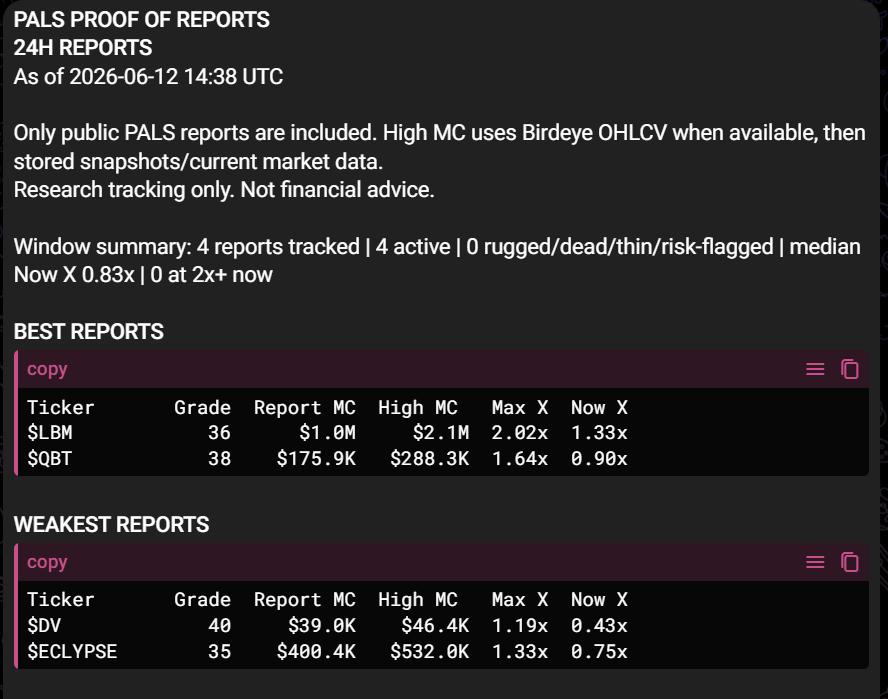
- Proof of Reports — performance tracking for past PALS reports so we can see how they performed after publication.
- /grade <CA> — Pro/Founding users can DM the bot a contract address and receive a private DYOR Logs-style report.
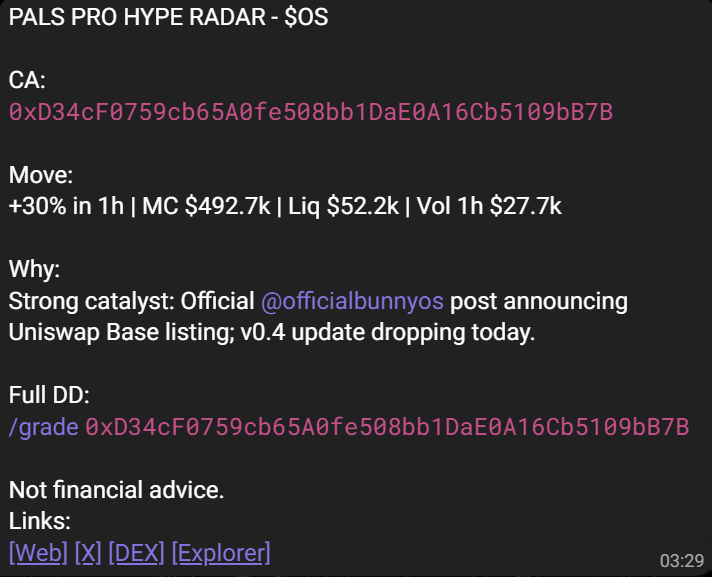
- Hype Radar — Pro/Founding users receive alerts when PALS detects unusual price/volume movement with possible social catalysts.
- Watchlist alerts — Pro/Founding users can track tokens and receive alerts when important market or safety changes happen.
- Private group/channel access — subscribers get access to the DYOR Logs community and PALS report feed.
- Ongoing upgrades — PALS is continuously being improved with better report quality, safety checks, scoring, and outcome tracking.
Passes: Basic Pass, for people who want access to the core DYOR Logs feed. Includes:
- private group/channel access
- public PALS research reports
- Proof of Reports updates
- general DYOR Logs community access
Pro Pass, for people who want the full PALS toolset. Includes everything in Basic, plus:
- /grade <CA> private reports in DM
- Hype Radar alerts
- Watchlist alerts
- advanced research features as they are released
- priority access to future tools (Pre-Launch detection tool is coming soon. You will be able to identify pre-launches).
The reason I built PALS is because I believe the edge in this market is not blindly chasing every chart.
The edge is filtering faster, avoiding obvious traps earlier, and understanding why something might be interesting before the crowd fully notices. PALS is still evolving.
Over time, it will become more than a reporting bot, a full research layer for new launches which is self learning, hype detection, watchlists, post-report tracking, and eventually more chains beyond Base.
How to join:
DM https://t.co/gHKJfWkcCJ and use /plans.
The bot will show the available passes, payment details, and activation steps.
PALS just got a major visual upgrade.
From now on, DYOR Logs reports will start appearing as clean professional report cards instead of only plain Telegram text.
This makes every report easier to read.
Same PALS logic. Cleaner output.
More upgrades are coming.
Research only. Not financial advice. PALS does not tell you what to buy. It helps you stop missing what matters.
To start using:
DM https://t.co/0MFiOh7lQw and send:
/terms
/accept_terms
/plans
You pick the Base tokens. PALS watches them around the clock and DMs you the moment price, market cap, liquidity, or safety changes, so you don't have to sit on the charts.
If a watched token moves, PALS tells you. If something dangerous appears, PALS warns you.
How to use:
/watch <CA>
/watching
/unwatch <CA>
More alert controls will keep improving, but the first live version is now running.
To join:
DM @palsai_bot and send:
/terms
/accept_terms
/plans
Then choose your pass and follow the bot instructions.
All subscription money goes directly into PALS development, APIs, infrastructure, and making the reports sharper.
The new Hype Radar function has been working pretty nicely so far with spot-on analysis.
If you are holding the PRO Pass, you will not need to open DexScreener and spend countless hours on X trying to understand why things are pumping.
Examples: $A2H & $OS
DYOR Logs → Open for both BASIC and PRO pass holders, gives you the quickest research materials for solid new launches.
HYPE RADAR → Only open for PRO pass holders, giving you alerts with the reasons why an onchain coin is pumping.