LET MY RECORD SPEAK
I just arrived United States this evening to honour an important invitation and participate in a series of engagements beginning at 9am tomorrow morning in Washington DC.
Throughout my election campaigns, I have sought to emphasise policies, ideas, and practical solutions that can deliver the change Nigeria urgently requires and help our nation overcome its current challenges.
Nevertheless, because certain individuals have repeatedly scrutinised my past, even as they appear uneasy about their own records, I have chosen to allow the facts to speak for themselves. Starting today and running for ten days, I will present some of the accomplishments recorded during my tenure as Governor of Anambra State. This series will outline my interventions, achievements and the responsibilities entrusted to me. I have titled it my Record of Service.
In every position I have held, I have consistently given my utmost effort in fulfilling my responsibilities. Although no one can always attain every intended result, I have never been found lacking in dedication or effort. I have always given the task my full commitment.
As campaign activities gather momentum, I will also continue to keep you updated on my daily engagements and other significant developments.
In particular, in light of allegations that I abandoned Anambra State during the erosion crisis, among other assertions, I consider it necessary to present the facts to the public. I have never evaded any responsibility entrusted to me, and I will certainly not shirk my responsibility to help address Nigeria’s challenges.
I am confident that, ultimately, facts outlast allegations, while records carry greater weight than rhetoric.
Let my record speak for itself! -PO
FUNSO DOHERTY EXPOSES THE PYRAMID OF AGBEROISM AND MULTI-LAYERED TAXATION ON LAGOS ROADS; THE PYRAMID.
The Lagos State Governorship Candidate of the Nigeria Democratic Congress (NDC), HE Funso Doherty, has drawn attention to what he describes as an entrenched system of agberoism and multiple layers of taxation operating across Lagos roads, raising serious questions about who benefits from the system and the burden it places on residents, motorists, traders, and transport operators. Here's is the pyramid.
According to Funso Doherty, the problem goes beyond the activities of individual street-level collectors. He argues that agberoism has evolved into a deeply entrenched structure, allegedly sustained by political interests and used as a channel for extracting revenue from ordinary Lagosians.
His position raises a fundamental question: why has a problem that continues to affect the daily lives and economic activities of Lagos residents remained unresolved?
Doherty argues that meaningful reform requires confronting the structures that sustain this system, rather than merely addressing its visible operators. Lagos deserves a transparent, accountable, and properly regulated transport and revenue collection system; one that protects livelihoods, eliminates arbitrary levies, and allows businesses and commuters to thrive without unnecessary financial burdens.
The people of Lagos deserve answers, accountability, and a government that puts their welfare above political interests.
The conversation about a cleaner, safer, and more accountable Lagos must begin with confronting the structures that undermine its progress.
O TI YÁ!
A New Lagos Is Possible.
The New Way Has Come.
The question in my mind isn’t whether Peter Obi will win; it’s whether he will be declared the winner!
In the peculiar brand of democracy we practice in Nigeria, winning an election and being declared the winner by the umpire are two entirely different things, sadly!
For years, the long-running political duel between former Imo governor, Senator Rochas Okorocha, and current Imo governor, Hope Uzodimma, has shaped Imo politics. Now, a court ruling has handed Okorocha a major victory in their latest showdown over the APC’s Imo West ticket.
On Arise Prime Time, Okorocha tells me that Uzodimma has never won an election and that the governor's style has been to sit in government house and write the entire results, an allegation Uzodimma's camp has denied.
Then former APC national chairman, Abdullahi Ganduje, visits Okorocha to publicly celebrate Governor Uzodimma's courtroom setback, raising questions about the fault lines within the ruling APC.
But the stakes go far beyond Imo West. Uzodimma reportedly has his eyes on the Senate presidency in 2027, a prize FCT Minister, Nyesom Wike, has vowed to oppose. Wike seems determined to weaken Uzodimma's national ambition - and Wike is not a man to be trifled with.
Meanwhile Okorocha’s old dance with Wike has resurfaced online - a reminder that Nigerian politics is all about shifting alliances and unfinished battles.
Uzodimma's camp has vowed to appeal the court judgement. It is an appeal which may decide the ticket, but the political war with the likes of Okorocha, Wike and Ganduje could decide much more.
So is this fight for a senate seat the next explosive chapter in a titanic rivalry that could reshape the APC’s 2027 power calculations?
Grab your popcorn! The ultimate Nigerian political thriller just dropped its main trailer, and the feature film starts right now.
Let’s activate giggle mode and squeeze out a couple of belly laughs before Nigerian reality sets back in:
Imagine if Nigeria ruled the world - every UN meeting would start two hours late, but no one cares because Burna Boy is doing his soundcheck.
The global national anthem would be Afrobeats and highlife. And you must stand up and dance when it plays.
Official language? Pidgin. "How far?" replaces "How are you doing today?"
Meetings would be 80% shorter and arguments would be 200% longer, but more entertaining. No more 9-to-5. Everyone has three side-hustles.
NEPA still takes light, but now globally. The world learns to live by "We have light? Quick, charge everything, iron everything, pump water." Generator becomes the world's most valuable stock.
Jollof is mandatory at all state dinners. Ghana jollof vs Nigeria jollof becomes a case at the International Court of Justice. Nigeria wins, of course.
Garri is declared a strategic reserve. Suya spots on every corner in Berlin, Tokyo, and Toronto.
You can't rule Nigeria with straight lines, so the world would have to learn to rule with flexibility. No more rigid rules - everything is negotiable. You want a visa? Bring your uncle who knows someone.
There would be 200 political parties in every country, and all of them would have a structure in every ward.
No one calls anyone by first name anymore. It's Sir, Ma, Oga, Auntie, Egbon, Mazi, Alhaji, Bros. Even the presidents of France, the UK and the US would call you "My Oga" before asking for a loan.
It would be a world where everyone knows everyone's business and everyone shouts.
The world would be more stressful - and more alive - if Nigeria ruled the world.
A presidential Independence Day broadcast goes viral, not for what President Tinubu said, but because some Nigerians are wondering whether it was even real, or whether it was AI.
Then twenty young youth corps Nigerians leave home to serve their country, and reportedly never make it to camp. Now comes a reported fifty million naira per-person ransom demand.
Then nursing students at Madonna University are expelled over a fifteen-second TikTok video, triggering another national argument: discipline or disproportionate punishment?
And beneath it all, a sobering economic reality: reports citing PiggyVest say only about 1 in 10 Nigerians can raise ₦156,000 within a week, only six per cent are financially secure, and ninety-four per cent need help.
So what exactly is happening to Nigeria? We are questioning what we see, afraid of where we travel, fighting over what young people are allowed to post, and struggling to raise emergency money when life goes wrong.
Rather than being separate viral stories, they all look like one bigger story about trust, safety, dignity and the widening distance between Nigerians and the institutions meant to serve them.
On October 1, we celebrate independence. But perhaps we should first remember what independence once meant.
In 1945, in a bomb-damaged Manchester town hall, a remarkable gathering of Africans and people of the African diaspora imagined something that, at the time, seemed almost impossible: a free Africa.
W.E.B. Du Bois, Nnamdi Azikiwe, Obafemi Awolowo, Jaja Wachukwu, Nkrumah, Kenyatta, Padmore, and others who refused to accept colonial rule as Africa’s permanent destiny, debated racism, inequality, economic power and self-determination - and imagined a continent that did not yet exist.
Eight decades later, we've inherited the freedom they dreamed of and the flag is ours. But what have we done with it?
The Pan-Africanists confronted colonialism, racism, inequality and division with a vision of collective freedom. Today, our divisions deepen, inequality widens, our politics shrinks our sense of self, and the chains we once broke seem to have returned in a different form.
Despite our political independence, we are riven with misrule, political criminality, corruption and weak institutions.
So this October 1st, what did those audacious people in 1945 imagine freedom would look like? And what happened to that dream?
Independence is not merely the absence of a colonial flag. It is the presence of a people who know who they are, what they are capable of, and refuse to surrender their future.
October 1st should be a reckoning.
DISCLAIMER: Fake Letter Circulating in My Name
My attention has been drawn to a fake letter circulating on social media, purportedly written by me to His Majesty, Igwe Nnaemeka Alfred Ugochukwu Achebe, the Obi of Onitsha, concerning political and financial matters in Anambra State.
This document is entirely false, malicious, and a fabrication by mischievous elements aimed at misleading the public. Furthermore, the signature appended to the letter is completely forged.
I urge the public and media to disregard this spurious publication. My focus remains steadfastly on issues of national development, accountability, and building a better future for our people - never on cheap fabrications. -PO
What Two Runs Taught Me About Building Institutions
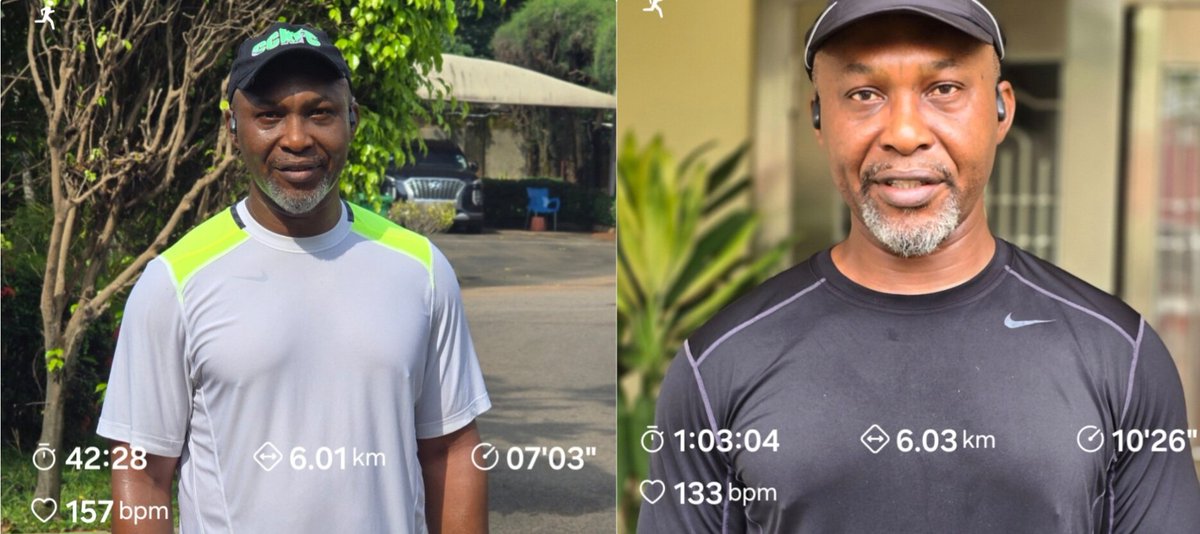
When I turned 54 last year, I made a decision that had little to do with speed and everything to do with longevity.
I would run for distance over pace, prioritise a controlled heart rate over raw intensity, and preserve my body rather than punish it. It sounded sensible enough.
In practice, it has been one of the more frustrating disciplines I have imposed on myself. There were mornings I abandoned the plan and ran to my ego instead, chasing pace because it felt more like the runner I had always been.
Two recent runs brought the struggle into focus.
On Tuesday, I covered six kilometres in 42 minutes, with an average heart rate of 157 beats per minute. Today, I covered the same distance in 63 minutes, deliberately keeping my heart rate largely below 140.
Strangely, today required more discipline.
I shortened my stride whenever my heart rate climbed while maintaining my running cadence. People accustomed to seeing me speed past them walked by and asked, “Are you okay?” More than once, I wanted to take off and restore what my ego considered the natural order.
I resisted because I had set an objective before I started, my watch was measuring me against it, and I had committed to reporting the result honestly afterwards.
The combination of a clear objective, measurement and accountability changed my behaviour.
It occurred to me afterwards that this is also at the heart of building capable institutions and, ultimately, a capable state.
Good intentions are not enough. Institutions need clear objectives, measurable standards, visibility when performance begins to drift, and accountability that leads to correction and learning.
There is another lesson. What looks like performance is not always performance. I could have accelerated when people passed me and looked like the stronger runner while defeating the purpose of the exercise.
Governments and organisations do this too. We mistake visible activity for outcomes and sometimes applaud the sprint while losing sight of the goal.
My running keeps reinforcing a simple philosophy: commit, measure, report, review, learn and repeat.
Accountability, properly understood, is not principally about catching people doing wrong. Its higher purpose is to shape behaviour before things go wrong.
That is true for a man learning to run slower at 55. It is also true for a state entrusted with the future of its people.
Osita Chidoka
19 September 2026
I am deeply disturbed by the reported unrest in Minna, the capital of Niger State, following the deaths of more than 30 youths, including minors while in the custody of the Nigeria Security and Civil Defence Corps (NSCDC).
The victims were arrested on 15 and 16 September 2026 at mining sites in the M.I. Wushishi/Lukoto axis of Minna.
This tragic loss of life is yet another painful occurrence that must not go unanswered.
The Niger State Government and the Federal Government must promptly, thoroughly, independently, and transparently investigate how a detention of only one to two days could escalate into a catastrophe that claimed the lives of young people, including children. Those found responsible must face the full weight of the law, not merely internal or administrative sanctions.
I extend my deepest sympathy and condolences to the families and all those affected by this tragedy. - RMK
I’m not sure you guys understand what just happened in Nigeria.
Over 30 young boys were arrested in Niger and locked in an overcrowded, unventilated cell with extreme heat by @official_NSCDC. They reportedly banged on the door and were ignored.
They were all found dead. Suffocated to dèath. By NSCDC. 💔
A President and the Endless Question of His Past
As a citizen of no other country, who has never sought foreign citizenship even when doing so became fashionable, my loyalty to Nigeria and my faith in her destiny remain unshaken.
Yesterday, 30th of August, being Sunday, I fervently prayed for our nation and for those entrusted with the solemn responsibility of leadership. I found myself deeply saddened by the direction in which our country is heading.
It is profoundly embarrassing that we have reached a point where a sitting President is asking a foreign court to withhold records concerning his past, particularly records relating to matters of legitimate public interest.
Leadership, in my humble view, demands the courage and humility to confront one’s history — to acknowledge mistakes, provide candid explanations where questions arise, and, where necessary, apologise and seek forgiveness. True authority is strengthened, not diminished, when a leader accepts responsibility rather than seeks to shield uncomfortable aspects of the past from legitimate scrutiny.
This becomes particularly important when questions concern educational credentials. Issues surrounding foundational schooling — primary and secondary — should not remain unresolved or be addressed primarily through legal proceedings. Nigerians deserve clear, credible, and verifiable explanations, especially when such had been submitted in the past.
My deepest concern is the example this sets for more than 200 million Nigerians, particularly the over 30 million young people in schools. The nation’s highest office should exemplify integrity, accountability, transparency, and ethical leadership.
An imperfect past is part of the human condition. What matters is the willingness to confront it with humility, honesty and deep apology, to make amends where necessary and, when circumstances so demand, to place the interests of the nation above personal ambition.
When will our political class fully appreciate that individual ambitions are temporary, while the nation endures? The Presidency is an office held for a season; the moral standards established by those who occupy it can influence generations.
Nigeria is greater than any one person, and the integrity of the Republic must always come before the interests of the individual.
A New Nigeria is POssible. -PO
"An anti-corruption agency should be fighting corruption, not turning itself into an institution for hunting down, detaining and prosecuting citizens over criticism or alleged 'cyberbullying.'
What kind of institution detains a university student for nearly a month, arraigns her for allegedly cyberbullying the agency, and then seeks to keep her behind bars while her final examinations are about to begin?"
I entirely agree with @sowore about @officialEFCC under @OlaOlukoyede_
The Osun election has triggered an issue far bigger than who wins.
President Tinubu ordered the EFCC to reverse a court-backed freeze on the Osun state government’s accounts, saying the timing, days before the election, risked creating the impression of federal interference.
But if the president can direct the EFCC to reverse course in Osun, why can’t he similarly intervene in the continuing detention of Nasir El-Rufai?
El-Rufai has secured bail in Abuja and Kaduna, yet critics say the conditions, including high-value properties and Level-17 civil servant sureties, are so onerous they amount to a denial of freedom. His family has also raised concerns over restricted medical access, while opposition figures have warned of a dangerous precedent for civil liberties.
So where exactly is the line? If executive intervention can be justified to protect confidence in an election, can it also be justified to protect an accused citizen’s liberty? Or is the answer that the president must not interfere with either, and that courts and independent institutions must be allowed to do their jobs?
This is no longer just about Osun or El-Rufai. It is about whether Nigeria is building institutions stronger than the people who occupy them, or institutions that bend when political power speaks.