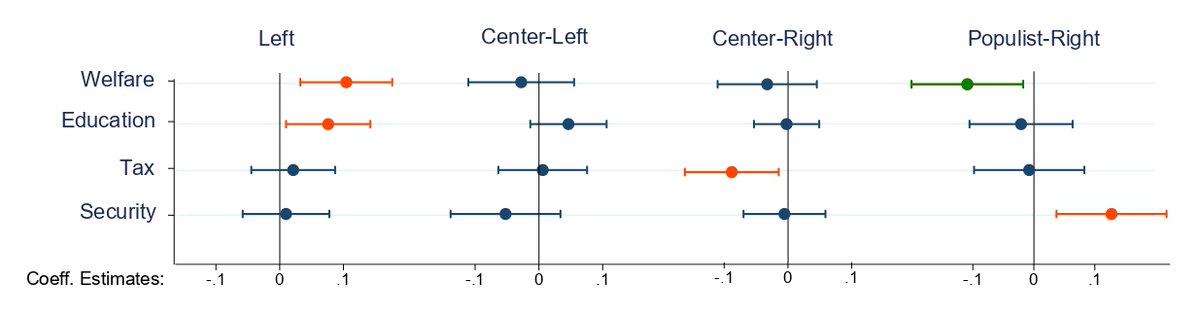
In this research, we try to understand why citizens often demand bad policies. Initial findings suggest people fail to understand even basic incentive schemes (video in Italian):
https://t.co/hMLpdDqtTl
The 7th edition of our #Bruneck Workshop on #political#economy this year will be on Nov 18th and 19th. If interested, here you can find the call for papers. https://t.co/mLe3fE7nxH
Do parties in coalition governments keep their promises? Random allocation of votes in local elections shows that parties leverage their higher bargaining power to shift budget spending toward their electoral platforms by appointing key cabinet members https://t.co/OLxrYoISgZ
Do parties in coalition governments keep their promises? Random allocation of votes in local elections shows that parties leverage their higher bargaining power to shift budget spending toward their electoral platforms by appointing key cabinet members https://t.co/OLxrYoISgZ
Glad to share our new working paper: "Misvoting in the Ballot: Random Power to Parties and its Effect on Politicians and Policies" (with Matteo Cervellati and @paoloroberti) (1/2) https://t.co/jYLfXZ4P2q
Recently published paper in the @JPubEcon :
"Optimal Leniency and the Organization Design of Group Crime"
Vol 191 (Nov 2020)
by Giovanni Immordino, Salvatore Piccolo (@salvapicc ), & Paolo Roberti (@paoloroberti )
https://t.co/ZDvjdkiGdW
The BBC reports that the 2020 US election campaigns smashed all spending records.
In "Vote buying in the US Congress" with Ulrich Matter and @MichaelaSlotwi1 we find that money effectively buys votes in the US Congress.
https://t.co/5DUgnCvYMP
https://t.co/n2CfA8F8JJ
We are hiring a three-year #PostDoc (RTD A) in #political#science at the Free University of Bolzano. We are particularly looking for people interested in #political#economics. PhD is required at the time of application. The call is here:
https://t.co/b6rC4yNdHy
@unibz_news