📢Ever wanted to insert objects from one 3DGS scene into another?
Check out our paper, "Lighting-Consistent Object Transfer Across Radiance Fields", which I'll be presenting at EGSR!
🔗Project: https://t.co/IyNku9AUWv
💻Code: https://t.co/clWw2g99PP
1/4 🧵
Introducing Nexels: Neurally-Textured Surfels for Real-Time Novel View Synthesis with Sparse Geometries
Nexels render in real-time at high quality without needing millions of primitives.
Site: https://t.co/mazzRQzhLV
Paper: https://t.co/R23NdVzsVb
Code: https://t.co/Hq3zUfAnxM
Content-Aware Texturing for Gaussian Splatting
Contributions:
• A texture representation for 2D Gaussians that defines texels with a fixed world space size, supporting visual reconstruction independent of the shape of the primitives.
• A progressive algorithm that adaptively determines texel size and allows for content-aware fitting of the scene.
• A resolution-based solution to control the number of primitives, adjusted to the textured representation.
Introducing the new fastest and most flexible view synthesis method: Radiance Meshes. RMs are volumetric triangle meshes that can be thrown into any game engine, rendered at ~200 FPS@1440p on a RTX4090, and edited using conventional tools. Here's a demo running on my desktop:
A bit overdue, but we finally have this year's papers preview video! watch it here: https://t.co/WezJEz4RWA
Only 5 days until the conference begins, do you have everything ready for it?
#I3D2024
Happy to announce the results of our latest research, which takes 3D Gaussian Splatting to the next level: "A Hierarchical 3D Gaussian Representation for Real-Time Rendering of Very Large Datasets," which has been accepted at #SIGGRAPH2024!🎉 Find it here: https://t.co/ZjspxIXPXo
Some concurrent works tackles the same problem, namely EAGLES https://t.co/aMfnVUgQHd, Compact3DGS https://t.co/0bTagjpOVc, Compact3D https://t.co/3qz8xdMQ9h, Compressed3DGS https://t.co/h5kWoFiq1N and LightGaussian https://t.co/ykg2Ol4zqj
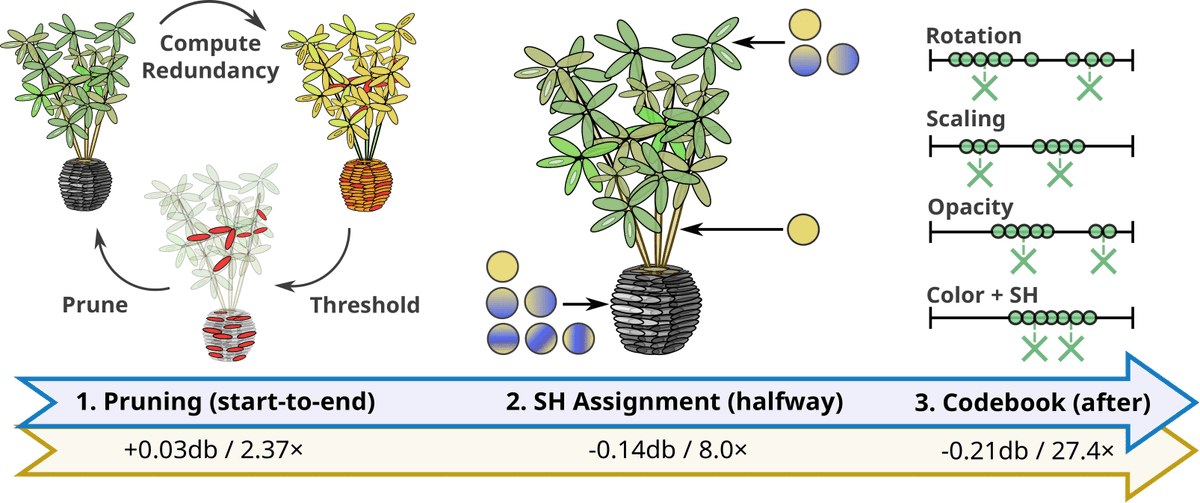
Third, as post-processing, we compress the final representation with a k-means clustering and half float quantisation. Overall, we end up with a representation that is around 27 times smaller and that renders 1.7 times faster.
Second, by exploiting that most parts of the scene don't need the full expressivity offered by the SH, halfway through the optimisation we discard effectively unused SH bands.
We introduce 3 methods to reduce the representation size of 3DGS representations. First, we calculate a resolution-aware redundancy metric that is used to remove primitives during optimisation.
With our work "Reducing the Memory Footprint of 3D Gaussian Splatting," a method that reduces the size of 3DGS from several hundreds to just a few tens of MBs, you now have more space available for additional scenes! For more, check out our project page https://t.co/iPJz1aYjTd
My supervisor G.Drettakis is looking for Master Students to work on topics that extend between Graphics, 3D Reconstruction, and of course Gaussian Splatting.
Feel free to apply if you are a MSc student and you look for a thesis
https://t.co/hzRnfdLOgN
https://t.co/b2du3ir1nN