NGC 474: shells and stellar streams ✨
An elliptical galaxy with a layered halo visible only in deep-field images.
Possible causes: tidal tails from the merger of multiple dwarf galaxies, or ripples resulting from a collision with the spiral neighbor to the right.
Diameter: ~250,000 light-years. Located in Pisces, ~100 million light-years away. The Milky Way's halo exhibits similar complexity.
🔭
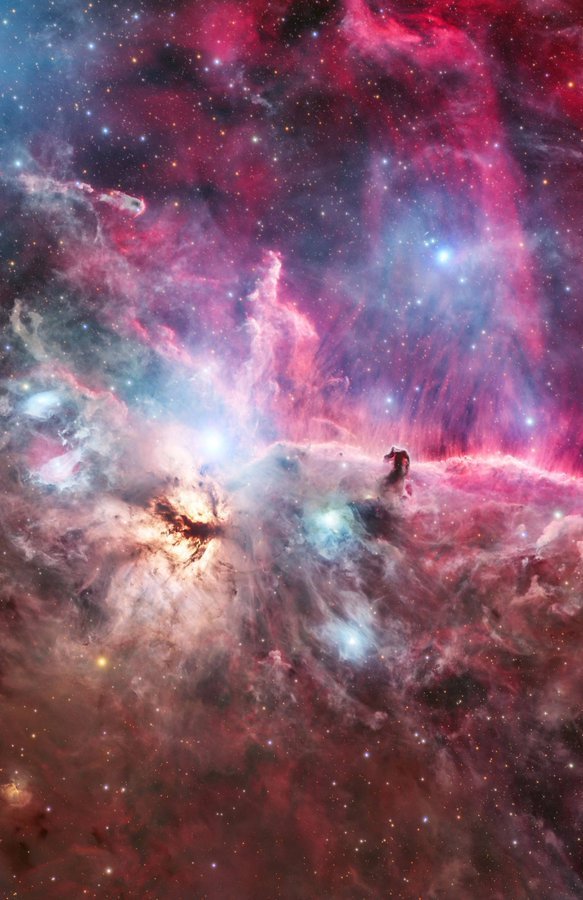
The Horsehead Nebula! ✨
It is part of the Orion Cloud—a vast stellar nursery of gas and dust spanning hundreds of light-years.
The reddish glow comes from plasma—ionized hydrogen—while the dark "head" itself is a concentration of cosmic dust.
Magnificent 😃
The James Webb Space Telescope (JWST) has revealed Saturn in a way never seen before, using powerful infrared vision to uncover hidden details within the gas giant’s atmosphere. In these remarkable observations, Saturn’s iconic rings shine brilliantly while the planet itself appears unusually dark because methane gas absorbs much of the reflected sunlight. Beyond the stunning contrast, scientists discovered mysterious dark spots, intricate cloud structures, and glowing auroral activity near the poles, revealing a far more dynamic and complex world than previously understood. These groundbreaking images are helping astronomers unlock new secrets about Saturn’s weather, atmospheric chemistry, and the evolution of giant planets throughout our Solar System. 🪐🔭✨