I'll bring @papercopilot to #ICML2025 and advocate for a more transparent and regulated peer review process. This position paper was accepted to the #ICML2025 Position Track. I’d love to hear your thoughts and discuss how we can better support the AI/ML community.
@openreviewnet@icmlconf
World models are moving beyond offline generation towards interactive, real-time experiences.
Introducing ⚡FlashDreams⚡: an open-source high-performance inference and serving library built for autoregressive world models:
🔥 Up to 3.10× faster LingBot-World inference
🔥 Up to 2.12× faster Self-Forcing inference
🔥 Up to 1.40× faster Wan2.1 inference
🔥 8 integrated models
🔥 Multi-GPU, streaming, low-latency serving
🔥 Agentic skills that teach you how to use it
FlashDreams is designed for a new generation of AI systems that continuously evolve over time while responding to user interactions. It powers applications across robotics, autonomous vehicle simulation, gaming, and virtual worlds.
Github: https://t.co/xM8LuPaRTS
Docs: https://t.co/IInORNIzy3
Research page: https://t.co/mZ6TLQSpIO
Join the #flashdreams Discord channel at https://t.co/GGOQ0k7liY
FlashDreams is also the runtime backbone behind NVIDIA OmniDreams (https://t.co/PLUt55gxxh)
1/n
#AI #WorldModels #FastInference #PhysicalAI #OpenSource #NVIDIA
You’ve done real work.
But most of it is hard to see.
DINQ brings your projects, code, and research onto one card.
No self-promotion. Just real signals.
Build your DINQ → https://t.co/IaEtN0Vkab
#DINQ
Holiday cooking finally ready to serve! 🥳
Introducing DFlash — speculative decoding with block diffusion.
🚀 6.2× lossless speedup on Qwen3-8B
⚡ 2.5× faster than EAGLE-3
Diffusion vs AR doesn’t have to be a fight.
At today’s stage:
• dLLMs = fast, highly parallel, but lossy
• AR LLMs = accurate, sequential, but slow
DFlash = diffusion drafts, AR verifies.
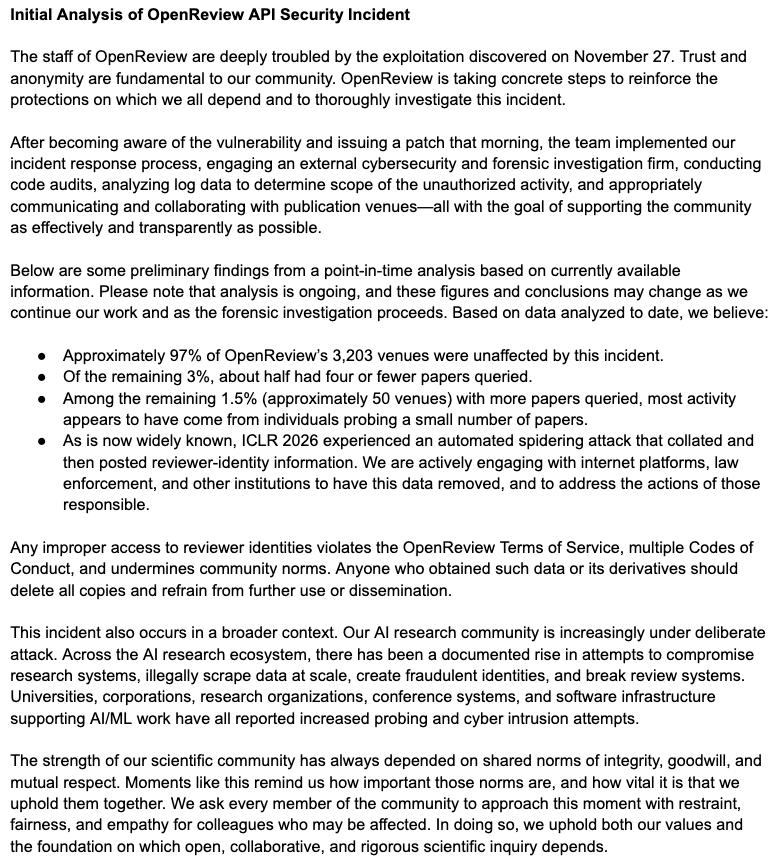
ICLR has placed OpenReview in a difficult position, so I want to offer a few words about the OpenReview team working behind the scenes.
OpenReview has long been operated at UMass Amherst as a non-profit organization founded by Andrew McCallum. Each year, Andrew must raise more than $2 million to support a 20-person team that provides essential infrastructure for most major conferences.
I once asked Andrew what might have been a naïve question: whether he had considered developing a business model for OpenReview, given its prominence and the seemingly obvious opportunities. He pushed back, explaining that everything he has done for OpenReview is driven by a commitment to serve and strengthen the academic community. He is willing to devote significant personal effort to ensure the platform remains freely accessible to all.
We should not blame such a brilliant and dedicated team for an accidental issue. Otherwise, fewer people would be willing to shoulder this kind of responsibility in the future.
Deep respect to the OpenReview team! I’m grateful for their work and happy to support in any way!
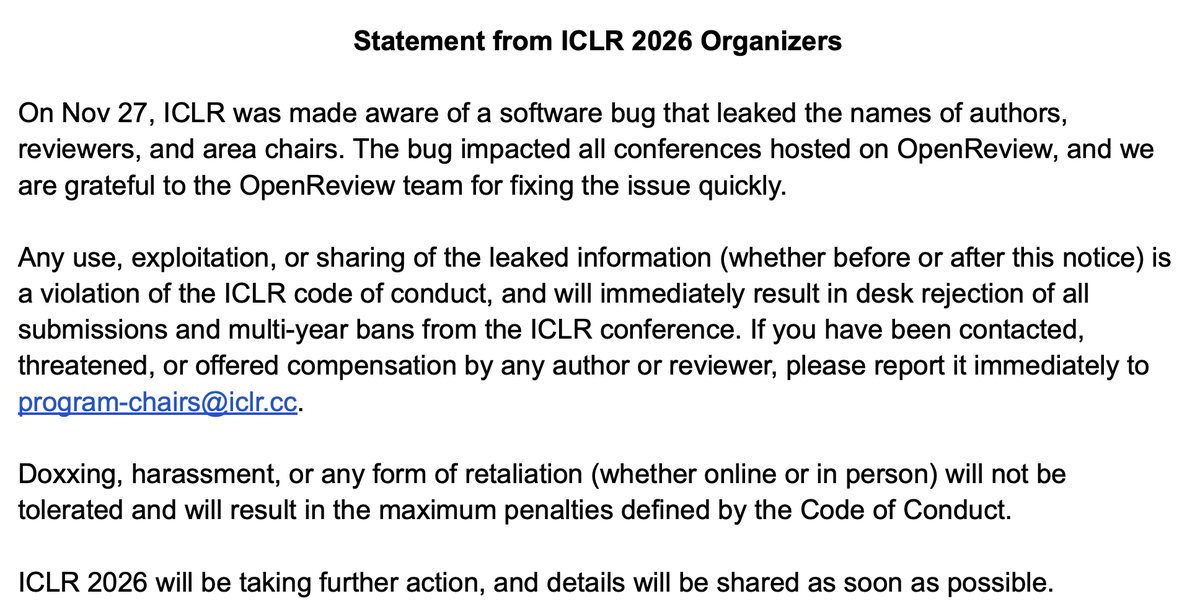
The ICLR leak is a disaster, but let’s talk about how to actually save the Peer Review process.
The Fix: Ending anonymity for irresponsible reviewers.
ICLR maintains high submission quality (at least in early years) because rejected papers are public—authors fear the reputation hit. Why don't we hold reviewers to the same standard?
If a review is fundamentally irresponsible (after confirming by ICLR Program Committee), the reviewer should lose the privilege of anonymity.
• Good review = Anonymous (if desired).
• "Rejected" review = Public Name.
Should add a tab to irresponsible reviewers, similar to publicly showing the rejected papers
https://t.co/yQ1YFKqaOV
We need symmetry. Authors face consequences for low quality submissions. Reviewers should too. @iclr_conf
We archived the ICLR 2024/2025/2026 daily scores for every paper (No reviewer identities are collected or disclosed). Regardless of whether score rollbacks occur or not, I think it’s time to release them publicly for the entire community. We hope this release can support the community through this hard time and contribute to greater transparency and understanding. #ICLR2026
Our Position: https://t.co/xROGJwMfnz
Data release: https://t.co/in8H46bZMb
Raw data: https://t.co/AESANTpwsb
@iclr_conf@openreviewnet
This is crazy. Please do not use, share and/or exploit any leaked information due to the bug of the openreview website. The anonymous reviewers are our friends who spent time and efforts to help improve our works, not our enemies.
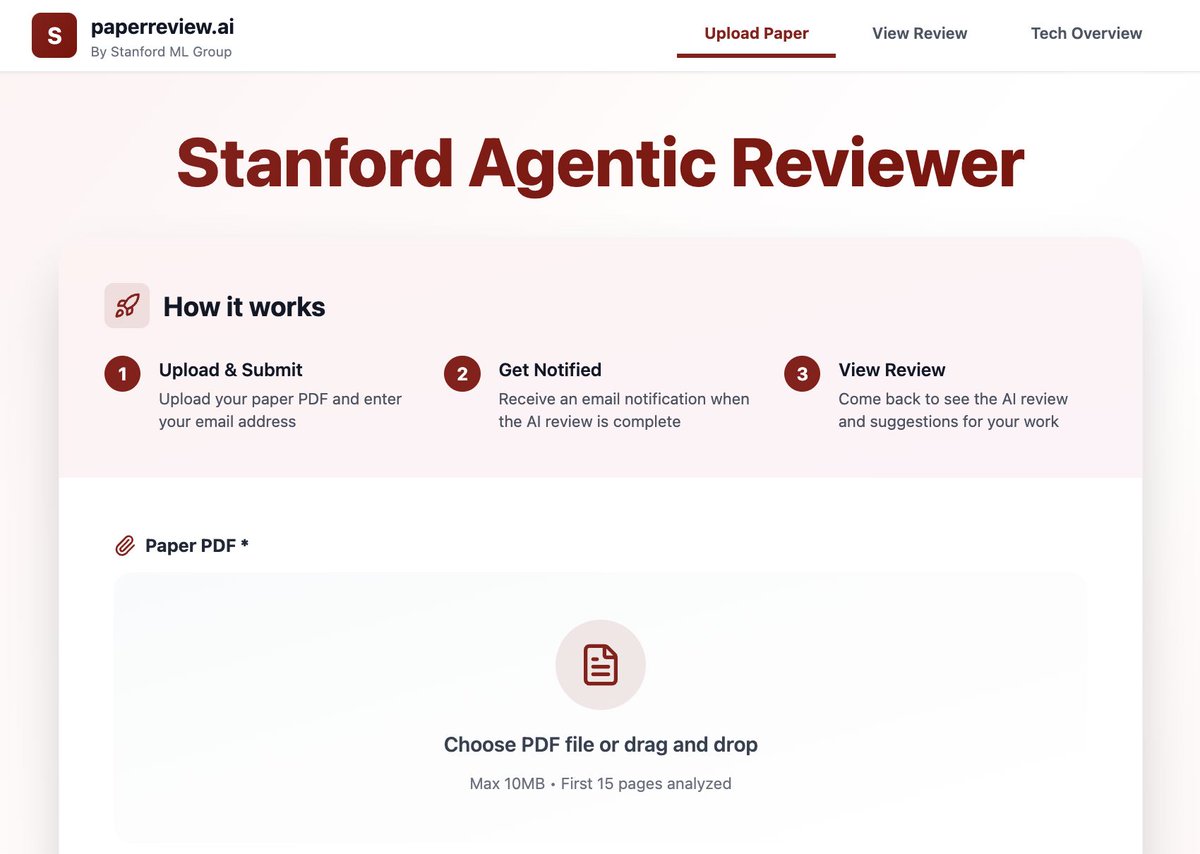
Releasing a new "Agentic Reviewer" for research papers. I started coding this as a weekend project, and @jyx_su made it much better.
I was inspired by a student who had a paper rejected 6 times over 3 years. Their feedback loop -- waiting ~6 months for feedback each time -- was painfully slow. We wanted to see if an agentic workflow can help researchers iterate faster.
When we trained the system on ICLR 2025 reviews and measured Spearman correlation (higher is better) on the test set:
- Correlation between two human reviewers: 0.41
- Correlation between AI and a human reviewer: 0.42
This suggests agentic reviewing is approaching human-level performance.
The agent grounds its feedback by searching arXiv, so it works best in fields like AI where research is freely published there. It’s an experimental tool, but I hope it helps you with your research.
Check it out here: https://t.co/n7ctnDilJJ
Thrilled that our paper received the only perfect score at NeurIPS this year.
Huge thanks to my collaborators and the reviewers. See you in San Diego!
https://t.co/HHTjelGU1Z
https://t.co/kitS2uUX6B
credit to @papercopilot
Thrilled that our paper received the only perfect score at NeurIPS this year.
Huge thanks to my collaborators and the reviewers. See you in San Diego!
https://t.co/HHTjelGU1Z
https://t.co/kitS2uUX6B
credit to @papercopilot
Thanks for using the Paper Copilot data — I’m really happy to see it being used to help build a better peer review ecosystem. @yuz9yuz@FlyPig23@yian_yin, your work is super inspiring! I'm also currently working with @Stanford and @Cambridge_Uni on releasing the temporal daily review data for ICLR 2024/2025 (and hopefully 2026 soon) to the community, so we can continue improving peer review for everyone.
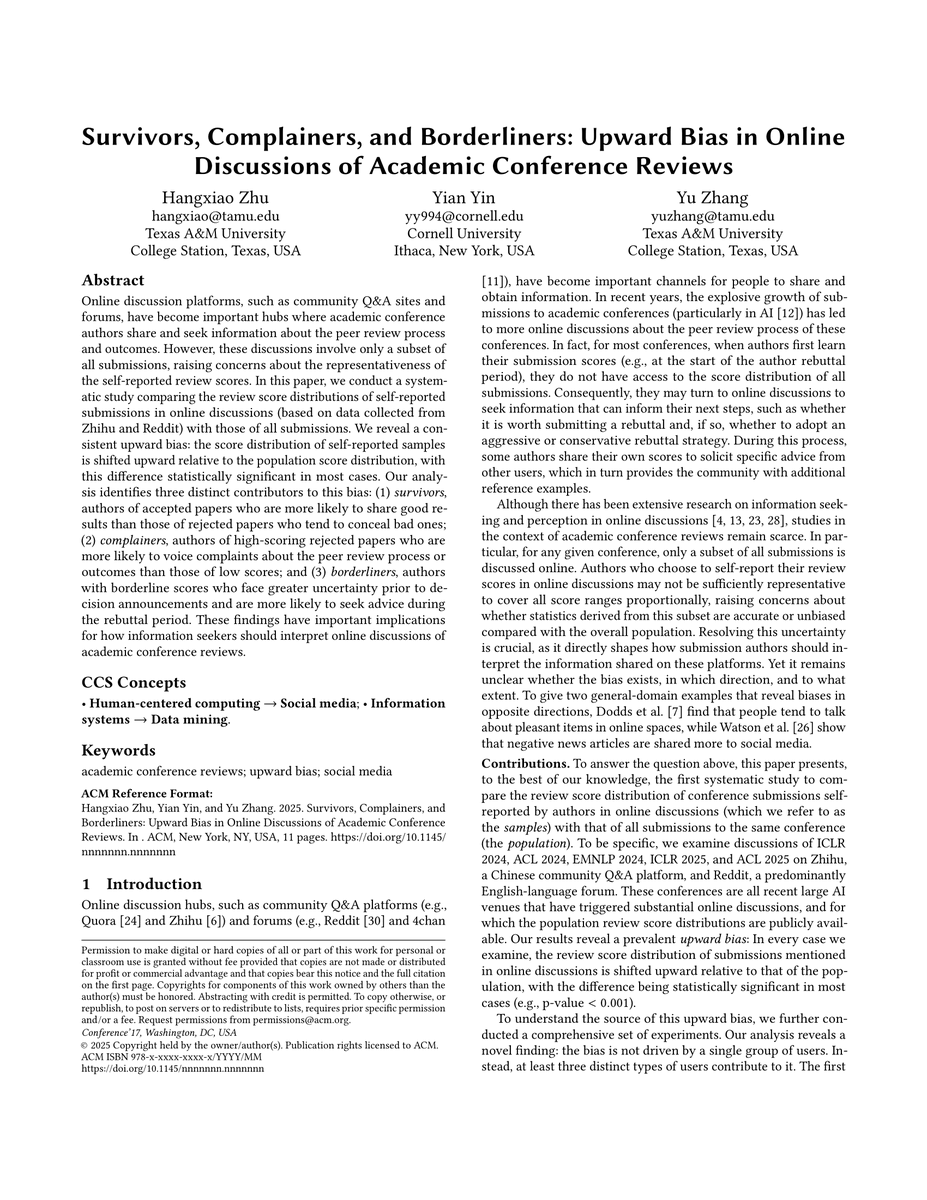
"Can submission authors rely on online discussions of review scores to estimate their percentile?" A recent study led by my student Hangxiao Zhu @FlyPig23, in collaboration with Prof. Yian Yin @yian_yin from Cornell, gives a clear 𝐍𝐄𝐆𝐀𝐓𝐈𝐕𝐄 answer!
(1/n)
"Can submission authors rely on online discussions of review scores to estimate their percentile?" A recent study led by my student Hangxiao Zhu @FlyPig23, in collaboration with Prof. Yian Yin @yian_yin from Cornell, gives a clear 𝐍𝐄𝐆𝐀𝐓𝐈𝐕𝐄 answer!
(1/n)