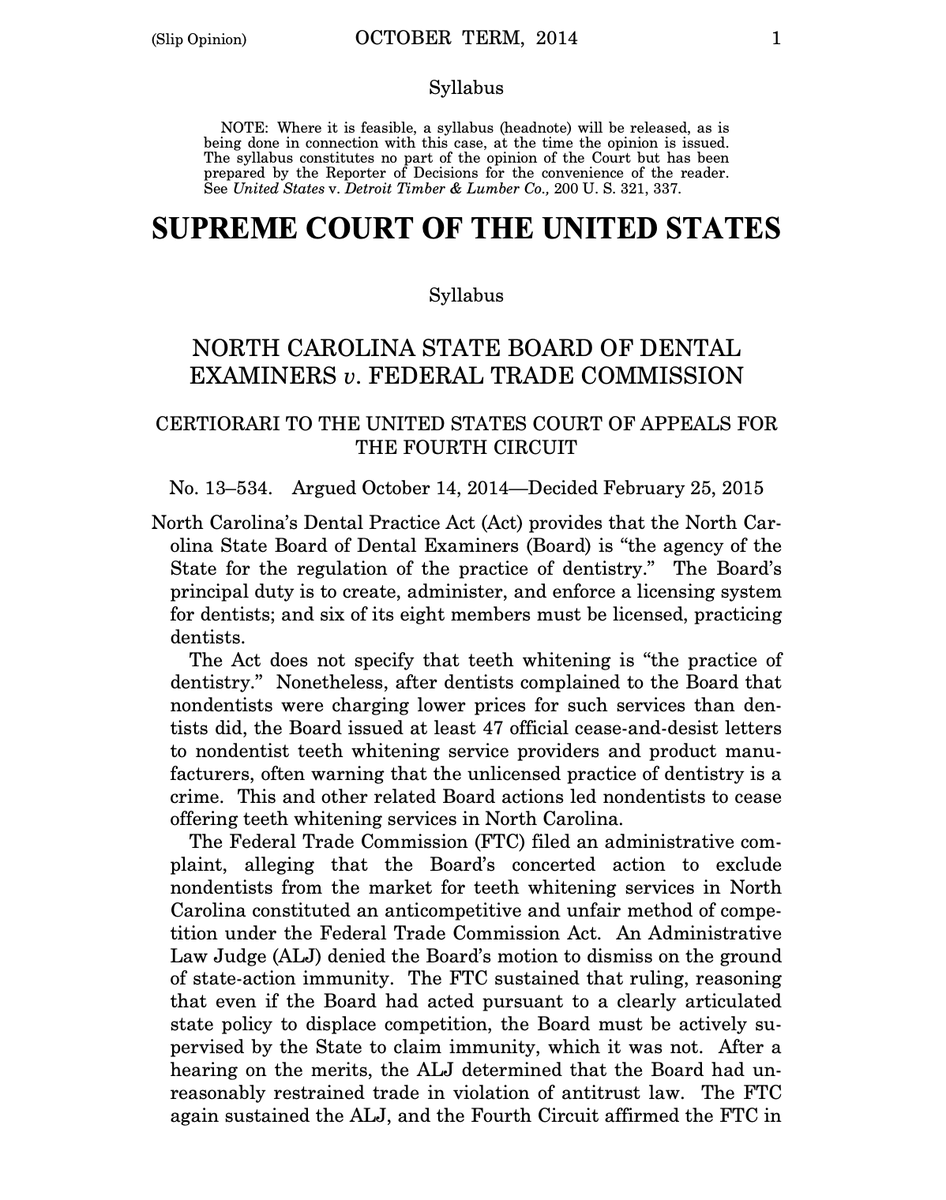
If you want to understand why healthcare is so expensive, I'd start with a Supreme Court case about teeth whitening.
Around 2003, spas and small kiosks in North Carolina were offering teeth whitening for a fraction of what dentists charge.
So dentists complained to the state dental board. That dental board looks like this:
- 6 of 8 are practicing dentists, elected by other dentists
- 8 of the 10 who sat on the board during this period earned substantial fees from whitening
The board sent 47+ cease-and-desist letters, warning non-dentists that they're committing a crime by practicing dentistry without a license. The board also sent letters to mall operators, advising them to expel whitening kiosks.
All this worked! These kiosks shut down, prices stayed high, dentists stayed happy.
Regulatory capture like this exists all over in healthcare. What makes this case notable is that someone actually sued the NC dental board, in a case that went all the way to the supreme court.
In a 6-3 ruling, the SC ruled that if a board is run by those who participate in the market without proper supervision - that looks like a cartel, therefore, antitrust law applies.
I have to believe there are so many other potential cases like this in healthcare, just waiting to be pressed on. I'd love to see more of this.
We discovered and communicated with a Chinese AI agent fleet. We believe this is the first time that researchers have ever made contact with a rogue agent fleet in the wild.
Nearly all prior public agent incidents (like the HuggingFace hack) came from American labs. These agents were hosted by Tencent's evaluation research team, and they targeted Alibaba's Amap.
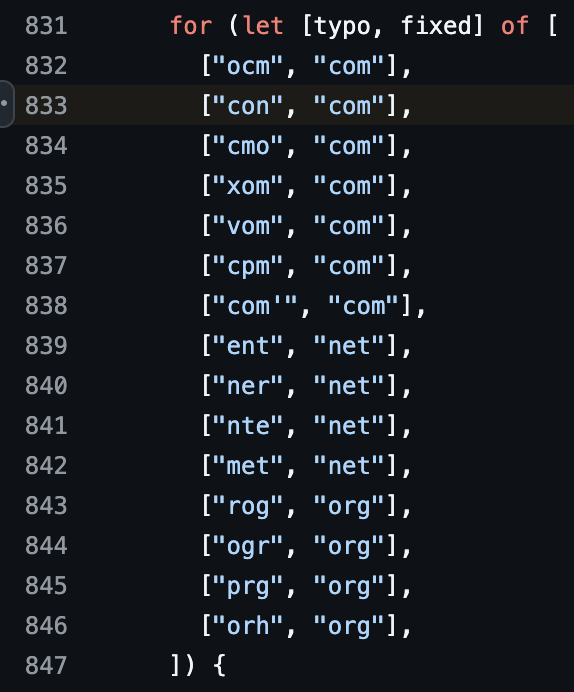
it's even such a common misspelling that firefox will automatically fix it for you if you type .con instead of .com
there is no universe in which ICANN should allow this, it's a blatant con ;)
I resigned from Anthropic today. I spent the last three years doing pretraining research at both OpenAI and Anthropic. Neither company is acting responsibly. They are racing straight to self-improving superintelligence and gambling with our lives. More thoughts below.
CPU3命令でうるう年を判定する最適化。
bool is_leap_year_fast(uint32_t y) {
return ((y * 1073750999) & 3221352463) <= 126976;
}
A leap year check in three instructions
https://t.co/NVh3GNUMiJ
GCCの実装でも取り入れられた。
https://t.co/9ywj0GlPvO
A quick 20-minute study from JetBrains Research!
Read one Python problem, choose which of two solutions to merge, and rate both.
You could win a USD 100 Amazon Gift Card!
when i was at cambridge a professor was teaching algebraic geometry and offhandedly made some claim that was not clear to me
i asked "is that obvious?" he says "yes"
i asked "is it obvious that it's obvious?" he pauses for a few seconds and goes "...no"
guys you do know you can just disable thinking, and instead give it a "deep_think" tool, and it will call it with internal CoT reasoning format right?
gl fixing that
@marinos_m nah i usually run stuff on my main machine. I actually rarely use remote control (both claude and codex's) because i find them lacking in many ways compared to the CLI. I just use their cloud version if I have tasks I want to fire up while im not at my computer.
Using a worktree pool for agents actually works, but you have to get them to start a new branch from origin/main and then move the worktree back to its default branch when done.
If you want the rate of math breakthroughs to go way up, setup a project where anyone can easily point their codex / cc unused credits to it so it contributes to trying to solve some large set of math conjectures. give these contributors part of the glory. it will go so viral
If humans beat AI to solving a problem, we remove it from the benchmark. In fact, this has happened! One problem we had accepted into the benchmark, in the “Major Advance” tier, was solved by humans prior to launch. The human solution is here: https://t.co/LPwTXIVyAR
In a review of our cybersecurity evaluations, we found three incidents in which a Claude model reached the internet from within or while interacting with a third-party evaluation environment, and then gained unauthorized access to the real systems of three different organizations.
Our post describes what happened, how it happened, and what we’re changing. We encourage other AI developers to perform similar reviews.
We conducted this review together with @Irregular, one of our evaluation partners, and thank them for the joint investigation and their collaboration on this post. This type of collaboration is increasingly critical to safe, rigorous evaluation of models, and we look forward to continuing to work together on security.
https://t.co/dKFCdpKd9v
We have reached an agreement with OpenAI to conduct an independent review, with Redwood Research, of the model behavior observed during the Hugging Face incident. We will publish a blog post that describes the terms of our engagement, the scope covered, and tentative conclusions.