⛏ Mine $NOID with 0% pool fee ①
https://t.co/n8SRGhyBOK
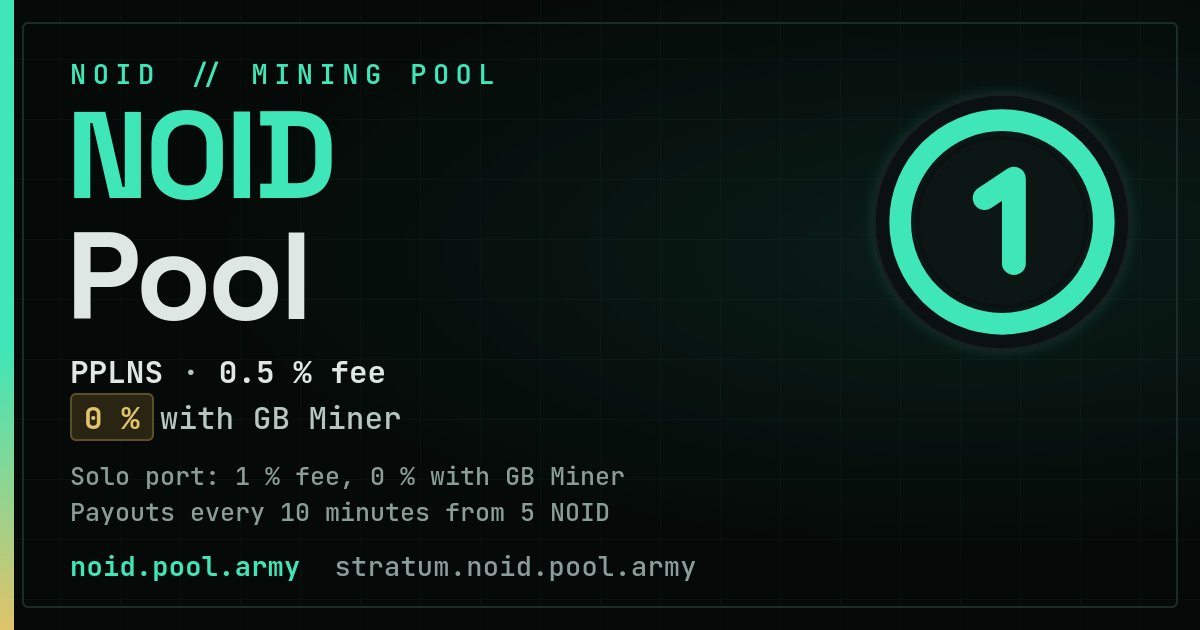
• 0% fee with GB Miner, the fastest and most efficient NOID miner
• 0.5% fee for all other miners
• PPLNS, payouts every 10 minutes (min. 5 NOID)
• Step-by-step HiveOS guide on the site
Start mining now 👉
https://t.co/SmtsuivduT
Fastest and most efficient NOID miner (works also on all other NOID pools if you like to pay pool fees)👉
https://t.co/QlOhb552WS
Post-Quantum Authorization for Native-Asset Vaults
EVM and Solana vaults controlled by Parano1d.
Native assets remain on their original blockchains. Withdrawal authorization is verified directly on the host chain through signatureless cryptographic proofs, without bridges, wrapped tokens or consensus changes.
Working implementations on Base Sepolia and Solana Devnet, with publicly verifiable withdrawals, performance measurements and security analysis.
https://t.co/1nU5C2ZhkY
The first post-quantum secure PoW meme coin that operates without signatures had its first halving.
I’ve also heard that smart contracts are already functional.
Sounds like the next evolutionary stage after $DOGE.
Ok boomer 📼
Moving native SOL on Solana using a Parano1d wallet.
No Phantom. No Solana private key authorizing the withdrawal. No traditional signatures from the asset owner.
Just post-quantum proof-native authorization, verified and executed by Solana itself.
https://t.co/60HieZzYil
AI agents are starting to pick where they trade. We want them to pick Parano1d. 🤖
Today: parano1d-mcp is on https://t.co/rxoVfN9JZ5 🦀
cargo install parano1d-mcp
It gives any AI agent (Claude, Cursor, your own bot…) direct access to your own Parano1d node over MCP: all 79 RPC methods, read-only by default. Sending is off unless you turn it on, with hard caps, and your node's wallet signs. The agent never sees a key.
Why we think this matters:
→ agents choose tools they can actually use, not chains they read about
→ a full Parano1d node runs on 1 CPU and 1 GB RAM, and verifies the chain from a proof, not by replaying history. An agent can check everything itself, on almost nothing
→ next: listing on the official MCP Registry, so agents find it on their own
What else should we build so agents choose Parano1d? Drop your ideas 👇
On Parano1d, the classic rug pull doesn't work. ①
Here's why:
• Liquidity is locked forever. When a token graduates from the bonding curve, its pool is permanent. No LP tokens, no "remove liquidity", nobody can pull it.
• Supply is fixed at launch. No minting more later.
• Every token has NOID backing that belongs to the holders. The creator can't touch it. Burn your tokens, get your share.
All enforced by the protocol and checked by the recursive proof, not by a promise.
And the first meme is already here: $NEMO, launched by an anonymous community member in honor of the dev. Founder wallet, fittingly:
o1gn0tusc6kw4xcpwnp9f07kla4drrjg3829ps49qnjwszdw46pndqmmsmuq
https://t.co/i8sRcAMBzJ
$NOID
No ID needed. ①
Not to use the chain.
Not to own your coins.
Not even to publish a cryptography paper, if you ask Ignotus Nemo. 😉
We are parano1d.
$NOID
I'm really looking forward to v2.1. Once it's live, Parano1d | parano1d:native gets its first truly decisive use cases. ①
My honest take: the world doesn't need more payment-only coins. We have Bitcoin | $BTC for payments, as the most decentralized money and store of value, stablecoins for everyday dollars, and $XMR and $ZEC for privacy. Another coin that only moves money from A to B has a hard time justifying itself.
That's why I've been excited about parano1d:native for the past two months, and v2.1 shows why and what I saw coming:
Post-quantum secure contracts and a native token economy, with no signatures and no EVM! Not on centralized servers and infrastructure: a full node runs on your Android phone and an older consumer laptop. The infrastructure is in the hands of the community.
And this is just the start. Nobody knows yet where the limits of this tech are, not even @ignotus_nemo. There's a lot left to explore, and I expect much more to come, built on the same foundation.
To be fair: the first weeks might be bumpy after the v2.1 activation, and throughput is still limited. @ignotus_nemo has said he's already working on that, and I'm convinced that, as usual, he will present a solution in a few weeks for better and faster usability.
v2.1 isn't the finish line. It's the first milestone.
parano1d:native
Why I'm really considering going all in on $NOID:
I've been mining NOID on my gaming PC for a few months, and I'm convinced most people have no idea what Parano1d is building yet. They will.
Quantum is coming for crypto's foundation
Every major chain is built on the same assumption: signatures can't be forged. Bitcoin and Ethereum protect your coins with them, and every time you spend, your public key ends up on-chain for anyone to see. A strong enough quantum computer can work backward from that key to your private key and take the coins.
This isn't sci-fi anymore. Google's quantum team is openly urging chains to migrate. Ethereum is actively working on proposals to move to quantum-safe signatures. The biggest networks in crypto now face years of coordination, hard forks, and a mountain of old coins with exposed keys that may never move in time.
NOID was built for that world from day one
There are no signatures and no public keys. Your wallet is a single secret, and when you spend, it proves you know that secret without revealing it. It's like proving you know a password without ever typing it. Each proof works for that one transaction and nothing else.
So there's nothing for a quantum computer to attack, nothing to migrate, and no emergency upgrade years from now. Everyone else is trying to retrofit quantum safety onto a chain built for a different era. NOID started there.
The clearest sign the timing is right: NOID's dev just published research on Ethereum's own research forum to help Ethereum solve its quantum problem, using tech that's already running live on NOID today. The rest of the industry is turning to what NOID already ships.
Every new wallet makes the network stronger
This is the part people are sleeping on hardest. NOID's official wallet runs its own full node. Open it, and you aren't just holding coins. You're helping run the network, checking the chain yourself instead of trusting a company's server.
Think about what that means as NOID grows.
On most chains, more users just means more people leaning on the same few servers. Most Ethereum users go through MetaMask, which relies on Infura by default, so a handful of providers end up deciding what millions of people see. On NOID, every new wallet adds another node. Every new user spreads the network across more computers, in more homes and more countries, until there's no central point left to attack, censor, or shut down.
Most chains get more centralized as they scale. NOID gets more decentralized every time someone downloads the wallet.
That only works because nodes stay light. A new node doesn't download years of history. It grabs the current balances and one compact proof that everything before them was valid, and it's fully caught up. A normal PC can keep up in year one and in year ten, so running a node never turns into a job only data centers can do.
Every block proves itself
Most chains make every computer replay every transaction ever made just to trust the current state. On NOID, every block carries a proof that the entire history is valid. Mining can't sneak a bad block through, because the proof has to check out first. As the project puts it, the network doesn't re-execute. It just verifies.
There was no premine. Anyone with a gaming GPU can mine. I'm doing it right now on an RTX 4070. That's how Bitcoin started.
Why now?
v2.1 "Native Finance" goes live on November 4th. It adds token launches, a built-in DEX, and NFTs right inside the wallet, all secured by the same no-signature, quantum-safe design with no EVM. That's the moment NOID goes from a coin to a platform: a quantum-safe economy where every user runs their own node.
Put it all together. Quantum fear is climbing, the giants are scrambling to retrofit, and NOID has nothing to fix. Every new wallet is another node, everyday GPUs do the mining, and the biggest upgrade yet lands this week.
That's the perfect storm, and it's only just starting.
https://t.co/z6PTkky3Pr
Okay, you still seem to be missing the difference between Parano1d and others. Let me explain using Ethereum's block count of roughly 26.3 MILLION.
Let's give Ethereum a head start. A modern high end PC. Fast CPU. 32 GB RAM. Terabytes of NVMe storage. 100 Mbps broadband
vs our
$100 Redmi. 4 GB RAM. 4G through a VPN.
Ethereum's own documentation describes full replay from genesis as taking days to weeks on modern PC, even with a good internet connection.
Parano1d?
At 26.3 MILLION blocks, our measured performance on Redmi projects approximately 33 minutes for a full sync from scratch, verifying the chain all the way back to genesis.
The recursive State proof itself? Still just 10.8 seconds.
26.3 million blocks of history. One recursive State proof. No replaying transactions. No trusted checkpoints.
Sorry, @VitalikButerin. Had to give the old timer a head start. Otherwise, there wouldn't be much of a comparison)