Let me explain exactly why OpenAI will sell you $14,000 of compute for $200, because the margin math only looks suicidal until you read it like an actuary.
A subscription is a premium. Tokens are claims. The weekly limit is the coverage cap. Insurance books get priced on the pool's average utilization, and that $14,000 figure is the maximum.
Back out the breakevens from SemiAnalysis's 75% gross margin assumption. A chatgpt-pro-20x subscriber stays profitable for OpenAI up to 5.7% utilization. Anthropic's max-20x plan holds to 10%. Meanwhile the median $20 subscriber asks a few questions a day and burns low single digits of their cap. Whales blowing through weekly coding limits get carried by millions of quiet users who barely touch theirs.
The caps hide the best detail. $700 vs $400. $3,500 vs $2,000. $14,000 vs $8,000. OpenAI's ceiling sits at exactly 1.75x Anthropic's at every single price point. One constant ratio across three independent tiers. Somebody set these limits with a competitor's spreadsheet open.
Rate limits do the actuarial work too. The worst possible whale costs OpenAI about $3,300 a month and Anthropic about $1,800, and the loss stops there by design. A hard ceiling on claims, written directly into the product. Actuaries spend entire careers wishing for that clause.
Now the deflation argument, and the catch inside it. a16z measured inference cost falling 10x per year, but that decline holds for a fixed level of intelligence. Whales never sit at a fixed level. They ride each new frontier model the day it ships, so the cost curve never catches up to them.
Which makes the model behind the plan the entire game. Cutting limits triggers public backlash that trends for a week. Routing the $200 tier to a model deflation already made cheap is silent and repairs the book overnight. SemiAnalysis predicts labs will withhold new models from subscriptions, and the actuarial math agrees. Last year's frontier at this year's serving cost turns every whale profitable without touching a single limit. Insurers take claims costs as given. AI labs choose theirs.
Limits are the lever everyone watches. The model behind your plan is the lever nobody sees.
ICYMI 👀: Z AI released GLM-5.2 for all users on GLM Coding Plans.
> As our new flagship model, GLM-5.2 delivers powerful coding capabilities, usable 1M-context support, and continued strengths in long-horizon tasks.
Open-source and API support are planned for next week.
You can now tell an AI "work until it's actually finished" and walk away.
Most people still use AI like a vending machine. Type, wait, read, type again. An hour in, you've said "keep going" fifteen times and you're the one keeping the whole thing alive.
One command ends that. You write down what finished means, in terms a stranger could check. All sections filled. No placeholders. Every claim has a source link. Then a second AI grades the first one's work against that list. Fail means it automatically goes back to work. Pass means it stops and hands you the result.
The judge being a different model than the worker is the whole trick. Same reason companies don't audit their own books. The thing that did the work always believes the work is done. And the worst failure happens when you believe it too: the run says "done," you move on, and three days later you find half of it was a stub that never ran.
I tested this on a trip-planning task. Normal way: 8 minutes, and it interrupted me three times with questions. With a finish line: 3 and a half minutes, zero interruptions, and it flagged the one thing it couldn't verify instead of quietly guessing.
Full playbook with copy-paste templates: https://t.co/UBuAvCOBrB
The command takes ten seconds to learn. The skill underneath takes longer: writing a definition of done so clear a machine can grade it without reading your mind. Build that and you stop being the thing that keeps the work moving.
Prepare for takeoff. ✈️ Flight simulator is now available globally on web to all users. https://t.co/hQP0No142P
We've recently added many our most powerful professional desktop features to web. Elevation profiles, new import types, but there's always been one other feature you've been asking us to add to the web version of Google Earth, just for fun...
Where will you fly? Share your best maneuvers, views, and flyovers with us!
Want a closer look at today’s launch? Here is a breakdown of what’s new and exciting 🧵:
First up: An upgraded, more thoughtful chat experience.
Powered by Gemini 3.5 and @Antigravity, you will now have better visibility into the AI's thinking process. Plus, each notebook has a secure cloud computer including 100+ curated software skills, unlocking deeper research and more complex analysis.
Here’s what launched this week:
— Gemini 3.5 Live Translate our latest audio model for live speech-to-speech translation
— @NotebookLM got a major upgrade including agentic capabilities in chat, more advanced reasoning, and a suite of new output formats
— Project Genie from @GoogleLabs is now available to Google AI Ultra 5x subscribers globally
— Notebooks in @GeminiApp are now available in the European Economic Area, United Kingdom, and Switzerland
— DiffusionGemma, our newest experimental open @googlegemma model that explores text diffusion, an exceptionally fast approach to text generation
The US government, citing national security authorities, has issued an export control directive to suspend all access to Fable 5 and Mythos 5 by any foreign national, whether inside or outside the United States, including foreign national Anthropic employees.
The net effect of this order is that we must abruptly disable Fable 5 and Mythos 5 for all our customers to ensure compliance.
Access to all other Claude models is not affected.
We apologize for this disruption to our customers. We believe this is a misunderstanding and are working to restore access as soon as possible.
Read our full statement: https://t.co/bwn0sximKZ
The best trade in Twitter's history was being marked down 25% on Twitter. Equity valued at $33 billion fifteen months ago starts trading inside a $1.8 trillion company today.
TL;DR: SpaceX lists on Nasdaq today under $SPCX at $135 a share, raising about $75 billion, the largest IPO ever. The investors who backed the $44 billion Twitter buyout, long considered underwater, ride in because two stock swaps quietly turned their social media equity into space and AI equity.
The chain, since the headlines compress it wrong: xAI acquired X on March 28, 2025, all stock, with X's equity valued at $33 billion against the $44 billion Musk paid in October 2022. Then SpaceX acquired xAI in February 2026, also all stock, valuing xAI near $250 billion and the combined entity around $1.25 trillion. Today that entity prices at roughly $1.77 trillion. SpaceX never bought X directly; X holders got there in two hops.
Here is the part the recap threads will miss: X the business never staged a comeback. The ad franchise that justified a 70% Fidelity markdown in 2023 is the same franchise today. The recovery happened entirely at the wrapper level. xAI re-rated from roughly $80 billion to $250 billion in under eleven months, and the merged company re-rated another 40% between February and today's pricing. X holders got paid by the multiple of whatever envelope their shares were stuffed into, with zero public price discovery at either hop. Today is the first time an open market votes on any link in that chain.
The macro setting makes the vote interesting. A $75 billion raise is a genuine supply event landing one week after the June 5 chip selloff, with my read showing rate-hike odds at 52% and the 10 year at 4.55%. My near-term S&P base case is 7,350, below spot, precisely because the tape is rate-capped. Watch the first close against $135: if the largest IPO ever cannot hold issue price, that is the cleanest single reading of real risk appetite this market has produced all year.
A view on the mechanics, yours to weigh.
Here's a simple loop: Tell codex to maintain your repos, wake up every 5 minutes and direct work to threads. That makes it easy to parallelize+steer work as needed.
I use a orchestrator skill combined with my triage+autoreview+computer use skills, so some work can land autonomously. https://t.co/FbBoJTIcfd
https://t.co/8389roVnOm
BREAKING: The SpaceX, $SPCX, IPO will be quoted at 9:50 AM ET today and begin trading at 10:00 AM ET.
Currently, the stock is indicated to open ~25% higher, making SpaceX the 7th largest public company in the world and Elon Musk the first trillionaire in history.
We heard you wanted to use Codex rate limit resets on your own time.
Starting today, we’re rolling out the ability to save rate limit resets to use later.
We’re starting Go, Plus, Pro, and Business users with one free reset:
America’s digital economy relies on our physical infrastructure and the electricians, pipefitters, welders, manufacturing workers & more who build and maintain it.
Today, we’re making an additional @googleorg commitment to help 300K American workers prepare for these in-demand skilled trades careers, expanding on the $1B we’ve already provided for digital skills and training globally.
🚨 Peter Steinberger, founder of Openclaw, says you shouldn't be prompting coding agents anymore.
Boris Cherny says he doesn't prompt Claude anymore. Instead, they both write loops.
Since then, the AI community has been asking the same question:
What exactly is a loop?
To help answer that, Matt Van Horn (co-founder of Zimride, which later became Lyft) shared a framework outlining the evolution of loops in Agentic AI—and how we've arrived at this new abstraction layer.
🔹 2022: ReAct Loop
🔹 2023: Self-Prompting Agents
🔹 2025: The Ralph Loop
🔹 2026: Productized Ralph
🔹 and the future: Multi-Agent Orchestration.
In multi-agent orchestration, loops become the primary unit of work—spawning, coordinating, and supervising other loops and agents.
The common theme across Peter's and Boris's comments is that the focus is shifting away from the prompt itself.
Whether you agree with this framework or not, it's a useful way to understand why some of the most experienced AI builders are talking less about prompt engineering and more about designing systems around loops.
Do you think loops are the next major abstraction for Agentic AI, or is this simply iterative prompting with a new name?
#agenticai #ailoops #claude #openclaw #aiengineering
Anthropic and OpenAI are both telling engineers to write loops.
Not prompts.
Not agents.
Loops.
That is not a coincidence.
When the two most important AI labs on the planet independently converge on the same pattern — that is a signal worth paying attention to.
Most engineers are still thinking in terms of single calls.
Input → model → output.
The engineers winning in 2026 think in cycles.
Output becomes input. The model evaluates its own work. The loop runs until the result is right.
This is the complete breakdown of what loops are, why they matter, and how to build them ↓
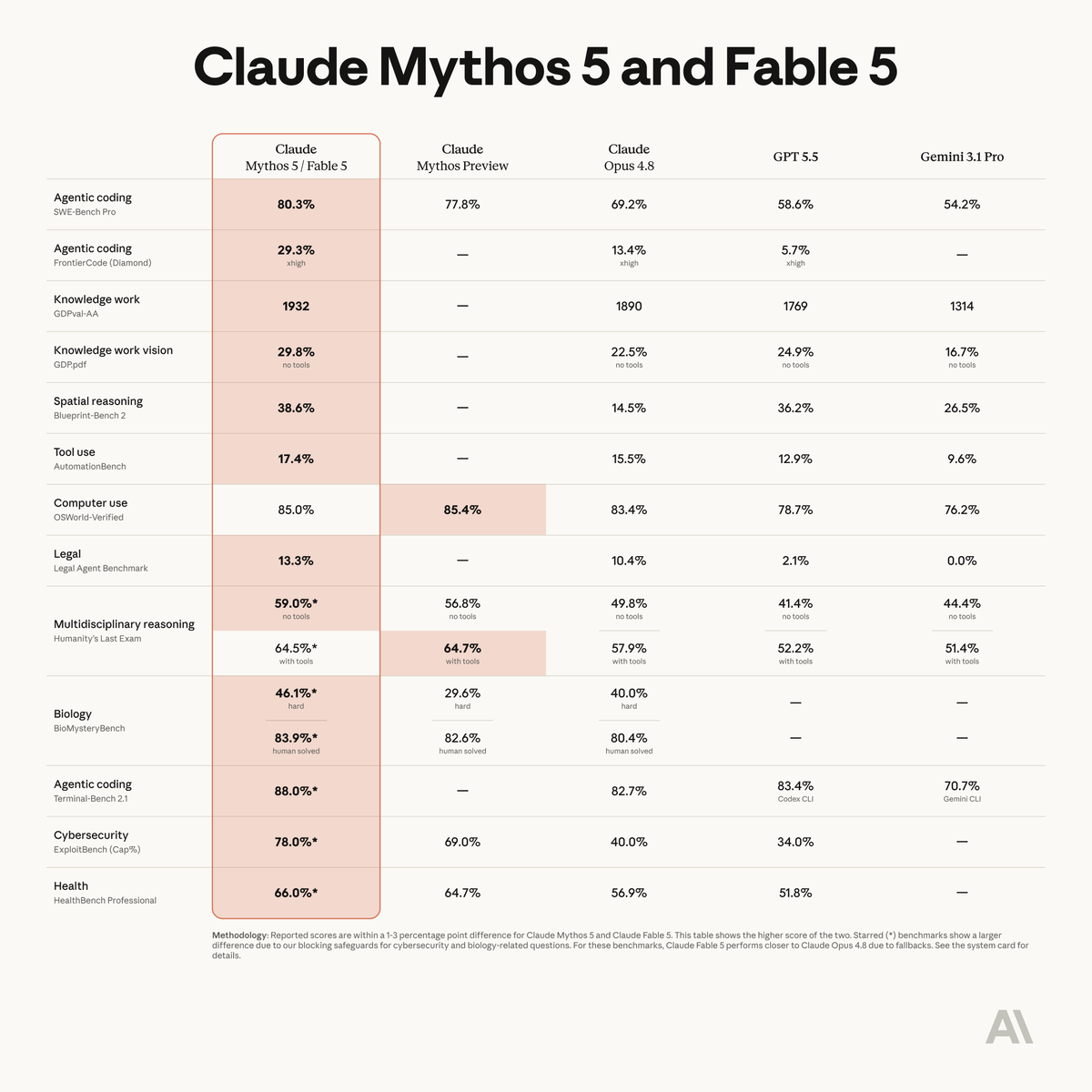
Fable 5 is state-of-the-art on nearly all tested benchmarks, with exceptional performance in software engineering, knowledge work, scientific research, and vision.
The longer and more complex the task, the larger Fable 5’s lead over our other models.