Why im bulish on @nodiens ?
I’m bullish on Nodiens because it brings different parts of market discovery into one experience
https://t.co/Y2Ak2ZlYGe
Instead of switching between multiple platforms for market data,news,social sentiment and community insights,Nodiens combines market intelligence,social content,watchlists,predictions and missions in one place
The Watchlist lets me follow the assets I care about,while the feed helps me discover market-moving information and community perspectives. Integrating data from sources such as Yahoo Finance and Stocktwits also adds more depth to the information available on the platform
What makes Nodiens more interesting to me is the interactive layer
Features like Feed Find,Engage Points and Missions turn discovery into participation,while Predictions gives users another way to express and test their market views
I also like the balance between information and community. It doesn’t feel like a platform where you simply consume data and leave; there are different ways to explore,participate and discover something new
That combination of market intelligence,social interaction and gamification is what makes Nodiens stand out to me
For me,the real potential is in turning fragmented market information into a single,engaging experience that people can return to regularly
#nodiens
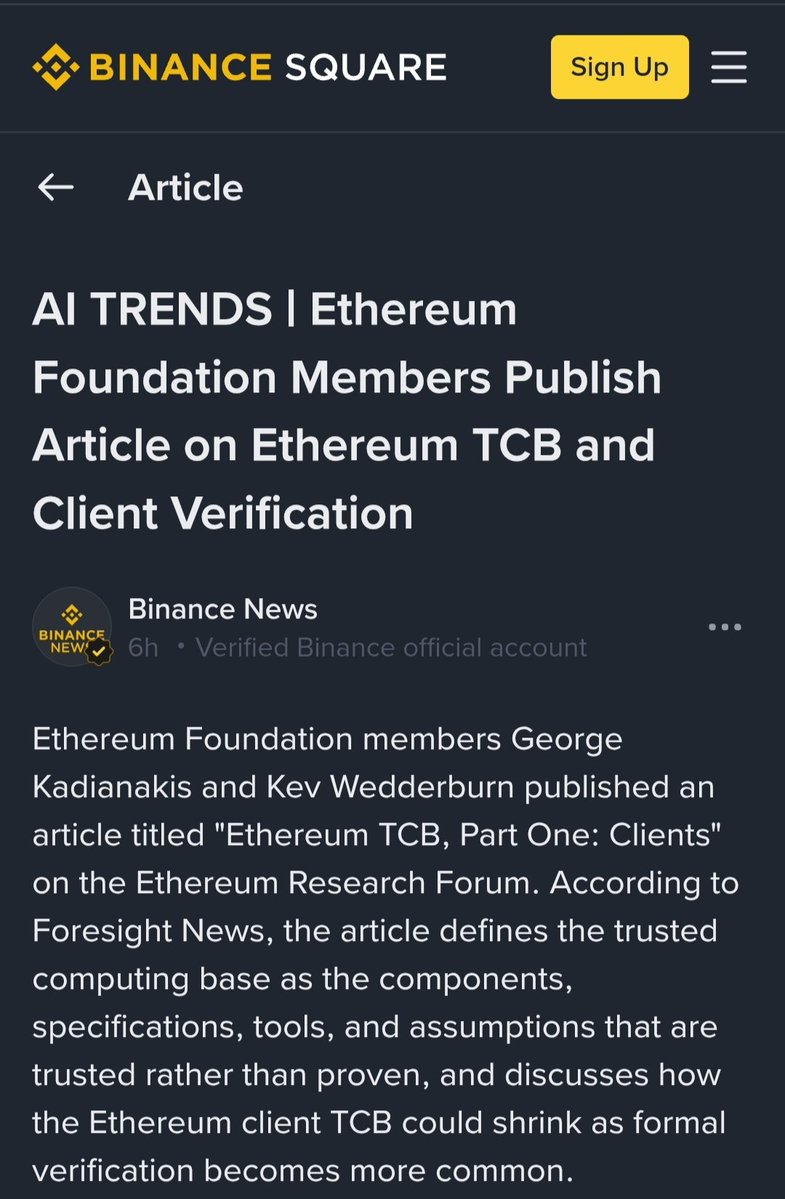
While exploring @nodiens Social Feed, I came across an Ethereum research piece that caught my attention:
“AI TRENDS | Ethereum Foundation Members Publish Article on Ethereum TCB and Client Verification”
join Nodiens:
https://t.co/Y2Ak2ZlYGe
The article looks at how Ethereum clients could reduce their Trusted Computing Base (TCB) , the parts, tools, specifications and assumptions we trust instead of formally proving them.
One idea I found especially interesting is separating “pure” modules, like cryptography and SSZ, from more complex “dirty” modules with side effects, like networking.
To me, this is a practical way to approach verification. Not every part of a client is equally complex, so starting with the parts that are easier to prove could make it easier to build stronger guarantees over time.
I also found the difference between proving a specification and proving that the actual implementation follows that specification very interesting. It shows that formal verification is not just about writing a specification , there is still a real engineering challenge between the specification and the software running in production.
The different approaches discussed in the article, from Lean4 to RISC-V and verified compilers, also made me think about how much Ethereum clients can still improve.
What I take from this is that better security may not always mean adding more layers. It can also mean reducing the amount of software we need to trust in the first place.
That direction is exciting to me: more verification, fewer assumptions, and a clearer line between what we trust and what we can actually prove.
This is the kind of discovery I enjoy finding through Nodiens Social Feed , something that starts with a piece of news and turns into a better understanding of where the technology is heading.
One thing I’ve started noticing while using @nodiens is that the interesting signals aren’t always the ones sitting at the top of the feed
Sometimes a narrative gets a lot of attention,but the actual market activity tells a different story
I like looking at the feed,market trends and price data together because it gives me a better way to spot those gaps instead of following whatever is getting the most noise
For me,the real value is in catching that change in attention early and asking what’s actually happening underneath it
Crypto moves fast,and sometimes what disappears from the conversation is just as worth watching as what suddenly becomes popular
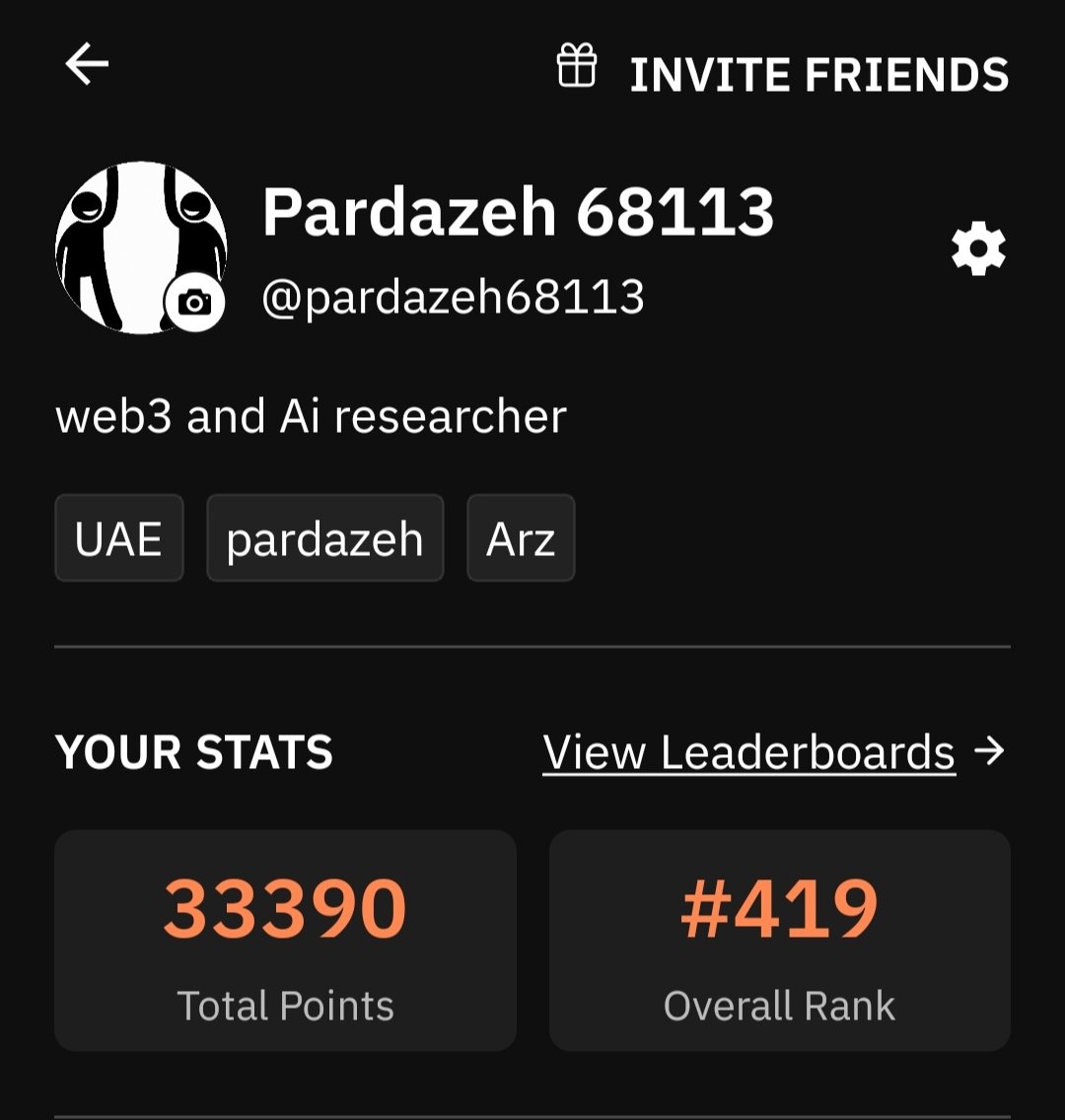
Just checked my @nodiens progress and I’m currently at 33,390 points,which puts me at #419 on the leaderboard
If you haven’t joined yet,you can start here:
https://t.co/Y2Ak2ZlYGe
For anyone asking how I got started,I basically went through the usual setup:
«Created my account
Filled out my profile
Connected X
Followed Nodiens
Completed the onboarding
Started working through the Points section»
Since then,I’ve just been checking back in for the daily activities and adding points whenever there’s something available
Still a long way to go,but I’m curious how high I can take this
One @nodiens metric I’ve been looking at lately is the Sharpe Ratio
Price shows how an asset performed,but it doesn’t show how much risk came with that return
Two assets can have similar returns,but one might have been much more volatile along the way
That’s where the Sharpe Ratio is useful
It compares the return with the amount of volatility behind it
A higher reading generally means you got more return for the risk you took
So instead of only asking “how much did it move?”
You can also ask “how much risk came with that move?”
That’s a small difference,but it gives me a better way to look at performance in Nodiens
The new @nodiens v4.1.0 update adds more ways to earn points through Missions by connecting your X,Google and Apple accounts
Join to Nodiens: https://t.co/Y2Ak2ZlYGe
One thing I like about Nodiens is that it doesn’t just show you what is moving,it helps you understand what is behind the move
You might see a quiet asset suddenly getting more attention,and instead of guessing why,you can check NSA,sentiment,token discussions and the news feed to follow the story behind it
Nodiens has become a place where I can follow the market and also understand the context behind what I’m seeing,all in one place
#nodiens