Classical education was built around a simple idea:
A young person should learn how to think before being told what to think.
That meant studying:
— Logic to recognize bad arguments
— Rhetoric to express ideas clearly
— History to understand human nature
— Philosophy to examine difficult questions
— Literature to understand other people
— Mathematics to develop reasoning
These subjects were not merely preparation for employment.
They were preparation for life.
The Left Are the Agents of Entropy
As if it needed any help…
They are its accelerationists.
Look at the physics.
1. Disorder has the numbers on its side. There are a million ways to break a vase and only one way to make it whole. That is the whole secret of the second law: decay is simply what is probable. Entropy needs no plan, no budget, no vote. The Left gives it all three.
2. Life is improbable order, kept alive by two things: a flow of energy and a boundary. Schrödinger put it simply, writing that a living organism feeds on negative entropy – it draws order from its surroundings and pushes disorder out. A cell, a family, a city, a civilization: all are islands of order that last only while energy flows through them and their boundary holds.
3. So the first attack is on the boundary. A cell lives because its membrane decides what comes in and what goes out. A family has a door, a nation a border, a word a meaning, a contract its terms. The Left calls every membrane a wall, and every wall oppression. Dissolve the membrane, and the inside becomes the outside. That is not liberation. In a cell, it is called death.
4. The second attack is on difference. Two centuries ago, Carnot showed that no engine can run on a single temperature: it needs a hot side and a cold side. Work flows only across a difference. In a society, the differences are effort and reward, risk and return, success and failure. Level them, and the engine stops – not because it is broken, but because nothing is left to flow. Equality of outcome is the economic name for heat death.
5. The third attack is on information. Maxwell imagined a tiny demon that could sort fast molecules from slow ones and so create order out of chaos. Physics later found the price: the demon can only sort because it knows. Order is paid for with information. A civilization is a society of such demons – millions of people sorting the true from the false, the good from the bad, the beautiful from the ugly. Lie to them, and they sort at random. And sorting at random is just another name for entropy.
6. Time is on the destroyer's side. A cathedral takes a century to build and an afternoon to burn. Breaking is fast and cheap; building is slow and costly. That is why the accelerationist always looks as if he is winning. He works with the arrow of time, not against it.
7. Europe adds a final refinement: the old is not allowed to die, and the new needs a permit to be born. Keeping a corpse warm costs energy too – and it is taken from the living. Meanwhile, the new is held in a state physicists call supercooling: pure water can stay liquid well below zero, as long as nothing gives it a crystal to start from. Every condition for new order is there; only the seed is forbidden. But physics has a hopeful footnote. Drop a single crystal into supercooled water, and it freezes all at once. In August 1980, one shipyard in Gdańsk was that crystal. Within months, ten million people had joined it.
We are that crystal now.
Entropy is a law of physics. The Left is a choice – and it calls the heat death progress.
On the other side are life and intelligence. Life builds order; intelligence builds it on purpose. That is the other choice. And it is why the Left attacks two things before all others: the boundary that protects life, and the truth that guides intelligence.
Mao Zedong's Great Leap Forward killed an estimated 45 million people between 1958 and 1962, and the backyard steel furnace campaign sits at the center of that catastrophe as a textbook case of central planning consuming itself alive.
Mao's logic was simple. If the Soviet Union had industrialized through state-directed production, China would do it faster and bigger. He ordered peasants across every province to smelt steel in small furnaces built on collective land. Party officials set output quotas with no reference to the resources, skills or demand that actually existed. Farmers melted down their own plows, woks and door hinges to hit the numbers, and stripped hillsides bare for fuel. What came out of those furnaces was mostly pig iron so brittle it had no industrial use. The quotas got reported as fulfilled, the statistics traveled up the command chain, and Beijing celebrated a triumph that existed only on paper.
Think about what those farmers abandoned to stand at furnaces all day. By most estimates, the 1958 harvest was decent. With the rural labor force diverted to smelting, the crops rotted unharvested in the fields. Free market economists call this opportunity cost: every hour a farmer spent producing worthless slag was an hour not spent producing food. Had anyone been allowed to use the price system, it would have made that tradeoff visible at once, because prices signal scarcity. Planners issue directives and wait for reality to disobey them.
Local officials who reported shortfalls faced execution or the labor camps, so they reported surpluses. Beijing then exported grain, partly to pay its debts to the Soviet Union and partly to project an image of socialist success, while provinces like Anhui and Sichuan descended into mass starvation. The state had monopolized food distribution, so when the numbers were wrong, there was no private market or informal trade left to move grain to the dying. The apparatus built to feed people became the mechanism that starved them.
Abolish private property and price signals, and you get 45 million corpses and a generation of Chinese children stunted by famine.
@JoeyO70 No way! Huge mistake. Look at https://t.co/Hzv22S8tjJ. He will be a 55 million plus cap hit. Be like Denver. Draft your QB in 2027 & fill in the holes on this team with remaining picks & cap space to get solid vets.
@ESPNCleveland@BenjaminSolak Hell no!
Think of this next part as weather forecast. Last week Kiper listed the top 25 draft prospects for 2027. Seven were QBs. The Browns have two 1st rd picks. Be like Denver & use the draft to build a roster with no major holes. Draft a QB.
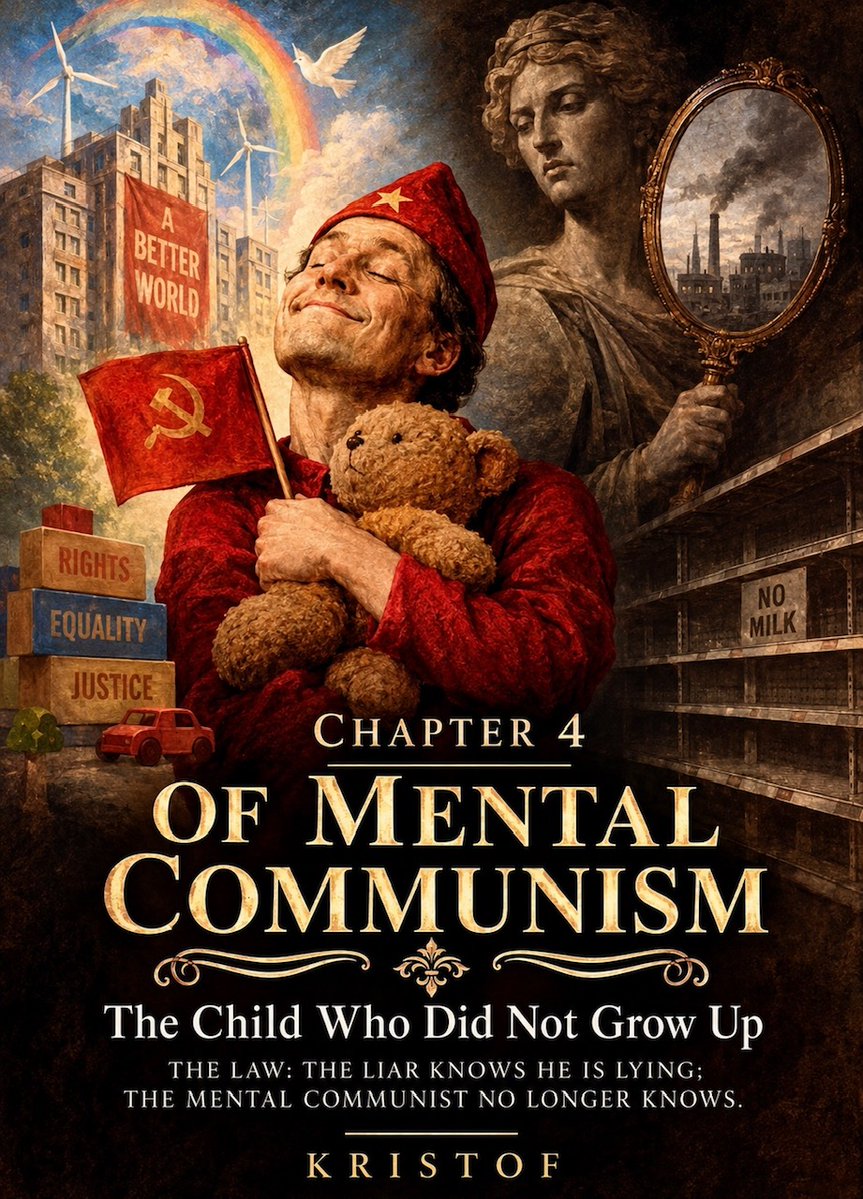
Chapter 4 – Of Mental Communism: the Child Who Did Not Grow Up.
The law: the liar knows he is lying; the mental communist no longer knows.
§1. Communism only partly fell in 1989. The regime fell – the party, the censor, the secret police. The habit of mind survived, and it traveled west. We call it mental communism: communism without the secret police, carried in the head. The liar of the old regime knew the truth and hid it. The mental communist has gone beyond the Lie. For him, reality does not exist – only wishes, words, poses and power.
§2. The greengrocer knew. When Havel's greengrocer put the sign in his window, he did not believe a word of it; he wanted to be left alone. That was the Lie in its classic form: everyone knew, nobody said. But a lie repeated long enough changes the people who repeat it. The first generation lies out of fear. The second repeats out of habit. The third believes – unless reality intervenes. In the East, it did: the empty shelf taught every day what the newspaper denied. In the West, comfort kept reality away. That is why communism ran out of believers where it ruled – and found new ones where it never did. The West kept the dream because it never had the wound. In the end, the Lie no longer needs liars. It has believers.
§3. Psychologists show small children a sponge painted to look like a rock. A three-year-old cannot hold both ideas at once – what a thing looks like and what it is. Around four, he can: it looks like a rock, but it is a sponge. At about the same age, he learns the harder lesson: wishing does not make it so, saying does not make it so, and the world has its own rules. Normally, children figure it out around four. The mental communist does not. He still believes that what is declared becomes true. Declare a right to housing, and houses appear. Print money, and wealth appears. Ban a word, and the thing disappears. The child says: I want. The mental communist says: I have a right to.
§4. In a child, this is fantasy, and it is charming. In an adult, it becomes delusion. In an adult with power, it becomes policy – and the rest of us have to live inside it. At best, the mental communist lives in models: the plan, the spreadsheet, the forecast, the simulation. When the model and the world disagree, he does not correct the model. He concludes that the world is wrong – and sets out to correct the world.
§5. Appearances come before reality. A child wants the costume, not the job. The mental communist is the same: what matters is to look good, not to do good. The right words, the right flag in the profile picture, the right slogan on the right tote bag. The wind turbines count for more than the electricity, the electric car for more than the coal that charges it, the intention for more than the result. Being good would require reality to check the work. Looking good requires only an audience. That is why he gathers where reality never checks: in the faculty, the newsroom, the NGO and the ministry.
§6. When reality does not exist, only power remains. If there are no facts, only narratives, then the only question is who controls the narrative. "Is it true?" gives way to "Who is speaking?" and "Whose side is he on?" A child who does not get what he wants throws a tantrum. A man who never grew up, given power, passes a law – then another to punish those who notice it does not work.
§7. Mental communism is a luxury. It survives only where someone else pays for reality: the parents, the taxpayer, the next generation. It fell in the East because there was nobody left to pay. It flourishes in the comfortable districts of Paris, London and New York, among people who have never borne the cost of their opinions. Communism forced the East to grow up. Comfort let the West stay a child. And the state, as it grows, becomes the last parent: the one who pays for everything, forgives everything, and never lets the child meet the world.
§8. You cannot refute a wish with a fact. Facts do not reach a mind for which reality does not exist; they bounce off as insults. So the mental communist does not answer the fact. He answers the person: racist, fascist, extremist. Arguing with him is like explaining to a three-year-old that the rock is a sponge. You are right, and it changes nothing. Children grow up in only one way: reality teaches them, gently or brutally, provided no one shields them from it. The mental communist is the child who was always shielded – by his parents, then by the university, then by the state.
The counter: the cure for a child who will not grow up is not argument. It is consequence. Do not shield him from reality, and do not pay for his wishes. Let every opinion carry its cost, and let those who vote for a policy live under it. Each time the cost of an idea falls on the man who holds it, a little mental communism dies. Reality is the only teacher he cannot cancel. Our task is not to replace it – only to stop standing between him and it.
Next: Chapter 5 – Of Its Fuels: Envy and Fear.
@big_mike9169 At this point, I’d say thank you & let him walk. There’s still 10 games left. He hasn’t completed a full season since 2020. He’s only won 1 playoff game against rookie Josh Allen. He’d have to get us to the AFC championship game before I consider changing my mind. No Hebert.
Chapter 3 – Of Its Masks: Socialism, Communism, Marxism, Leftism, Wokism.
The law: the masks change; the Lie does not.
§1. Every discussion of socialism soon becomes a discussion about words. That was communism, not socialism. That was Stalin, not Marx. That is wokism, and wokism does not exist. The argument about the name is never innocent: while we argue about the mask, nobody looks at the face behind it. So let us begin with what they say about themselves. In the doctrine of Marx and Lenin, socialism is not the opposite of communism. It is its first stage – the waiting room. The Soviet Union never called itself communist. It called itself the Union of Soviet Socialist Republics and announced communism for later. Khrushchev even set a date: 1980. Communism never arrived. The waiting room was all there ever was, and the camps were built in it.
§2. The differences between the five are real, but they are differences of role, not of nature. Marxism is the theory: history as a war between oppressors and oppressed, which the oppressed must win. Communism is the destination, and the party that rules in its name. Socialism is the program: the state takes over what people own and what they decide – in part or in whole – in the name of equality. Leftism is the broad camp: all who put equality above liberty, the collective above the person, and the state above the family. Wokism is the latest generation: the same war, with race, sex and identity in place of class, and the university and the HR department in place of the factory. Five names, one story: a world divided into oppressors and oppressed, a paradise postulated at the end, and in the meantime, power for those who speak in the name of the victims.
§3. The masks are not made for the believers. The believers do not need a mask; they love the face. The masks are made for the decent people who would never vote for the face: the worker who wants a fair wage, the mother who wants her child treated kindly, the student who wants to do good. Most people who vote for the left want none of what follows. That is precisely what the mask is for.
§4. Every mask wears out. Reality discredits it – the famine, the camp, the queue, the bankruptcy – and the name can no longer be sold. Then the movement does to itself what, as we have seen, it does to everything else: it renames. Communism became socialism. Socialism became "progressive." "Progressive" became "social justice," and then "woke" – until that word, too, became an insult, and we were told that wokism does not exist. Poland watched it happen in a single weekend. In January 1990, at its last congress, the Polish communist party carried its banner out of the hall and dissolved itself. The same delegates founded a new party on the spot, called Social Democracy. Five years later, its leader was elected president. The movement loses every argument with reality, but every defeat costs it only a name.
§5. The victim changes as easily as the name. Marx announced that the workers would rise. In the West, they grew rich instead. The movement did not abandon the theory; it changed the oppressed. Gramsci turned to culture, and his heirs in the universities found new victims for the same war: the colonized, women, minorities, and finally the planet itself. The oppressor changed with them: the bourgeois, then the West, then the man, then the white man, then mankind. The movement does not exist to liberate a class. It needs an oppressed class in order to exist. And when it cannot find one, it manufactures one.
§6. The mask also changes with the audience. In Moscow, it called itself communism. In Caracas, the socialism of the twenty-first century. On American campuses, social justice. In Brussels, European values. And in Paris, Sartre changed idols every decade – Stalin, then Castro, then Mao – without ever changing his mind. The idol changes. The worship does not.
§7. Take off all the masks, and the same face is underneath: the Systemic Lie – what Poles call zakłamanie. Each mask says the opposite of what the face does. Leftism postulates tolerance and produces censorship. Wokism postulates inclusion and produces exclusion: the cancelled, the fired, the silenced. Socialism postulates equality and produces privilege. Communism postulates paradise and produces the camp. Each mask tells a different lie. Underneath, it is always the same Lie: the gap between what is proclaimed and what is done, maintained every day by those who live from it. That is why the masks can change so easily. The mask is only the Lie's method. The face is the Lie itself.
§8. The last mask is the most refined: the one that denies there is a face. That was not real socialism. Wokism does not exist. Cultural Marxism is a conspiracy theory. Whoever describes the mechanism is called paranoid, and the description itself becomes suspect. Baudelaire put it best, writing that the Devil's finest trick is to persuade us that he does not exist – and the Prince of Lies has learned the trick well. A thing that does not exist cannot be fought, cannot be judged, and never has to apologize.
The counter: do not fight the masks one by one. There will always be a new one, and the argument about the name is how the face buys time. Judge by the mechanism. Ask three questions of any program, whatever it calls itself. Who is declared guilty? Who receives the power to fix it? And what happens to those who disagree? Wherever the answers are the same – a guilty class, an apparatus that grows, and silence for the dissenters – the face is the same, whatever the mask. There are five masks and a hundred names, but only one face: the Lie. Learn it once, and no new name will ever fool you again.
Next: Chapter 4 – Of Mental Communism: the Child Who Did Not Grow Up.
Milwaukee, you shared your stadium with us Clevelanders for one of the greatest sports movies of all time. You even shared your stadium with us to the point it was our home field when we couldn’t play at our own. Most importantly, you shared Bob Uecker with us. Bob is the reason I’m a fan. We are eternally grateful and congratulations on this amazing #WorldSeries championship.
#WinOurWay #GuardsBall
What the Push to Transition Children Is Really About.
Whatever you think of trans adults – whether you see it as a real identity or as a mental illness – this is not about them. It is about a playbook aimed at children, part of something larger: creating chaos, and people deeply hurt – the two things the left thrives on.
1. Manufacture the grievance. Take a confused teenager – and almost every teenager is confused – and tell him the problem is not adolescence, anxiety or loneliness. He was born in the wrong body, and the world around him is the oppressor.
2. Commit him through sacrifice. Offer an irreversible step: puberty blockers, hormones, surgery. Once someone has paid a price that cannot be undone, doubt becomes unbearable. Defending the cause becomes defending his own life.
3. Use him twice. First as a soldier, carrying a grievance against the whole world and an urge to destroy it. Then as one of the oppressed the movement claims to protect, which makes every critic look like an aggressor.
Reality has started to answer. In 2024, after England's Cass Review, the UK has banned puberty blockers for under-18s outside clinical research. Scotland paused them, and Sweden and Finland had already pulled back.
And watch what happens to those who turn back – the detransitioners. Instead of support, they often meet silence or hostility from the movement that claimed to protect them. That is the tell: the movement protects the oppressed only as long as they stay useful.
Children are not raw material for a political movement. But this one is aimed at destroying Civilization, so it doesn’t care.
How do we know we live under socialism in Europe?
Not by what it calls itself. By its symptoms.
First: they lie. Socialism can't stand reality.
The green transition would make energy cheaper. Censorship is "fighting disinformation." The economy is "resilient" while the factories leave. A system that works with reality doesn't need to lie. A system that contradicts reality has to lie every day, just to keep going.
Second: they are taking us to war.
Socialism needs war to hide its contradictions. In war, everything socialism wants becomes normal: rationing looks like virtue, central planning like necessity, censorship like security, debt like patriotism, and dissent like treason. An American writer put it a century ago: war is the health of the state. And Orwell saw the deepest use of it. In 1984, the war is never meant to be won – the rulers wage it against their own people, to keep them poor, afraid and obedient.
This is not about defense. Poland knows its neighbors, and arms itself for good reason. It is about the use of war: a permanent emergency that excuses every failure at home. The factories closing? The war. The energy bills? The war. The debt? The war.
And of course they are not the first socialists to use this strategy…👇🏻
So reverse the logic. A system that told the truth would not need to lie. A system that delivered would not need an emergency.
Socialism lies because it can't face reality. It needs war because it can't face its own people.
—
Socialism in expensive suits and sweatshirts of course:
What Socialism Is.
Socialism is not a real model to be applied in the world – it is a contradictory rhetoric used to gain power over people, by manipulating those who are easiest to manipulate.
It is anti-life, because it contradicts reality. Its contradictions stay harmless only as long as it stays on paper. Try to implement it, and they come due.
It postulates equality – and produces the most unequal societies of all: the nomenklatura in its special shops, everyone else in the queue.
It says it frees the workers – and in 1980, ten million Polish workers had to rise up against the workers' state.
It postulates abundance – and gets rid of the people who produce it. Venezuela, sitting on the largest oil reserves in the world, watched its people lose an average of eleven kilos in a single year.
It says the state will wither away – and builds the biggest state in history.
It postulates peace – and needs an enemy for every failure.
"From each according to his ability, to each according to his needs." Needs, of course, especially of the immoral, are unlimited. Ability is punished.
Someone has to resolve these contradictions. In socialism, that someone is the police, by force. When the theory says one thing and reality another, it is never the theory that gets arrested.
That is why it is anti-life. Life works by getting reality right: every living thing survives because it reads the world correctly. Socialism switches off the instruments – prices that say what is scarce, profits and losses that say what works, free speech that says what is wrong. A society that can no longer see where it is going ends up where socialist societies always end up: first the queue, then the famine and the camp.
And yet it keeps coming back. Why? Because socialism is not an economic theory that failed. It is a technique of power that works. The economics always fails. The rhetoric never does – on those easiest to manipulate, and for those who rise by manipulating them.
Socialism has never delivered what it says. It has always delivered what it is for: power.
Communists don't give up power once they have seized it.
Bukele said it clearly: "If you don't impeach corrupt judges, you CANNOT reform the country. They will form a cartel (a judicial dictatorship) and block all reforms."
Brazil has just shown it live. The Supreme Court annulled Lula's corruption convictions on procedural grounds. The same court sentenced his main rival, Jair Bolsonaro, to 27 years in prison, after the electoral court had already barred him from running. Yesterday, Lula won a fourth term.
France has practiced it for decades, maybe more subtly and discreetly – though in 2013, a left-wing magistrates' union was caught with a "wall of idiots" in its offices: photos of right-wing politicians pinned up for mockery.
Universal suffrage only makes sense if the last word belongs to the elected – not to a network of irremovable magistrates who interpret the rules according to their own interests.
Without real removal of political judges, elections remain theater.
The cartel stays in place.
Now imagine Poland, where our judiciary is in total continuity from communist times. A military judge of martial law later presided over a chamber of the Supreme Court of supposedly free Poland. The methods are more subtle now, of course – these people are smart – but the results are the same.
And just for good measure, look at who eagerly congratulated the corrupt Lula straight away: Ursula von der Leyen. Birds of a feather recognize each other at first sight.
It tells us a lot about Ursula and Lula alike…