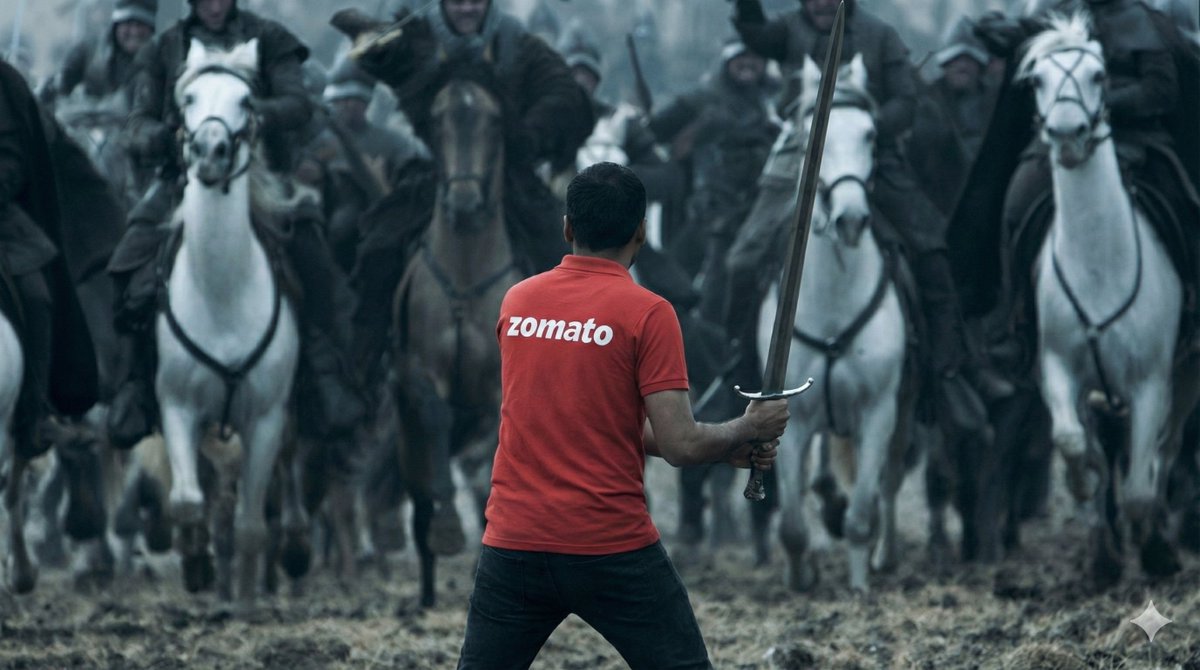
In FY2026, 31 lakh Indians chose to earn through Zomato and Blinkit as delivery partners. That’s 57% more than the previous year.
Behind every one of these numbers is a person with interests and ambitions. A student balancing classes, an entrepreneur building something of their own, a dancer pursuing their passion, and a parent juggling work and family.
We co-created this song with @ItsAmitTrivedi to celebrate our delivery partners, their many pursuits, and the journeys they’re on.
We’re proud to be a part of each and every one of them.
One delivery guy is waiting outside Haldiram in this cold, for you to make the order so that he earns in that hour, while you are “helping” the delivery worker by not ordering anything.
Activism is great. But choose better ways.
We may troll Zomato, Zepto, Lenskart, Urban Co., Swiggy etc for their high valuations and less profits but in reality, they are offering unskilled job for many poor youngsters who are ignored by government. They are also organising the industry and helping Govt. garnering more GST.
I fully support Startup culture and their CEOs for amazing out of box thinking and hard work.
Incredible India🇮🇳
Solid pattern in India - before markets get organized by online companies, nobody cares about worker incomes or regulations. After markets get organized, old economy players with regulatory capture or other interests at stake hold the organizing entity to an entirely different standard. Examples in food delivery, quick commerce, medicine delivery, taxis, guesthouses, astrologers, home services etc.
Very well written @deepigoyal Every word is true. It beggars belief that a Champagne Socialist who married a film star and had a designer wedding in Udaipur and a first wedding anniversary in Maldives has the audacity to then shed crocodile tears around alleged exploitation of gig workers. Aam Aadmi my foot
Last one on this topic, and I have been holding this in myself for a while.
For centuries, class divides kept the labor of the poor invisible to the rich. Factory workers toiled behind walls, farmers in distant fields, domestic help in backrooms. The wealthy consumed the fruits of that labor without ever seeing the faces or the fatigue behind it. No direct encounter, no personal guilt.
The gig economy shattered that invisibility, at unprecedented scale.
Suddenly, the poor aren't hidden away. They're at your doorstep: the delivery partner handing over your ₹1000+ biryani, late-night groceries, or quick-commerce essentials. You see them in the rain, heat, traffic, often on borrowed bikes, working 8–10 hours for earnings that give them sustenance. You see their exhaustion, their polite smile masking frustration with life in general.
This is the first time in history at this scale that the working class and consuming class interact face-to-face, transaction after transaction. And that discomfort with our own selves is why we are uncomfortable about the gig economy. We want these people to look our part, so that the guilt we feel while taking orders from them feels less.
We aren't just debating economics. We are confronting guilt. That ₹800 order might equal their entire day's earnings after fuel, bike rent, and app cuts. We tip awkwardly, or avoid eye contact, because the inequality is no longer abstract. It's personal.
Pre-gig era, the rich could enjoy luxury without moral discomfort. Labor was out of sight. Now, every doorbell ring is a reminder of systemic inequality. That's why debates explode. It's not just policy. It's emotional reckoning. Some defend the system (“they choose it”), others demand change (“this isn't progress, its exploitation”).
And here’s the uncomfortable twist: the unsaid ask of clumsy ‘solutions’ isn’t dignity. It is about returning to invisibility.
Ban gig work and you don’t solve inequality. You remove livelihoods. These jobs don’t magically reappear as formal, protected employment the next day. They disappear, or they get pushed back into the informal economy where there are even fewer protections and even less accountability. Over-regulate it until the model breaks, and you achieve the same outcome through paperwork instead of slogans: the work evaporates, prices rise, demand collapses, and the people we claim to protect are the first to lose income.
And then what happens?
The rich get their old comfort back. Convenience returns without faces. Guilt dissolves. We go back to clean abstractions and moral posturing from a distance. The poor don’t become safer, they become invisible again: back in cash economies, back in backrooms, back in shadows where regulation rarely reaches and dignity isn’t even debated.
The gig economy just exposed the reality of inequality to the people who previously had the luxury of not seeing it. The doorbell is not the problem. The question is what we do after opening the door.
Visibility is the price of progress. We can either use this discomfort to build something better (which we keep doing continuously as delivery partners are our backbone), or we can ban and over-regulate our way back into ignorance. One of those choices improves lives. The other simply helps the consuming class feel virtuous in the dark.
One more thing. Our 10 minute delivery promise is enabled by the density of stores around your homes. It’s not enabled by asking delivery partners to drive fast. Delivery partners don’t even have a timer on their app to indicate what was the original time promised to the customer.
After you place your order on Blinkit, it is picked and packed within 2.5 minutes. And then the rider drives an average of under 2kms in about 8 minutes. That's an average of 15kmph.
I understand why everybody thinks why 10 minutes must be risking lives, because it is indeed hard to imagine the sheer complexity of the system design which enables quick deliveries.
Also, if you've ever wanted to know why millions of Indians voluntarily take up platform work and sometimes even prefer it to regular jobs, JUST ASK any rider partner when you get your next food or grocery order.
You will be humbled by how rational and honest they will be with you.
Having said that, no system is perfect, and we are all for making it better than today. However, it is far from what it is being portrayed on social media by people who don't understand how our system works and why.
If I were outside the system, I would also believe that gig workers are being exploited, but that's not true.
Agree.
I repeat – gig workers is one of the largest organised job creation engines in India. And we provide insurance, fair, timely and predictable wages.
Gig doesn’t need more regulation, it needs less regulation. It will bring more people into the fold, who will be able to earn some money, upskill themselves and later join India’s organised workforce. Not to mention, consistently send their kids to school - which will fundamentally change the fabric of our nation one generation later.
I am all for peaceful protests against anything and everything. But violent protests and stopping others who want to work from working is not okay (proof attached).
Here’s what we know – a number of these protestors were not even our delivery partners. They were agents of political interests, piggybacking on the narrative to gain political mileage.
@makemytripcare Yeah you just reiterated what you said earlier. Very unfair.When your refund actions are determined by airline why make such a fraudulent claim of " No Question asked refund" for Covid patients. Like I said earlier you lost a loyal customer, your loss.
@Rajesh_Magow
@makemytripcare@Rajesh_Magow So much for a no question asked refund for Covid + patients! Very poor treatment by MMT for a loyal MMT black user. @Rajesh_Magow you have lost one loyal user to https://t.co/ISiUb8zTF6 today.
@makemytripcare The reply I got is that I should contact the airline for my refund, why ?? I did my booking via your website and not the airline. Why does MMT claim they do refunds for Covid patients ? Not fair !
Cc @Rajesh_Magow
@airtelindia@Airtel_Presence incorrect bill plan activated when I recently moved back to airtel. Your app doesn't work for plan change, nor does your call center. Need help.
@Airtel_Presence No reply ! And here I am trying to come back to airtel from Jio. Anyone cares or should I just continue with Jio broadband? @VittalGopal