I’m building pialgorithms to solve document work and help organizations adopt AI.
The AI-native document management software is one part of that. Here are the products behind it ⬇️
pialgorithms builds AI-native document management software and provides AI engineering services.
Our document management software is built around the following products: athenaeum, lexicon, hermes, and panorama.
Product demos below⬇️
https://t.co/QlXR6w1MPp
When users ask an AI assistant about a document, they want to open the cited source and check the answer against the page they're looking at.
In a document management application, you can do things like read files on screen, search for information inside your documents, or ask an AI assistant questions about them. Behind those features, the document viewer displays the file, while another component reads its text and tables for search and AI. If each opens a Word or Excel file independently, an answer can cite a page or quote a price that differs from what the user sees on screen.
The approach I’ve taken to resolve this inconsistency is to convert the file once to a shared PDF, giving the application a fixed set of pages to display and use as the reference for search and AI answers. The original stays available to download, edit, and send, preserving formulas, charts, and other details people may still need to work with.
That way, what users read on screen, what they find through search, and the information the AI uses to answer their questions all come from the same prepared version of the document.
In this week’s article, I explain how this works and why the shared reading copy and the original file each have a role.
https://t.co/EN9RauAF2Z
Yet another article about document security, but as boring as this subject might seem to a lot I think we can all agree it's paramount.
In a document management system each person’s permissions should apply throughout their work, whether they’re opening a file, searching, or asking the AI assistant a question. For example, someone on the finance team can work with finance documents, while confidential legal files stay available to the people authorised to use them.
In this week’s technical follow-up I explain how I’ve built this. At sign-in, the system identifies the person and reads their company group memberships, which determine their access to shared document libraries. Each person also has a personal library tied to their own identity. The server then checks each request against the libraries that person can access before retrieving a file, and the same boundaries apply when searching or finding information for an AI answer.
Security checks that control who can access each document and the information inside it. Simple, makes sense.
https://t.co/UO8uEHpUse
In a document management system each person’s document permissions should follow them through everything they do, whether they’re opening a file, searching, or asking the AI assistant a question.
For example, someone with access to the finance library can search and ask questions about those documents, while confidential files in other libraries stay available to the people authorized to use them.
In this week’s article, I explain how I’ve built this around each person’s identity and team memberships, covering both shared team documents and their own files.
https://t.co/ZyOZivZhEC
Rather interesting move. Looks like Elon is all in in autonomous agents, and makes sense given his well placed exposure on the whole Ai / agentic space, rather than bring dependent on just the model or application layer. Curious to see if it backfires in the future, but I think it's smart.
Important note regarding Grok @Bot:
Going forward, @SpaceX will use the best back end model for any given task, including Claude Opus 5.5, MidJourney, Suno and other leading APIs.
Whatever is most likely to give you the best outcome.
Rather interesting move. Looks like Elon is all in in autonomous agents, and makes sense given his well placed exposure on the whole Ai / agentic space, rather than bring dependent on just the model or application layer. Curious to see if it backfires in the future, but I think it's smart.
Turn handwritten documents into structured data ready for delivery to your systems.
With hermes service, @pialgorithms extracts handwritten information from any kind of document, including invoices, delivery notes, customer orders, and any document specific to your industry, whether supplied as an image, a scanned PDF, or another supported format.
hermes supports handwritten documents in English, French, German, Italian, Spanish, Portuguese, Simplified Chinese, Japanese, and Korean, and can be configured to support many other languages depending on each client’s needs.
The example below shows a handwritten wholesale customer order in Greek for supermarket products, using fictional data, with customer details, delivery requirements, payment terms, product descriptions, quantities, and notes extracted into editable fields.
Hovering over an extracted field highlights its source in orange in the original document for quick user validation. Data can be sent to your systems automatically or after user approval.
While user sign-in and permissions that control which documents each person can access are essential to securing an app, security in an AI-native document management system also depends on how the software itself accesses your documents and data, as well as how it connects to the services it uses.
Even after a user is allowed to open a document, the application still needs to connect to storage, search, and AI services to retrieve and process it. If those connections rely on stored API keys, anyone who gets a copy may be able to access those services using the application's credentials.
With @Azure Managed Identity, the application signs in using its own identity, and each service checks the permissions assigned to that identity. Hardcoding reusable access keys is a fundamental security mistake as a single leaked key can give an attacker direct access to sensitive documents and data. For connections that support identity-based authentication, those keys shouldn't be sitting in code or application settings in the first place.
In this week's article I explain how I've implemented this for the services behind document storage, search, AI processing, and live status updates. The aim is to reduce the risk of leaked credentials exposing an organization's documents and data, while keeping the application's access limited to the operations it needs.
https://t.co/LAiexYSwHR
I'm proud to share that @pialgorithms has been named an @OpenAI Select Partner.
I founded pialgorithms to solve enterprise document work with AI. We build AI-native document management software and provide AI engineering services to put that mission into practice.
As part of the OpenAI Partner Network, we look forward to continuing our work with OpenAI to help organizations build, deploy, and scale AI solutions responsibly and effectively.
Learn more: https://t.co/Fpl7EK5vKI
The security of a document management platform depends on two separate sign-ins: the person opening a document and the app accessing the services behind it.
A company can carefully control which document libraries each employee may open, while the app still uses a storage key copied into its settings. If that key ends up in a build log, an old ticket, or someone’s laptop, whoever has it can reach the storage account without going through the employee’s library permissions.
Securing the employee’s login doesn’t make a copied storage key safe, especially when rotating it later means tracking down every copy. In this week’s article, I explain how I use the app’s own identity and limited permissions for storage, search, and the services behind AI answers and extraction. I also cover the credentials that still have a specific job, because some services still require them.
Together those checks reduce the risk of confidential documents and data being exposed to someone who shouldn’t have access to them.
https://t.co/lkNanmeYCV
Excellent read that captures the state of modern/ next gen software companies/ agencies, and it resonated with me as I started @pialgorithms approx two years ago under that exact premise with the mission to solve enterprise document work with AI.
I remember thinking at the time “today’s models are the worst they will ever be” (and they honestly seemed terrific at the time, yes, even tab completion) and today we have reached a state where one could argue that professional coding ability has already been achieved, and having coded for more than 10 years and worked with many other prof coders (much better than myself), today’s models are already somewhere in the far-right tail of the bell curve (is there anyone still doubting that?) .
Imo being AI-native extends also from the product to having AI embedded in how the organization itself operates from the ground up, rather than simply adding AI capabilities to an otherwise traditional product or company and calling it “AI-powered” (honestly, pretty much everyone is AI-powered today, or at least claims to be). One human - many agents companies are already a thing of today.
And the best part is that compared to when I started, today it WORKS! and as the models get better, the product and the organization get better with them under a state of compounding intelligence.
I'm so excited to see how modern entrepreneurship will be shaped from all this.
Grok Bot just released for Tesla and I'm blown away
I was lucky enough to have early access. Having your car drive you around while you talk to an army of agents is incredible
In this video I take you for a ride in my Cybertruck and show you just how awesome this new release is
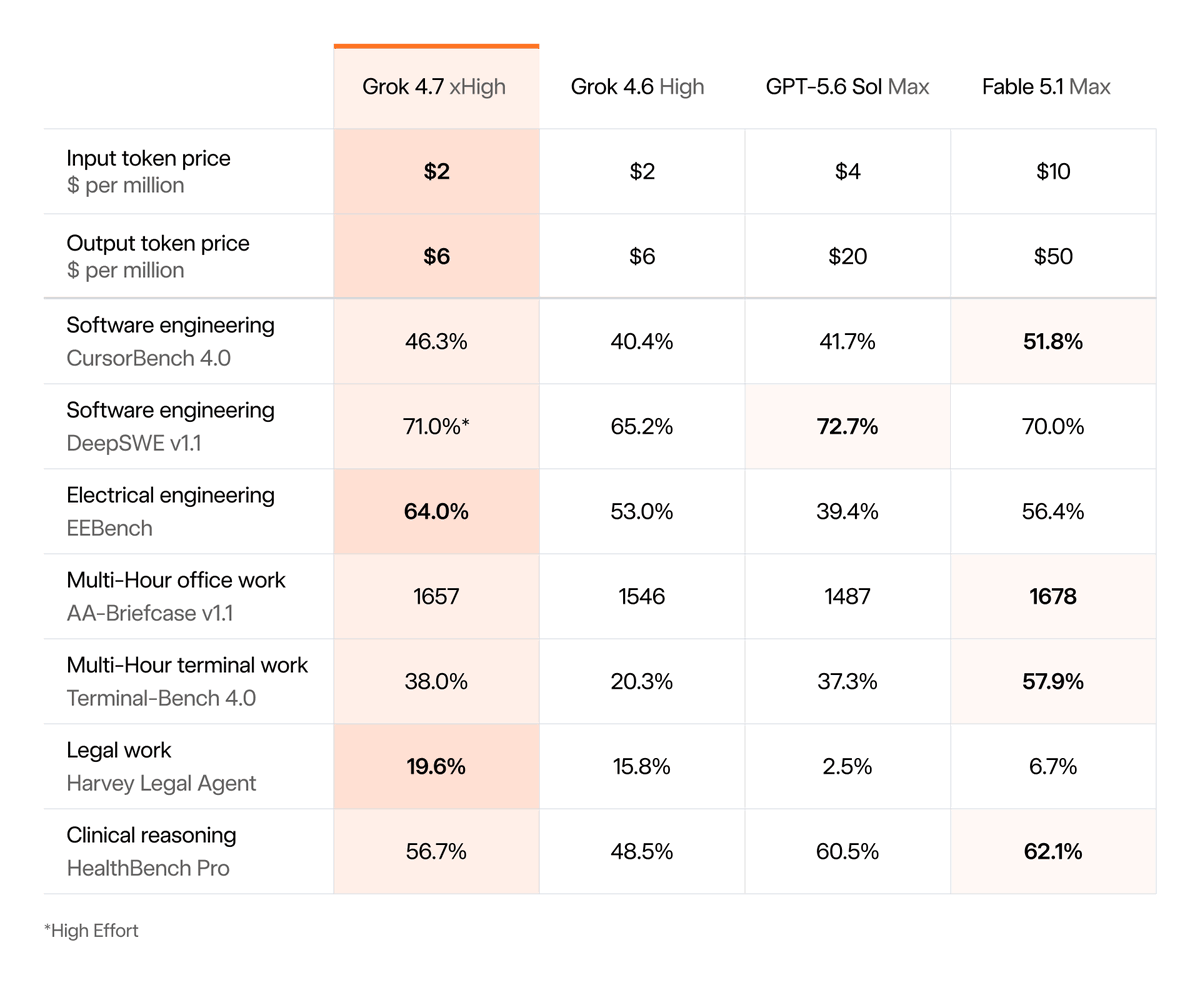
4.6 for me was by far the most cost-effective model for professional coding. Before that, I was mainly using Opus, which was great, but is overkill given its cost and the level pretty much all models have reached now. On the open source point, you might be right, I haven't tried any but heard very good feedback.
Having said that, I'm quite confident that for heavy technical research, Anthropic and OpenAI are better than Grok. So I think I've concluded that each model has its place in the space.
Also, I haven't tried 4.7 yet, but I'm looking forward to it. And I think I agree with you that Grok 5 will struggle to reach the frontier. What do you mean by wow factor? Got any specific personal benchmark you run them on?
Pls double down on stability and robustness. Frontier models deliver at the beginning, but after a few days, it often seems like their performance sharply deteriorates. I don't know if it's intentional or what the reasons are, but whatever it is, please don't fall into this trap. At least for me (heavily coding tasks + building my business with the help of agents), I appreciate stability even at the cost of slightly lower performance, since I'm using these agents in my operations and therefore expect consistent outputs (considering, of course, the stochastic nature of LLMs).
I think there are many of us who feel this way, and it's not just me. Thanks for delivering.
My first thought is that the reason is there isn't as much publicly available low-level code, in contrast to high-level code, which the internet is flooded with. So you're right, it's better in high level. Hence let me rephrase it: would it still struggle if it were trained on larger volumes of low-level code (lets assume same volumes as high level)? I think not. unless you see another reason.