That’s the opening of “History Ends Before the Singularity” by @kowei1995, the third essay in Parity’s Telescope Editions.
His argument: the singularity is not a date to wait for but a horizon, and we may already be inside it.
https://t.co/QD3K4TZlUP
Breaking codes is the big one. Apart from the one-time pad, nearly all cryptography assumes one-way functions exist, and nobody has proven it.
ETH’s fall doesn’t touch them. But as @kowei1995 writes, “no one has thought of a way” should no longer count as a security assumption.
We knew we could use an efficient algorithm for NP problems to find proofs of mathematical theorems. Now that AI is doing that, is there anything remaining, outside of breaking codes, where P = NP solves practical problems that AI and optimization can't?
https://t.co/q34GzvuTJ3
The essay ends with a bet instead of an omen: humanity reaches 10¹⁶ watts, a Type I civilization, by the end of 2050, and 10²⁶ watts, Type II, by 2100.
“Trust no omens. Trust the curve.”
https://t.co/QD3K4TYO5h
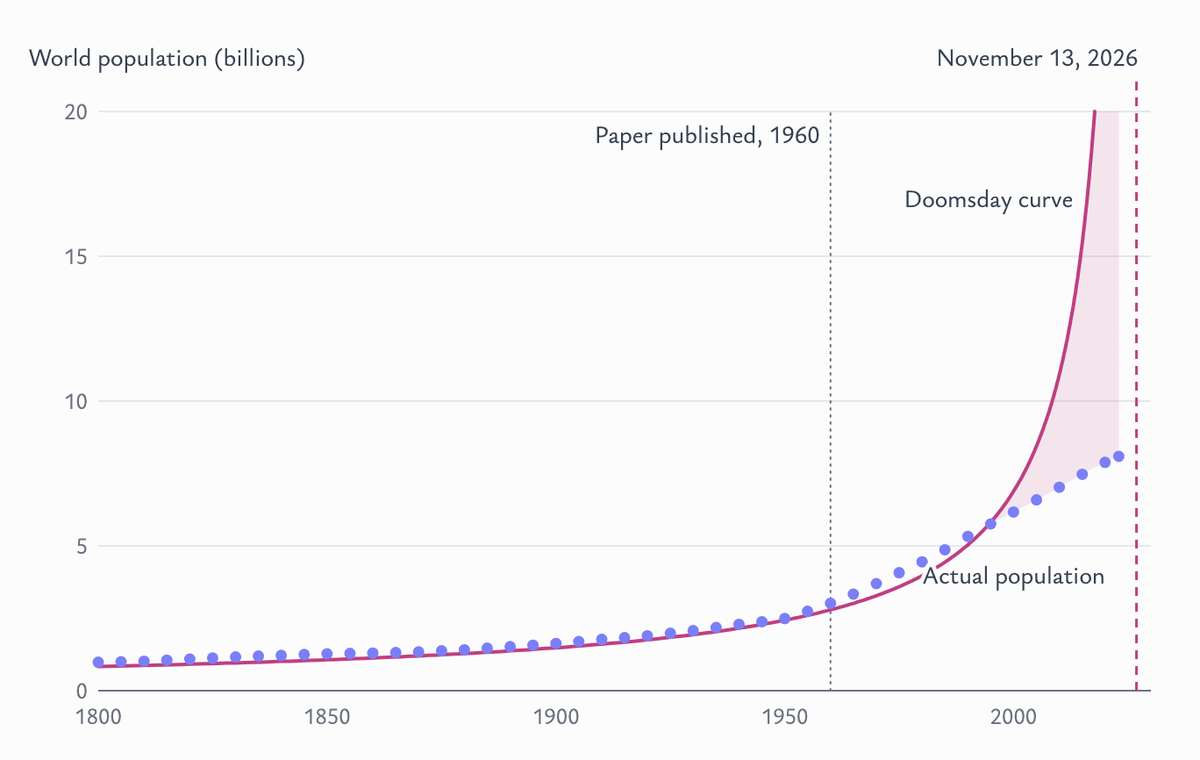
In 1960, Science published a paper titled “Doomsday: Friday, 13 November, A.D. 2026.”
Heinz von Foerster and two colleagues fit two thousand years of world population to a curve that reaches infinity in 2026.87.
That Friday is seven days from now. 🧵
A pause stores momentum and hands the frontier to whoever is least willing to stop. The way out is to change the game itself.
It has been done: nuclear warheads peaked near 70,000 in 1986 and number about 12,000 today. For AI, the thing a treaty can count is chips.
Entanglement used to be a paradox. Now it's a resource.
How quantum teleportation could let separate quantum computers act as one.
A short film based on the essay by @guiltygyoza.
https://t.co/6NioQgaifk
Privacy shouldn't require a second job.
GrayPunk explores how ordinary people can stay safer together, without becoming security experts.
A short film based on the essay by @mashbean .
Japanese narration · English audio available.
https://t.co/1PT1UzWTFs via @YouTube
It was a ton of fun tracing EPR paradox to quantum teleportation, nonlocal gates, scaling quantum computing platforms, and nonlocal interference for optical astronomy potentially exceeding the angular resolution of VLBI
thank you @parityfund for the publication and @0xGimmy for the unwavering encouragement. essay also published on my blog https://t.co/rXanbfddZu
image from Stas et al. 2025
Two cells flicker red and blue. Measure one and it freezes, sending its color to the other at one cell per step, this tiny universe’s speed of light.
Now make it infinitely fast.
You’ve just modeled entanglement, Einstein’s “spooky action at a distance.” 🧵
The same links do more. Blind quantum computing lets you rent a quantum server that learns nothing about your algorithm or data.
Telescopes could be joined by entanglement instead of vacuum pipes: a 2025 experiment ran nonlocal interferometry over an effective 1.55 km baseline.