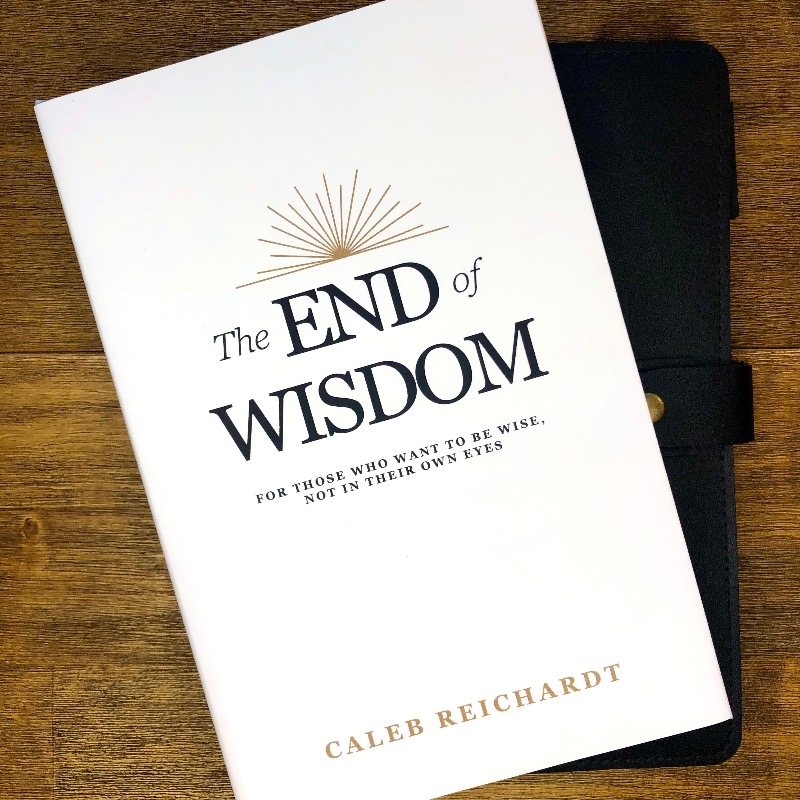
If the fear of Yahweh is the beginning of wisdom, then what is its end?
Cut through the abundant nonsense, empty platitudes, and conventional musings of the world and get straight to the heart of what it means to be wiseIf the fear of Yahweh is the beginning of wisdom, then what is its end?
Cut through the abundant nonsense, empty platitudes, and conventional musings of the world and get straight to the heart of what it means to be wiseIf the fear of Yahweh is the beginning of wisdom, then what is its end?
Cut through the abundant nonsense, empty platitudes, and conventional musings of the world and get straight to the heart of what it means to be wise.
From @MattWalshBlog:
In our society we don’t talk about sin, evil, vice, or bad choices anymore. It has all been subsumed under the banner of “mental health.” Every evil action is a symptom of a disease. A guy randomly murdering an innocent woman on the train is merely showing signs of a medical illness. Savage killers are morally indistinguishable from cancer patients. This is the root of many of our problems.
The people who created the Tower of Babel showed tremendous unity, but they were united against the will of God. It is better to be divided by truth than united in error.
— @ekkiet
It is plain that complete havoc must be made of the whole system of revealed truth, unless we consent to derive our philosophy from the Bible, instead of explaining the Bible by our philosophy.
— Charles Hodge
Philosophy is merely thought that has been thought out. It is often a great bore. But man has no alternative, except between being influenced by thought that has been thought out and being influenced by thought that has not been thought out.
— G. K. Chesterton
It is plain that complete havoc must be made of the whole system of revealed truth, unless we consent to derive our philosophy from the Bible, instead of explaining the Bible by our philosophy.
— Charles Hodge
While it is true that limits can be annoying and even stupid, the libertarian fantasy of a world without limits would inevitably produce something far worse than unnecessary laws—it would lead to chaos and, ironically, slavery.
— @crwiley1962
Secular humanists didn't really believe in humanity; they just disbelieved revealed religion, especially Christianity. They were more against that than they were for humanity.
— @crwiley1962
If you believe an exception invalidates something that is generally true, then generally speaking, you’ve set yourself up to be mugged by reality.
— @crwiley1962
Some evangelists for artificial intelligence don’t like the term because it implies that artificial intelligence is not real intelligence. They want to conflate what humans do when we think and what machines do when they think. For the evangelists there's no real difference—intelligence is intelligence, like "love is love."
— @crwiley1962
“The new skeptic is so humble that he doubts if he can even learn . . . The old humility was a spur that prevented a man from stopping, not a nail in his boot that prevented him from going on. For the old humility made a man doubtful about his efforts, which might make him work harder. But the new humility makes a man doubtful about his aims, which will make him stop working altogether . . . We are on the road to producing a race of men too mentally modest to believe in the multiplication table . . . The meek do inherit the earth, but the modern skeptics are too meek even to claim their inheritance.”
Written by G. K. Chesterton in 1908. Truer today.
This sort of “humility” has, in part, produced the current cultural madness that we find ourselves in, with a populace, for instance, that is afraid to say that men are men and women are women and that the former cannot be or become the latter and vice versa—you know, the kind of thing that would have a child of a past age laughing at the intelligentsia of today.
This sort of humility produces a society bereft of truth. And when truth is lost, “my truth” becomes paramount. Subjectivity becomes the new objectivity, and the religion of relativism reigns supreme.
This faux humility, in practice, goes by many names: “tolerance”, “inclusion”, “sensitivity”, “acceptance”, etc.—squishy words for squishy people stripped of all meaning—but let us focus on the first, tolerance, for a moment. Fulton Sheen once remarked: “America, it is said, is suffering from intolerance. It is not. It is suffering from tolerance: tolerance of right and wrong, truth and error, virtue and evil, Christ and chaos. Our country is not nearly so overrun with the bigoted as it is overrun with the broad-minded.”
So before you say you’re just being “open-minded,” I would say that it is quite possible to be so open-minded that your brain falls out. Chesterton wrote elsewhere: “An open mind is really a mark of foolishness, like an open mouth. Mouths and minds were made to shut; they were made to open only in order to shut on something solid.” The open-minded can actually be the most close-minded, for they have closed their minds to the possibility that truth can be known.
“When the ordinary man calls himself a skeptic or an unbeliever,” said T. S. Eliot, “that is ordinarily a simple pose, cloaking a disinclination to think anything out to a conclusion.”
This skepticism is not a bad thing on its own; it’s only bad when that’s all there is and, after having its fun, all that remains; in other words, when you ultimately know nothing and believe nothing. When there’s not an ounce of conviction in your bones and only confusion and cowardice without a trace of truth.
Truth, by definition, has an exclusivity to it. Meaning, a conclusion results in exclusion. Meaning, one thing being true runs the risk of another thing being false. Little Scotty being born a boy runs the risk of offending Little Scotty when he decides to be a girl. Abortion being murder runs the risk of insulting an abortionist when you call him a “murderer” rather than a “champion of women’s rights.” Christianity being true, good, and beautiful runs the risk of Islam, to take one, being false, evil, and ugly.
Because of these risks, it can, and often does in today’s day and age, take some measure of courage to step up to the microphone, if you will, and speak the truth. But what else can we do but to speak it in love?
My 14-year-old is far more developed than my 2-year-old—physically, mentally, and emotionally. But she is not more my child. Beware of justification by sanctification.
— @MattSmethurst
If one only wished to be happy, this could be easily accomplished; but we wish to be happier than other people, and this is always difficult, for we believe others to be happier than they are.
— Montesquieu
The “left” is religiously redefining words at an alarming rate. Redefining marriage, gender, hate, tolerance, woman, man, etc. They don’t prove their ideology true. They just redefine words so they can merely assert it is true.
— @MikeWingerii