Grace Hopper suggested teaching computers English, critics scoffed, insisting that machines "only do arithmetic."
She built the world's first compiler in her spare time.
She was right and the experts were wrong..
In the early 1950s, processing time on million-dollar machines like the UNIVAC I was treated as infinitely more valuable than the labor of the human programmers who operated them.
At the time, programming was a brutal exercise in hardware manipulation. Programmers had to write instructions in pure machine code or octal notation, manually keeping track of where every variable was stored in the machine's memory. The job required a deep understanding of the computer's internal architecture and an immense tolerance for tedious, error-prone translation.
Grace Hopper, a mathematician working on the UNIVAC, believed this manual translation was backwards. If computers were so good at repetitive tasks, she reasoned, they should be the ones translating human-readable instructions into machine code. In 1951, she proposed a "compiler"—a program that would take high-level mathematical symbols and automatically convert them into executable binary code.
The computing establishment rejected the idea outright. Critics argued that computers were not built for symbolic manipulation, and even if they were, using precious machine cycles to compile code was a foolish waste of resources.
After proving her compiler concept worked with the A-0 system, she didn't stop at mathematical symbols. She recognized that for computers to be truly useful in business and industry, non-mathematicians needed a way to program them. Her team developed FLOW-MATIC, the first programming language to use English keywords like "COMPARE," "ADD," and "TRANSFER."
By demonstrating that software could be written in a language close to plain English, Hopper fundamentally changed the trajectory of computer science. Her work proved that writing software could be abstracted away from the physical hardware, shifting programming from an exercise in binary translation into a tool for broad logical problem-solving.
This conceptual leap laid the direct foundation for COBOL, democratizing software development and setting the standard for almost every high-level programming language that followed.
It's estimated that about 27 million trees sprout and start growing every single day, so statistically, you probably share a birthday with a few million trees.
Let me get this right: Anthropic are asking the Australian gvt for full immunity from IP theft - the right to train their model on everyone's copyrighted work without their consent - while simultaneously saying it's beyond the pale to do "distillation" on their models?
I've seen corporate hypocrisy in my life but this is a whole new level.
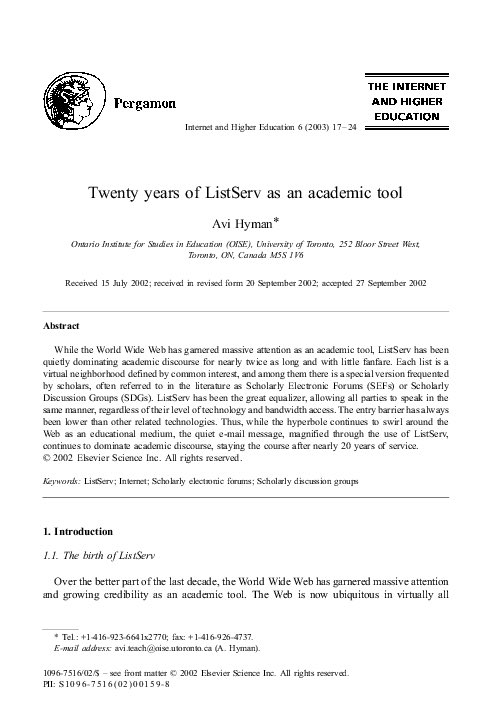
Paper: Twenty Years of ListServ as an Academic Tool — and the Rediscovery of Its Living Archives
In 2003, Avi Hyman, then at the Ontario Institute for Studies in Education (University of Toronto), published a quietly powerful reflection in Internet and Higher Education: “Twenty years of ListServ as an academic tool.”
This paper arrived at a moment when the World Wide Web was still the loud, hyped newcomer in education and scholarship.
Hyman’s central observation was simple yet profound: while the Web grabbed headlines and funding as the transformative academic technology, ListServ had already been the real workhorse of scholarly discourse for nearly twice as long and it had done so with almost no fanfare.
The provided first page (abstract and opening) captures the thesis perfectly. ListServ, Hyman argued, was “the great equalizer.” It let scholars, students, and interested outsiders speak in the same register regardless of their bandwidth, hardware, or technical sophistication.
All you needed was email still the most ubiquitous and lowest-friction digital tool even in the early 2000s.
Each list functioned as a “virtual neighborhood defined by common interest.” Among them, Scholarly Electronic Forums (SEFs) and Scholarly Discussion Groups (SDGs) became the serious, sustained heart of academic exchange.
Here are the most enduring insights from the 2003 analysis:
ListServ was the unsung dominant force in academic discourse. By 2003 it had already outlasted the early Web hype cycle in actual day-to-day scholarly use. Email lists simply worked; reliably, asynchronously, and across every level of institutional and personal infrastructure. It was push messages in what was becoming more a pull world.
It was the great equalizer. Low barriers to entry meant a graduate student in a low-bandwidth setting could participate as fully as a well-funded researcher at a major university.
The technology did not amplify existing privilege the way early graphical Web tools often did.
Scholarly lists created genuine “virtual neighborhoods.” Focused, interest-driven communities (HUMANIST from 1987 onward, H-Net networks, discipline-specific lists) fostered the kind of ongoing, substantive conversation that formal journals and conferences could not match in speed or intimacy.
Active moderation was the secret sauce. Hyman and the studies he cites show that well-moderated lists produced markedly higher participation, satisfaction, and intellectual quality. Moderation turned raw email into something closer to a managed seminar.
Endurance came from simplicity, not spectacle. Even as the Web exploded, ListServ stayed the course because it asked almost nothing extra from users. The quiet, push-based email message, magnified across thousands of subscribers, proved more durable for real scholarly work than pull-based websites and early forums.
Hyman was clear-eyed about limitations too: participation often followed power-law distributions (a small number of heavy posters, many lurkers or one-time contributors), follow-up threads could be thin, and there were ongoing questions around copyright, credit, and whether list contributions “counted” in academic evaluation.
Still, the overall verdict was that ListServ had delivered on the promise of networked scholarship more consistently than its flashier rivals.
A Personal Bridge to the Present: My Recent LISTSERV Tape Backup Discovery
Reading Hyman’s paper now is interesting. Just yesterday (July 5, 2026) I shared the breakthrough discovery of what appears to be one of the largest surviving collections of raw LISTSERV archives decades of data across thousands of lists, pulled from old university cartridge tape backups I acquired years ago as surplus.
1 of 2
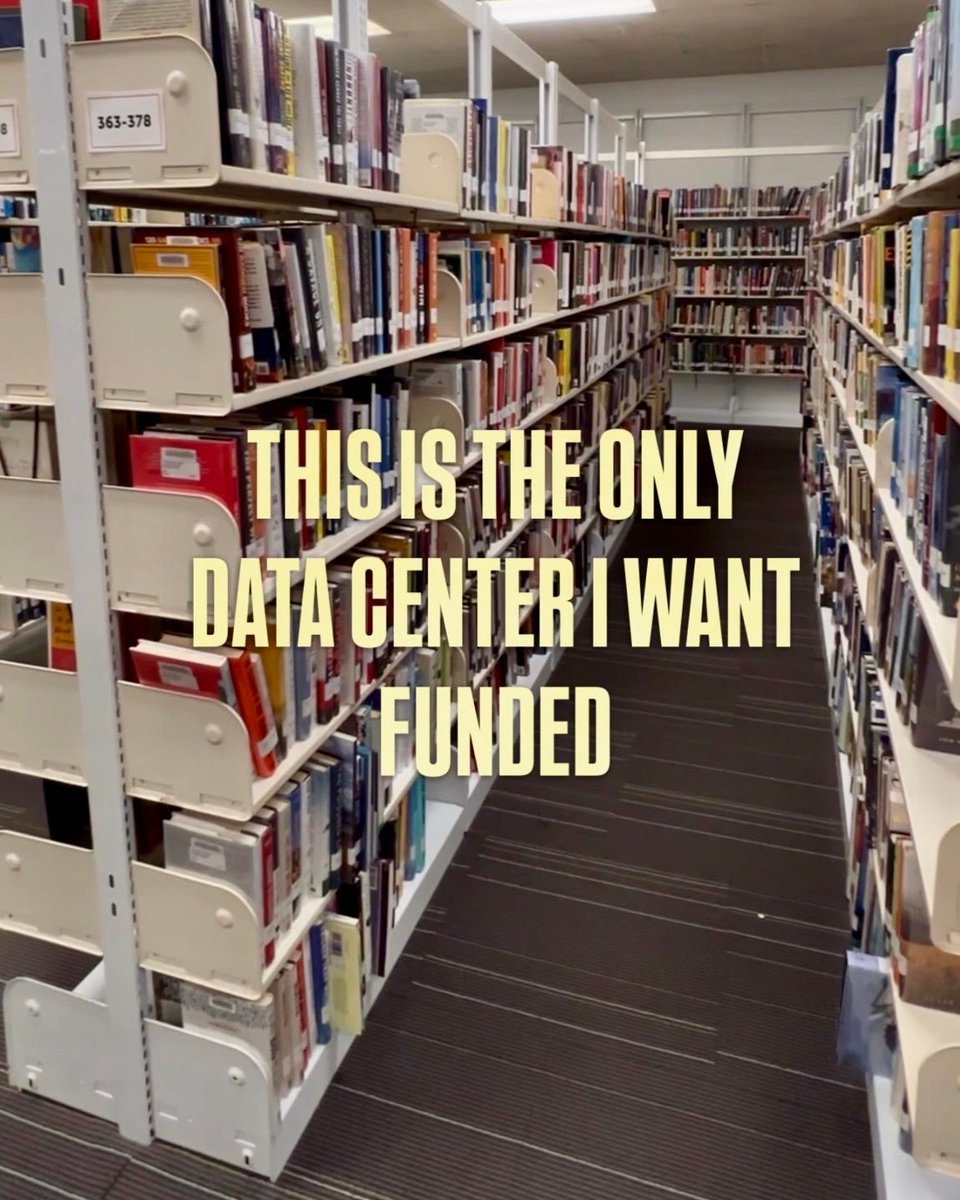
I find it deeply depressing how schools are gutting their humanities programs to become glorified tech labs. In Fahrenheit 451, the abolition of reading began when colleges stopped teaching the liberal arts. Without history, literature, music, we have no culture and no future.
🚨 BREAKING: Norway BANS the use of AI in primary school, with its Prime Minister adding that children should focus on learning to write, read, and do math.
They have my full support.
This is not 2004 anymore. We are past the social media hype and seem to have learned the lesson.
Technology should not interfere with the learning process or with children's intellectual and emotional development.
Some steps should not be skipped, regardless of the shiny new tech available. AI can wait until they are older.
Kudos to Norway! Which country do you think will be next?
I'll keep you posted!
-
👉 To stay up to date on AI policy, ethics, and regulation, join my newsletter's 97,200+ subscribers below.
Scientifically it shows that babies/children learn emotions like fear by watching how adults react in these situations. So message can be on these same lines.
The so-called “calculator riots” of 1986 serve as a powerful reminder that today’s anxieties about artificial intelligence replacing human thinking are far from new.
In April 1986, a determined group of math educators staged a vocal protest outside the National Council of Teachers of Mathematics (NCTM) annual convention in Washington, D.C. Led by influential textbook author John Saxon, demonstrators carried signs declaring, “The Button’s Nothin’ ’Til the Brain’s Trained.”
They were opposing the NCTM’s new recommendation to incorporate electronic calculators into mathematics education at every grade level, including homework and exams.
The protesters worried that reliance on calculators would erode students’ mental arithmetic skills, numerical intuition, and deep conceptual understanding, potentially creating a generation of “calcuholics” overly dependent on machines.
The NCTM countered that calculators would free students from repetitive, low-level calculations, enabling them to tackle more complex problem-solving and higher-order thinking. Ultimately, the debate led to a pragmatic compromise: students would first master core mathematical concepts and mental strategies before using calculators as tools for more advanced work.
This balanced approach allowed technology to enhance, rather than replace, mathematical reasoning.
Today, as schools navigate the rapid rise of generative AI, the 1986 calculator compromise offers a valuable blueprint: prioritize genuine understanding first, then thoughtfully integrate powerful new tools.
Can AI really detect AI?
Currently, universities, journals, and various educational institutions are using AI detectors to identify AI-generated writing.
However, a recently published study has challenged this widely held assumption.
In a study titled "AI Detecting AI in Academic Writing: Why Most AI Detector Findings Are False," published in Elsevier's Elsevier journal Next Research, researchers argue that most results produced by current AI detectors are not reliable and can often lead to incorrect conclusions.
The reason is that modern Large Language Models (LLMs), such as ChatGPT, have become so advanced that even experts often find it difficult to accurately distinguish between human-written and AI-generated text.
Nevertheless, many institutions are treating AI detector reports as if they were definitive evidence.
The study also shows that AI detectors frequently misclassify human-written content as AI-generated.
One of the study's most important findings is that when the actual prevalence of AI-generated writing is low, the false-positive rate of AI detectors increases dramatically.
In other words, if AI use is relatively limited in practice, an innocent author may face a much higher risk of being wrongly accused of using AI.
The researchers further note that authors who do use AI can often evade detection simply by modifying, editing, or rewriting portions of the generated text.
This means that a writer who never used AI may still be accused of doing so, while someone who did use AI may not be detected at all.
According to the researchers, AI detector results should not be used as the sole or definitive evidence of AI usage.
🚨 THIS IS THE ENTIRE AI INDUSTRY'S NIGHTMARE IN ONE QUOTE.
An author suing OpenAI says AI companies didn't just buy books.
They allegedly downloaded them from pirate sites.
Then, according to his claim, stripped away copyright pages and ISBN information before feeding the material into AI models.
La primera ministra de Dinamarca, Mette Frederiksen:
"Existe un vínculo totalmente establecido entre el poder político, el capital, los gigantes tecnológicos y la IA. Y el propósito de todo esto es socavar la democracia. Ese es el objetivo".
Let me trace the timeline here because nobody's connecting it.
Step 1: Scrape the entire internet. Every book, every article, every conversation, every piece of art, every forum post. Do it without asking. Do it without paying.
Step 2: Train a model on all of it. Call it "artificial intelligence."
Step 3: Go to BlackRock's Infrastructure Summit and announce: "We see a future where intelligence is a utility, like electricity or water, and people buy it from us on a meter."
Step 3 is where you sell people's own knowledge back to them. On a meter.
They took the collective output of human thought, compressed it into a model, and now they want to charge you by the token to access a version of what you and everyone you know already created.
One Reddit user put it perfectly: "They stole all this data from us, the people, our life's work, creativity, art, by devouring the internet and blowing through all copyright laws. Now they want to sell it back to us in the form of a utility."
Imagine if someone photocopied every book in the public library, burned the library down, and then opened a subscription service for the copies.
That's the metered intelligence business model.
And they're pitching it to infrastructure investors as though they invented water.
🚨 Today is #WorldFishMigrationDay, but wild fish aren’t celebrating.
Data collected by @wildfishcons shows that over 70,000 barriers, from weirs to dams, are slicing our UK rivers into fragments.
One man in San Francisco has personally returned the California pipevine swallowtail to the city.
Tim Wong is an aquarium biologist who noticed the butterfly had pretty much completely vanished from the area. The caterpillars can only eat one plant: the California pipevine, which was also disappearing.
So he got cuttings from the botanical garden, propagated his own pipevine plants, built a backyard butterfly enclosure, and started with 20 caterpillars in 2012.
He's now raised thousands. Every year since, more California pipevine swallowtails have been seen flying free in San Francisco. The population is recovering because of one guy and his back yard.
Conservation at this scale doesn't always require a million-dollar foundation and government action. Sometimes it's just one person, one host plant, one species, one yard.
What butterfly host plant are you growing this summer?
@politico Let me fix that headline for you:
"How Canada is Enforcing Accountability on Corporations that Took Taxpayers Money."
The "collapse" of this trade deal stems directly from a demand for basic corporate accountability.
👉 Stellantis and General Motors accepted massive Canadian taxpayer subsidies with explicit job guarantees.
👉 They broke those signed contracts. Stellantis moved Jeep Compass production to Illinois, and GM eliminated shifts in Oshawa and shut down production in Ingersoll.
👉 Minister Joly enforced the agreements by threatening to sue and claw back the taxpayer funds.
The United States auto monopolies violated their deals. When Canada held them financially accountable for eliminating Canadian jobs, they lobbied the White House to kill the trade talks. Enforcing contracts and protecting domestic workers is the basic duty of a sovereign government. Canada holds corporations accountable.
______
Sources:
Kelowna Now: "5 things you need to know this morning" reporting that the Politico piece cited Joly's threats to sue Stellantis and claw back funds as the main triggers leading U.S. auto chiefs to complain to the White House.
The Wall Street Journal / Reddit Archive: "Canada to Claim Stellantis, GM Owe Hundreds of Millions to Government" detailing the scale of the subsidies and the explicit conditions tied to production that were broken when GM cancelled shifts in Oshawa and stopped van production in Ingersoll.
• r/CanadaPolitics Discussion: Outlining the reduction in tariff-free exemptions for Stellantis and GM after they idled plants and failed to honor their commitments to Canadian auto workers.
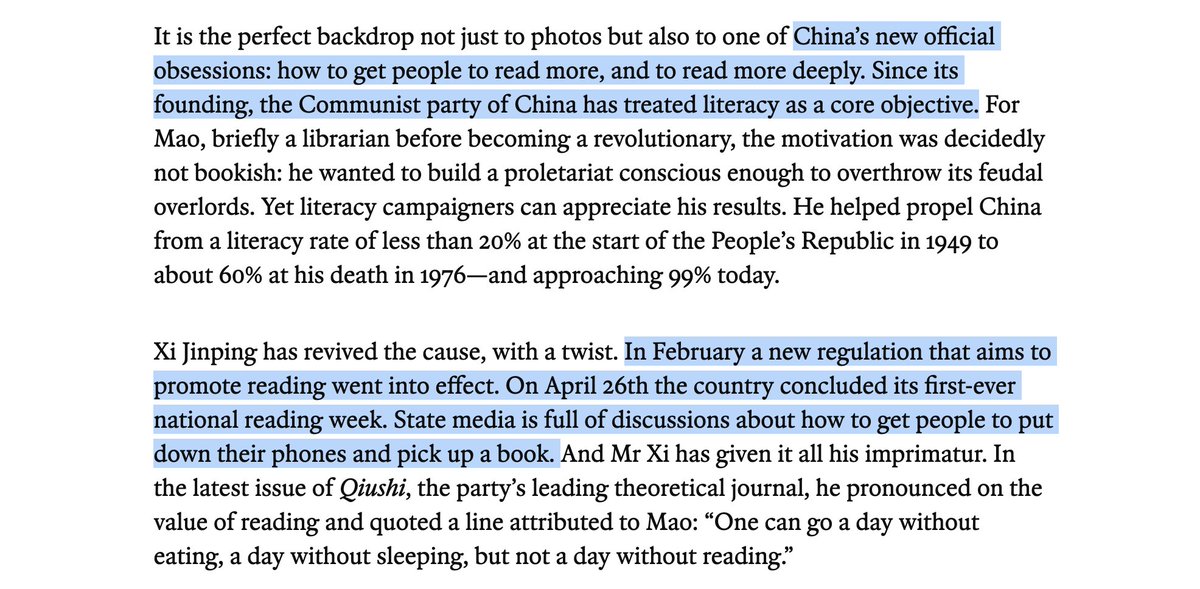
China’s new official obsession: Getting people to read more books.
In February, China passed a new regulation to build more public reading facilities and spaces.
In April, China had its first-ever national reading week.
State media encourages people to put down their phones and pick up a book.
President Xi wants China to become a “cultural powerhouse” by 2035, and says the revival of reading is one of its pillars.
Xi quotes Mao saying, “One can go a day without eating, a day without sleeping, but not a day without reading.”
In 1949, less than 20% of China's population was literate. Today it's approaching 99%.
When one of the most tech-focused countries in the world says that a population of book readers is vital to their future, we should all take note.